USAID DEC
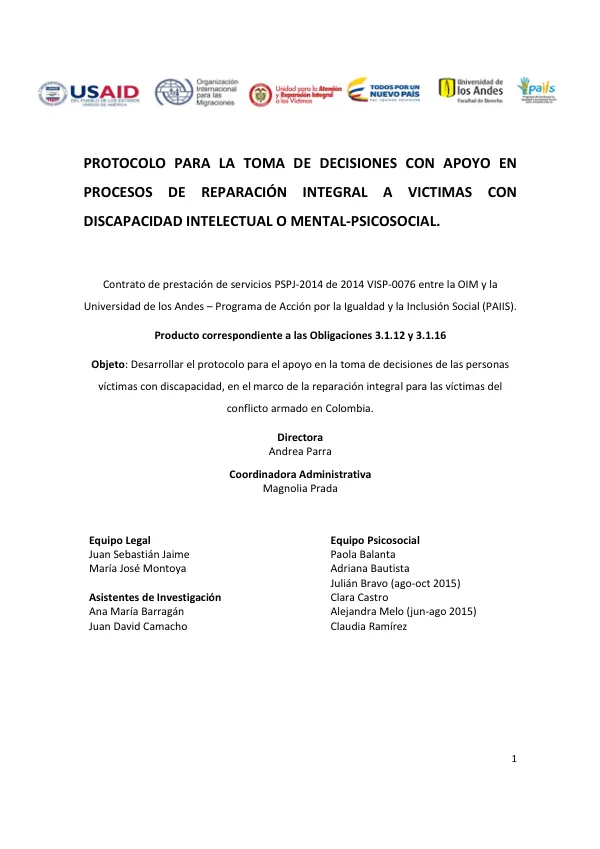
Protocolo para la Toma de Decisiones con Apoyo en Procesos de Reparación Integral a Víctimas con Discapacidad Intelectual o Mental-Psicosocial
Sign inINTERNATIONAL ORGANIZATION FOR MIGRATION
Protocolo para la Toma de Decisiones con Apoyo en Procesos de Reparación Integral a Víctimas con Discapacidad Intelectual o Mental-Psicosocial
The Protocol for Decision-Making Support in Processes of Integral Reparation for Victims with Intellectual or Mental-Psychosocial Disabilities was developed in accordance with the Obligations 3.1.12 and 3.1.16 of the Contract of Service PSPJ-2014 of 2014 VISP-0076 between the International Organization for Migration (OIM) and the University of the Andes - Program of Action for Equality and Social Inclusion (PAIIS).
2014 · 96 pages
Sign in to readA free account is required to download.
Abstract
The objective of the protocol is to support the decision-making of persons with disabilities in the framework of integral reparation for victims of the armed conflict in Colombia. The protocol aims to address the historical exclusion of persons with disabilities from decision-making processes, as well as the lack of access to attention, assistance, and reparation. The protocol is based on the principles of the Convention on the Rights of Persons with Disabilities, which recognizes the full capacity of persons with disabilities to participate in all aspects of life. The protocol establishes a framework for the support of decision-making for persons with intellectual or mental-psychosocial disabilities, including the development of a tool for the evaluation of support needs. The protocol also defines the roles and responsibilities of various actors involved in the process, including the Orientador, the Enlace Integral, the Funcionario de Valoración de Apoyos, and the Grupo de Oferta de la Dirección de Gestión Interinstitucional. The protocol is divided into several sections, including an introduction, objectives, scope and applicability, and a conceptual framework for integral reparation. The protocol also includes a section on the legal framework for its application, as well as a section on the profiles of victims with intellectual or mental-psychosocial disabilities. The protocol establishes three scenarios for the application of the instrument for the evaluation of support needs, including a scenario for all types of victimizing facts, a scenario for victims of forced displacement, and a scenario for victims of other types of victimizing facts. The protocol also defines the responsibilities of various actors involved in the process, including the Orientador, the Enlace Integral, the Funcionario de Valoración de Apoyos, and the Grupo de Oferta de la Dirección de Gestión Interinstitucional. The protocol is based on a human rights approach and aims to ensure the full participation of persons with disabilities in decision-making processes. The protocol also aims to address the historical exclusion of persons with disabilities from decision-making processes and to ensure that they have access to attention, assistance, and reparation. The protocol is a tool for the support of decision-making for persons with intellectual or mental-psychosocial disabilities, and it is intended to be used in the framework of integral reparation for victims of the armed conflict in Colombia. The protocol is based on a human rights approach and aims to ensure the full participation of persons with disabilities in decision-making processes. The protocol is a key tool for the implementation of the Law 1448 of 2011, which establishes the right to integral reparation for victims of the armed conflict in Colombia. The protocol aims to ensure that persons with disabilities have access to attention, assistance, and reparation, and that they are able to participate fully in decision-making processes.
Related documents