GOVERNMENT OF COLOMBIA
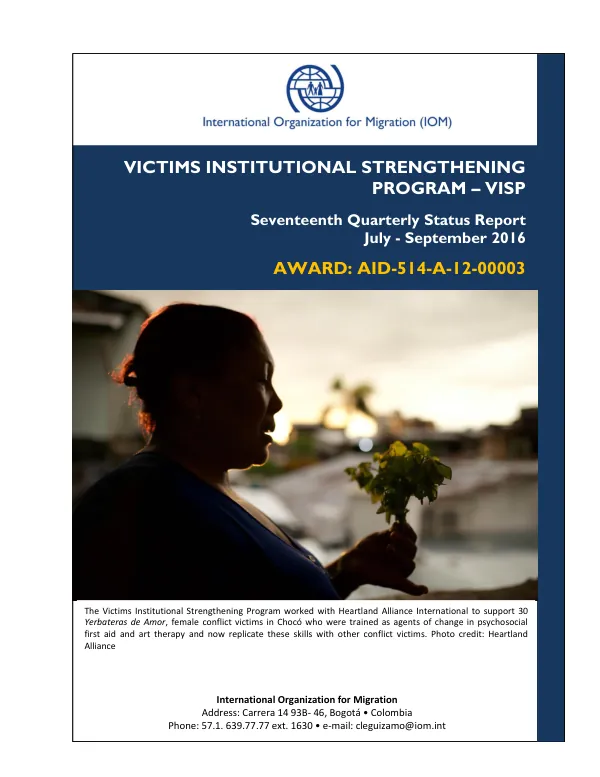
Seventeenth Quarterly Status Report: Victims Institutional Strengthening Program
The Victims Institutional Strengthening Program (VISP) is a strategic initiative aimed at providing accompaniment and support to the Government of Colombia's policies, systems, and institutions at the national, departmental, and municipal levels.
2016 · 39 pages
Sign in to readA free account is required to download.
Abstract
The program's objective is to strengthen capacities and build necessary competencies for the timely and effective execution and implementation of the Victims Law. During the period from July 1 to September 30, 2016, VISP made significant progress in each of its four intermediate results. Intermediate Result 1 focused on improving the Government of Colombia's strategic management for the Victims Law. This included the launch and implementation of a special job market inclusion strategy for vulnerable populations, including conflict victims. The Constitutional Court decreed that the government of Colombia has made progress addressing the needs of internally displaced persons (IDPs), particularly in terms of participation and registry. Intermediate Result 2 involved the integration of the Victims Psychosocial and Comprehensive Health Program (PAPSIV) application into the Victims Registry, ensuring greater availability of data on victims' psychosocial attention and care. Additionally, 416 people were trained on mine risk education at the local level, as part of support for the Comprehensive Directorate against Landmines (DAICMA). Intermediate Result 3 focused on transitional justice processes, including the systematization of a process researching victims' opinions on the reparative effect of free version audiences and reparation spaces. The English translation of the general historical memory report "Bastante Ya!" was completed, finalizing support for activities to disseminate the report in different spaces. Intermediate Result 4 involved the launch of an online course on differential approaches and the transfer of the Gender Backpack to include gender perspectives in policy to 334 people at the regional level. The National Center for Historical Memory (CNMH) also supported the production of the film "Women in Resistance" as part of the program. The program's operations were affected by two factors: institutional uncertainty resulting from the results of the referendum on the peace accord and the need to adjust the victim's registry to continue advancing reparation in a moment of change. The referendum's results led to the need to open a space to renegotiate, which could last anywhere from December to presidential elections in 2018. As a result, the possibility of working in Revolutionary Armed Forces of Colombia (FARC) concentration zones was suspended, along with the extra faculties that the president expected to have to implement the accords and the Victims Unit (VU) to carry out necessary operational adjustments. Despite these challenges, the program recognized advances on issues supported by VISP, including a robust registry with over 80 percent of declared victims, doubling initial projections. Participation has also been consolidated at the municipal, departmental, and national levels, which VISP has been addressing since victims roundtables first became operational in 2013. The new VU directorship is facing a delicate situation in terms of writs of protection and victims' high expectations on pending reparation. The program has adjusted its operations to focus on institutional responses, including adjusting the VU's structure to decentralize resources and responsibilities, and developing a unified response to mitigate delays in response times. The program has also had to adjust to the government's decision to establish criteria to define minimum subsistence and suspend humanitarian aid to IDPs and set minimums to overcome the condition of victim with reparation measures. This has led to an increase in demands, and the program has had to adjust its focus to address these challenges. The program's financial report for the quarter shows a total confirmed funds of $74,788,121 and a total cash disbursement of $56,870,000. The program's financial situation is stable, and it has sufficient resources to continue its operations and achieve its objectives. In conclusion, VISP has made significant progress in each of its intermediate results, despite the challenges posed by institutional uncertainty and the need to adjust to the government's decisions. The program has recognized advances on issues supported by VISP and has adjusted its operations to focus on institutional responses and address the challenges posed by the government's decisions.