USAID DEC
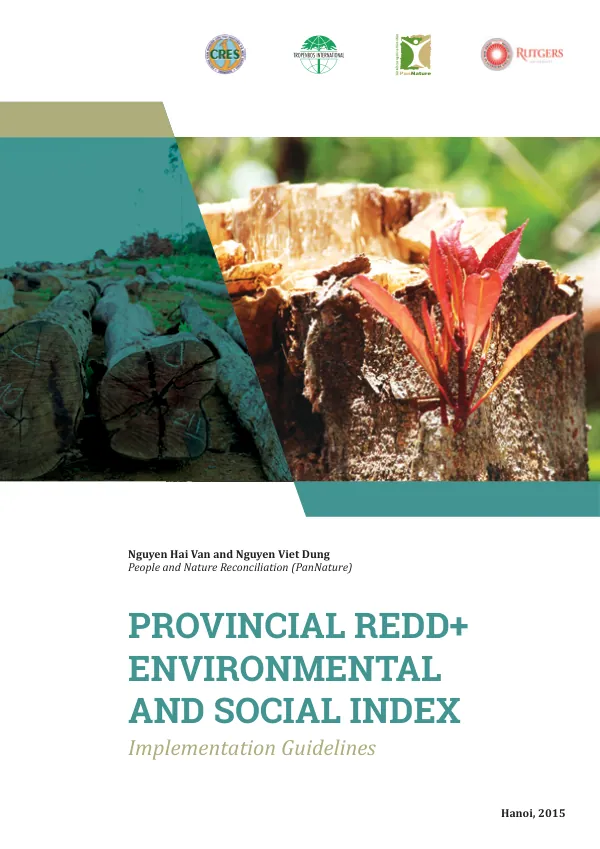
Provincial REDD+ Environmental and Social Index Implementation Guidelines
The REDD+ initiative emphasizes the role of forests in mitigating climate change by generating environmental and social benefits, including sustainable forest management, increased forest carbon sequestration, and improved local livelihoods.
2015 · 40 pages
Sign in to readA free account is required to download.
Abstract
However, REDD+ may have potential risks due to changes in land use and the right to access resources, which could negatively impact local livelihoods, particularly for forest-dependent minority groups. The REDD+ Environmental and Social Index (RESI) was developed by the People and Nature Reconciliation (PanNature) in collaboration with the Center for Natural Resources and Environmental Studies (CRES) and Tropenbos International in Vietnam, with technical support from Dr. Pamela McElwee. The RESI assesses local environmental and social conditions and identifies advantages and risks in implementing REDD+ at the provincial level. The index evaluates a province's readiness to implement REDD+ projects and activities, providing useful information for investors when surveying potential locations for REDD+ implementation. The RESI includes four main components: legislation and policy, institutional setting, environmental condition, and social condition. These components consist of 21 criteria and 149 indicators, which are used to assess a province's readiness for REDD+ implementation. The final RESI score is the average of all indicator values, categorized into three groups: not ready, ready, and partially ready. The RESI was piloted in four provinces: Dien Bien, Kien Giang, Son La, and Son La, and the results showed that all provinces were very low or not ready for effective REDD+ implementation due to multiple limitations and potential risks. The most significant challenges included a weak forest economy, incomplete forest monitoring system, lack of information sharing and participation of stakeholders, and unclear rights to own, access, and benefit from forest resources. The RESI is a new safeguard in REDD+ implementation, providing a tool for assessing a province's readiness and suitability for REDD+ projects and activities. The index can help identify areas that require improvement and provide a framework for developing strategies to address these challenges. The REDD+ initiative aims to reduce greenhouse gas emissions by reducing deforestation and forest degradation. Climate change poses a significant threat to social welfare, quality of life, and quality of life, and reducing emissions is essential for mitigating its effects. The REDD+ program is a market-based mechanism that provides financial incentives for countries to reduce deforestation and forest degradation, promoting sustainable forest management and increasing forest cover and quality of carbon sequestration. The RESI is a valuable tool for assessing a province's readiness for REDD+ implementation, providing a framework for evaluating the environmental and social conditions necessary for successful REDD+ projects and activities. By identifying areas that require improvement, the RESI can help develop strategies to address these challenges and ensure the effective implementation of REDD+ at the provincial level. The RESI has been piloted in four provinces, and the results showed that all provinces were very low or not ready for effective REDD+ implementation due to multiple limitations and potential risks. The most significant challenges included a weak forest economy, incomplete forest monitoring system, lack of information sharing and participation of stakeholders, and unclear rights to own, access, and benefit from forest resources.