FHI 360
FHI 360 IHANN Semi-Annual Report: October 2017 - March 2018
The Integrated Humanitarian Assistance to Northeast Nigeria (IHANN) project, implemented by FHI 360, aims to provide comprehensive support to internally displaced persons (IDPs) in Borno State.
2018 · 34 pages
Sign in to readA free account is required to download.
Abstract
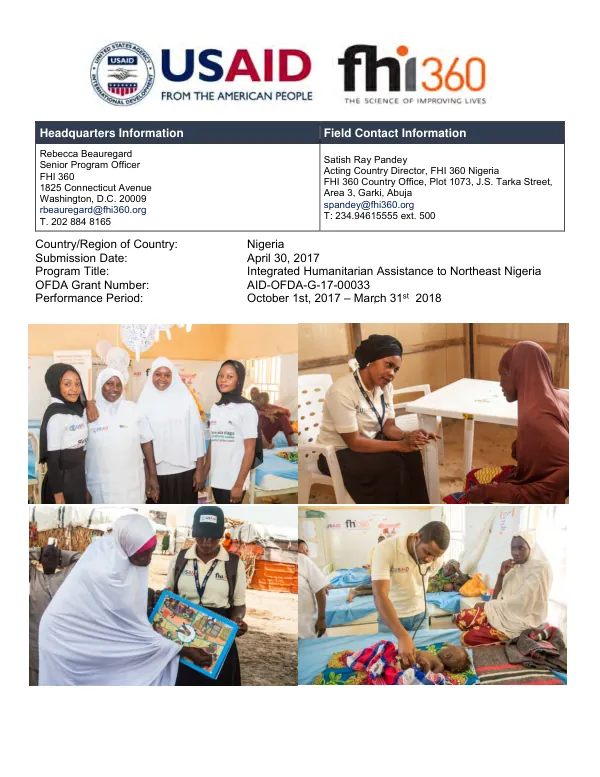
The project focuses on health, protection, water, sanitation, and hygiene (WASH), and nutrition activities to reduce morbidity and mortality and improve the well-being of displaced and conflict-affected individuals. FHI 360 serves as the local government area (LGA)-level sector coordination lead for health, WASH, and protection in Dikwa and Ngala. During the reporting period, the organization completed the rehabilitation of Ngala General Hospital, which is now fully operational. Nutrition activities, including infant and young child feeding (IYCF) and management of severe acute malnutrition (SAM) with medical complications, are also fully in place. The health sector of the IHANN project targets 100,750 IDPs and aims to improve access to critical primary healthcare (PHC), reproductive health, and health outreach services in conflict-affected and displaced communities. FHI 360 has established four fully operational health facilities, providing outpatient consultations for communicable and non-communicable diseases, sexual reproductive health (SRH) services, laboratory services, pharmacy services, and health education. During the reporting period, FHI 360 provided clinical outpatient consultations for 33,014 patients and 71,287 community-level consultations through community health extension worker (CHEW) outreach. The organization trained 18 health workers, covering the four operational health facilities and five CHEWs, on various topics, including health education, community mobilization, surveillance, health management information systems, and management of chronic disease. FHI 360 has a memorandum of understanding with the Borno State Ministry of Health and the State Primary Healthcare Development Agency, which has helped secure support for referral pathways in all locations. The organization currently supports fully functional ambulances in all locations, and various agencies within these locations utilize these referral mechanisms, creating a synergistic interagency relationship. In terms of communicable disease, FHI 360 provides diagnostic tests, including rapid malaria tests, malaria microscopic tests, Widal tests for typhoid fever, syphilis tests, and hepatitis B/C tests, in all supported health facilities. Clinical services are provided according to national and international protocols, and essential pharmaceuticals and medical consumables for the management of communicable disease are supplied in a timely manner. FHI 360 also offers screening services and symptomatic management for syphilis and other common STIs, and all four facilities are fully stocked with an adequate drug supply for the management of common and prevalent STIs. The organization collaborates with 360's Northeast HIV Initiative, funded by the Global Fund, which offers HIV screening, treatment, and counseling at all FHI 360-supported health facilities. In the area of reproductive health, FHI 360 provides essential SRH clinical services, reaching a total of 6,201 women within the reporting period. A total of 2,250 pregnant women attended at least two comprehensive antenatal clinics, and 417 babies were delivered by skilled birth attendants in all three locations. FHI 360 continues to face challenges in getting clients to deliver in hospital facilities and to come for postnatal care. However, the organization plans to mitigate this challenge by carrying out awareness campaigns with traditional birth attendants and involving them in the active referral of women to FHI 360-supported hospital facilities for delivery.