USAID DEC
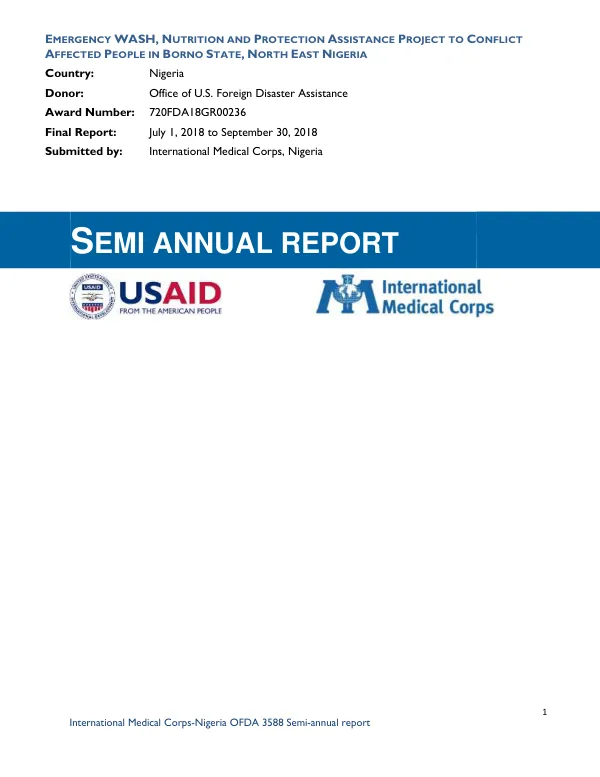
Emergency WASH, Nutrition and Protection Assistance Project to Conflict Affected People in Borno State, North East Nigeria
Sign inINTERNATIONAL MEDICAL CORPS
Emergency WASH, Nutrition and Protection Assistance Project to Conflict Affected People in Borno State, North East Nigeria
The Emergency WASH, Nutrition and Protection Assistance Project to Conflict Affected People in Borno State, North East Nigeria, is a humanitarian intervention project implemented by International Medical Corps (IMC) in collaboration with the community and relevant government line ministries.
2018 · 35 pages
Sign in to readA free account is required to download.
Abstract
The project aims to save lives and promote a life with dignity for conflict-affected people in targeted areas through the provision of quality lifesaving preventive/curative nutrition, WASH, and protection/Gender-Based Violence (GBV) assistance services. The project is implemented in four Local Government Areas (LGAs) in Borno State: Damboa, Maiduguri, Jere, and Konduga. The project activities include the provision of nutrition preventive and curative interventions, WASH services, and protection/GBV assistance services. The project has achieved significant milestones, including the screening of 28,212 children 6-59 months for severe acute malnutrition (SAM), the treatment of 2,987 children 6-59 months for SAM without medical complications, and the provision of safe and continuous potable water supply to 65,670 people in IDP camps and host communities. The project has also made significant progress in the area of protection/GBV, with case management support and referral services provided to 210 survivors through Women Friendly Spaces (WFS) and 53,288 community members reached through outreach activities. The project has employed participatory approaches to receive inputs from the communities, particularly in the identification of appropriate locations for project activities. The security situation in Borno State remains unpredictable, with increased security incidents reported at various LGAs in the north and south of the state. Despite these challenges, the project has continued to operate in the area, relying on the support of UNHAS helicopters operated by the WFP with the support of a number of donors, including USAID. The project has also updated its security documents, including standard operating procedures and contingency plans, to ensure the safety of its staff and beneficiaries. The project has made significant progress in reaching its target population, with a cumulative total of 147,170 people reached, including 65,518 IDPs and 81,652 host community members. The project has also achieved significant milestones in the area of nutrition, with a 27% increase in the number of children screened for SAM compared to the previous reporting period. The project has also made significant progress in the area of WASH, with the provision of safe and continuous potable water supply to 65,670 people in IDP camps and host communities. The project has also implemented a cholera outbreak response, with a total of 3,624 suspected cases of cholera reported as of September 30, with 64 deaths. The project has also made significant progress in the area of community participation, with the involvement of community members, leaders, and beneficiaries in IDP camps and host communities as part of the project's accountability to the affected people. The project has also employed participatory approaches to receive inputs from the communities, particularly in the identification of appropriate locations for project activities. The project has also made significant progress in the area of population movement, with the State not experiencing any major displacement that could jeopardize the success of the proposed project or drastically increase the targeted population. The project has also made significant progress in the area of community participation, with the involvement of community members, leaders, and beneficiaries in IDP camps and host communities as part of the project's accountability to the affected people. Overall, the project has made significant progress in achieving its objectives, despite the challenging security situation in Borno State. The project has continued to operate in the area, relying on the support of UNHAS helicopters operated by the WFP with the support of a number of donors, including USAID. The project has also updated its security documents, including standard operating procedures and contingency plans, to ensure the safety of its staff and beneficiaries.
Related documents