USAID DEC
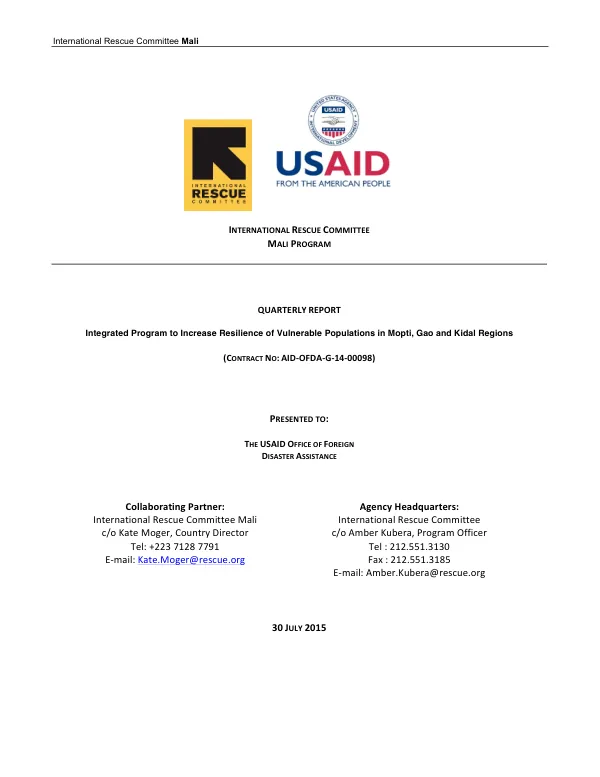
Quarterly Report: Integrated Program to Increase Resilience of Vulnerable Populations in Mopti, Gao and Kidal Regions
Sign inINTERNATIONAL RESCUE COMMITTEE
Quarterly Report: Integrated Program to Increase Resilience of Vulnerable Populations in Mopti, Gao and Kidal Regions
The Integrated Program to Increase Resilience of Vulnerable Populations in Mopti, Gao, and Kidal Regions in Mali began in July 2014 with funding from the USAID Office of Foreign Disaster Assistance.
2015 · 16 pages
Sign in to readA free account is required to download.
Abstract
The program aimed to increase the resilience of vulnerable individuals, households, and communities in the Gao, Mopti, and Kidal regions of Mali through enhanced capabilities and resources. The program had four main objectives: to increase knowledge and awareness on GBV and Child Protection, improve access to psycho-social services, support and advocate for protection and promotion of the rights of children and women; to increase access to basic water and sanitation facilities, promote awareness to control and prevent WASH-related diseases, and promote resilience for future shocks; to increase awareness, knowledge, create behavior change, and advocate on nutrition issues for communities and authorities; and to enhance women's livelihoods through a pilot program of direct support using VSLA methodology and business skills. The program targeted a total of 75,268 beneficiaries, including 9,658 for Protection, 22,916 for WASH, 7,555 for Nutrition, and 4,815 for Early Recovery and Market Systems. The program was implemented in the Mopti, Gao, and Kidal regions of Mali and was expected to last for 18 months, from July 1, 2014, to December 31, 2015. During the reporting period of April 1 to June 30, 2015, the program continued to face challenges due to the volatile security situation in the region. Despite these challenges, the program made significant progress in achieving its objectives. In the area of Child Protection, 236 people participated in child protection trainings, including 22 people who received training on child protection in Ansongo and 47 people who participated in a series of two trainings on psychological first aid in Douentza. The program also made significant progress in the area of WASH, with 9,154 children and youth participating in psychosocial activities in Kidal, Gao, and Ansongo-Douentza. The Youth Centre of Douentza was rehabilitated during this quarter, and 200 young mothers received NFI support, including blankets, plastic mats, soap, and mosquito nets. The program also reached 51,942 people through mass sensitization sessions, including 8,763 men, 14,754 women, 12,192 boys, and 16,233 girls. The involvement of community leaders contributed strongly to mobilize participants, and adults, leaders, and participants made commitments to invest in various awareness-raising activities from family to family and in neighborhoods. The program's achievements during the reporting period included the registration of 332 children in the CPIMS database, with 202 children located in Douentza and 130 children located in Ansongo. The program also provided support to 100 young people referred from Case Management to the Livelihood team, who received support in Income Generating Activities (IGA) based on the activities they had selected. Overall, the program continued to make significant progress in achieving its objectives, despite the challenges posed by the volatile security situation in the region. The program's achievements during the reporting period demonstrate its commitment to increasing the resilience of vulnerable populations in the Gao, Mopti, and Kidal regions of Mali.
Related documents