USAID DEC
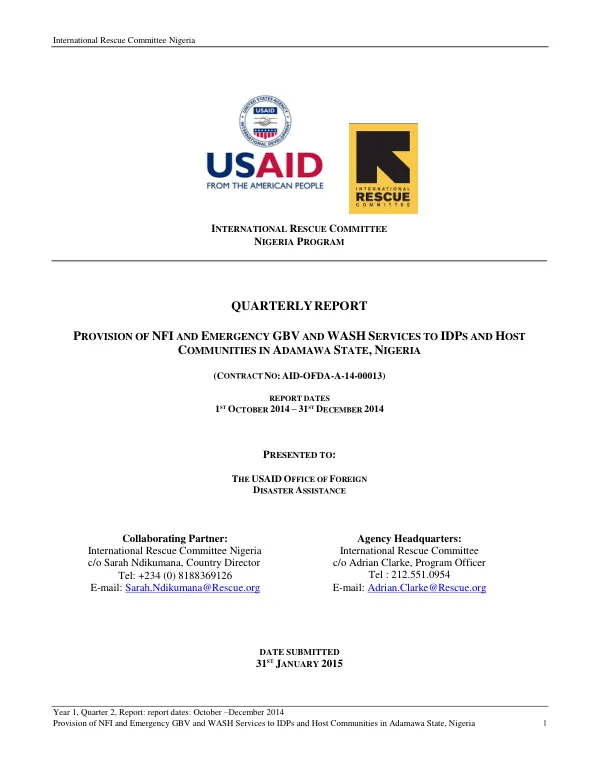
Provision of NFI and Emergency GBV and WASH Services to IDPs and Host Communities in Adamawa State, Nigeria
Sign inINTERNATIONAL RESCUE COMMITTEE
Provision of NFI and Emergency GBV and WASH Services to IDPs and Host Communities in Adamawa State, Nigeria
The humanitarian situation in northeast Nigeria has worsened significantly since September, with increased insurgency violence and additional aggressive gains from Boko Haram, leading to new and repeated IDP movements within the region.
2015 · 12 pages
Sign in to readA free account is required to download.
Abstract
In late October, the IRC was forced to relocate its Mubi field office to Yola due to the taking of Mubi town by Boko Haram on 29 October. The IRC is now in the process of scaling up its emergency response in Yola North, Yola South, and Girei LGAs, while also examining needs in additional neighboring LGAs. Although the security situation in Mubi and Yola has begun to calm down, the IDPs are still arriving in Yola and are reluctant to return due to fear of further attacks. The IRC has been in Nigeria since 2012 and has been present in the northeast since early 2014. The IRC is still one of only two humanitarian actors present in Adamawa state, and is working with three local partners under the OFDA grant and utilizing its strong relationships with relevant Nigerian ministries, NEMA and SEMA. The IRC has been able to integrate more deeply into host communities and IDP camps as a result of these relationships, thereby enabling a more thorough and comprehensive assessment of new needs while engaging with local populations to identify IDPs and other vulnerable groups. During the reporting period, the IRC continued to work towards addressing all three elements of OFDA's mandate to save lives, alleviate human suffering, and reduce the social and economic impact of disasters. The IRC worked to continue putting Gender-Based Violence (GBV) programming into place and to scale up its on-going WASH and NFI activities. The emergency provision of GBV – including health and ERMS activities – and WASH services, and associated NFI, will provide life-saving access to treatment for GBV survivors and safe water to affected populations, as well as reduce the fatal consequences of deadly water and fecal-borne diseases. The IRC assessed 20 health facilities in which the IRC health program and nutrition programs will be operating, including in Yola North and Yola South LGAs. The assessment aimed to evaluate what kind of services, drugs, and treatments the facilities currently have for victims of sexual abuse or GBV. As a result, the majority of facilities do not have the available services or equipment required; and the IRC plans to conduct staff training and on-the-job monitoring and training to ensure they can provide the necessary services to survivors of GBV. The IRC will also distribute the required equipment and supplies to ensure the services can run adequately. The IRC worked to finalize the contents of the dignity kits to be distributed to IDP women and decided on the beneficiaries to be targeted for distribution of the dignity kits, which are currently being finalized and will be reported on in Q3. The newly-recruited staff carried-out sensitization sessions with 907 IDP women and adolescent girls in several host communities and 8 camps on the following topics: signs and discussion around domestic violence, awareness of sexual violence and reporting mechanisms, dangers of stigmatization of survivors, and available services should anyone come forward for support or need referrals. Under Objective 4, the IRC continued to implement an emergency Water, Sanitation, and Hygiene (WASH) intervention to rapidly improve environmental health conditions in newly targeted villages/communities and the IDPs Settlements: Gerie, Fufure, Yola North, and Yola South LGAs. In these locations, the IRC has accomplished the following: local government water sanitation and hygiene department sensitization meetings were held with LGA water and sanitation departmental heads in Gerie, Fufure, Yola North, and South LGA on how to engage and empower them to be part of sustaining the project in the communities and IDPs settlement within their LGAs. Activities were moved from Hung, Maiha, Michika, Madagali, Mubi North, and South to Gerie, Fufure, Yola North, and South LGAs as a result of the capture of Mubi by Boko Haram.