USAID DEC
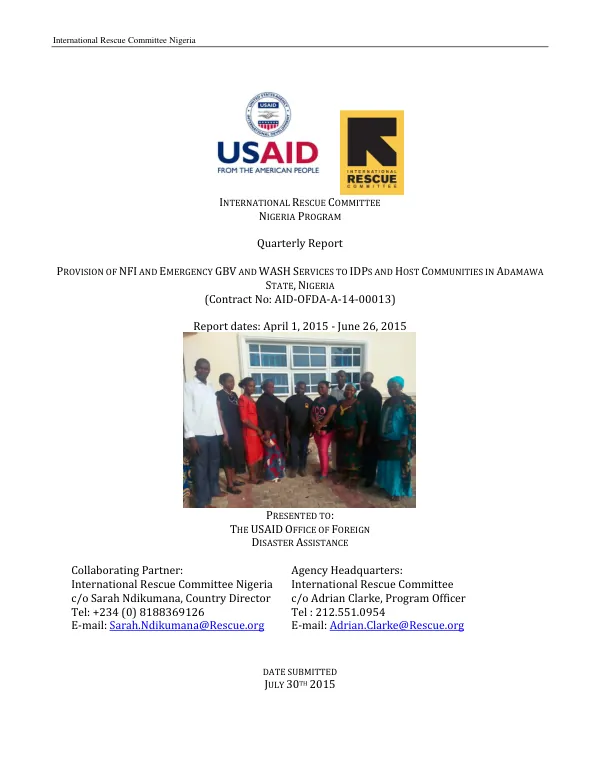
Provision of NFI and Emergency GBV and WASH Services to IDPs and Host Communities in Adamawa State, Nigeria
Sign inINTERNATIONAL RESCUE COMMITTEE
Provision of NFI and Emergency GBV and WASH Services to IDPs and Host Communities in Adamawa State, Nigeria
The agricultural development initiative in Adamawa State, Nigeria, began in 2014 with funding from the USAID's Food Security Program.
2015 · 19 pages
Sign in to readA free account is required to download.
Abstract
The project aimed to provide safe and effective gender-based violence prevention and water, sanitation, and hygiene services, as well as non-food item distributions to internally displaced persons and families in Adamawa State. The goal was to support the recovery, healing, and dignity of survivors of gender-based violence and allow them to rebuild their lives. The project focused on three key objectives: providing appropriate quality health, psychosocial support, and safety services for survivors of gender-based violence; increasing women's access to and control of resources, thus reducing their vulnerability to gender-based violence and sexual exploitation and abuse; and providing rapid improvements in environmental health conditions in targeted villages. The project targeted a total of 62,000 individuals, including 23,250 internally displaced persons. During the reporting period, April 1, 2015, to June 26, 2015, the Multi-National Joint Task Force (MNJTF) reclaimed several Boko Haram strongholds, and the country experienced a peaceful transition of power between Goodluck Jonathan and the new president, Mohammed Buhari. This decrease in volatility in the northeast fostered a more conducive environment for some internally displaced persons to return to their areas of origin. Prior to returning, internally displaced persons often sent a family member, usually women, on 'go and see' visits to their places of origin to assess the potential to return. The International Organization for Migration's (IOM) Displacement Tracking Matrix (DTM) covering the states of Bauchi, Borno, Yobe, Adamawa, Taraba, and Gombe confirmed this drop in internally displaced persons. In Round II of the DTM, IDP figures in Adamawa state were projected at 220,195; in Round III, it counted 222,882 IDPs; and in Round IV, the IDP figures in Adamawa had decreased dramatically to 113,437, amounting to a 49% decrease in the IDP population in Yola. To better understand the priority needs of the people in areas of return, the IRC conducted a rapid assessment in the LGAs of Mubi South, Mubi North, Hong, and Maiha from June 3rd to 6th, 2015. This multi-sectoral assessment looked at food security and livelihoods; health and nutrition; environmental health; education; child protection; and women's and general protection. According to this assessment, approximately 80% of the people in those areas had returned from displacement and were in the early stages of trying to re-establish a sense of normalcy in their respective communities. Key findings from the WASH sector results demonstrate that access to water sources is a huge challenge for the populations assessed: 70% of the respondents noted that on average it takes one to two hours to access the closest water point. The most commonly utilized water sources are hand pumps, hand-dug wells (protected and unprotected), streams, and seasonal water ponds. Many of these water sources are overwhelmed by huge numbers of users and many are said to be in poor condition. Some households have resorted to buying water for household use, where a 20-liter jerry-can costs 100 Naira (0.51 cents), representing almost 10% of the average weekly income for households. The assessment noted that while some housing infrastructure was still standing, individual shelters had visible bullet holes, a result of sporadic gunfire from the main roads, especially in Hong LGA. Around 371 shelters in this LGA were believed to have been destroyed. Access to basic NFIs, including water containers, household utensils, soap, blankets, mosquito nets, and sleeping mats, among others, were listed as a priority need for the respondents. Most respondents said they lost many of their possessions when they fled, and some houses were looted while they were displaced. Given the other urgent needs of those returning, many IDPs have not replaced these essential NFIs. In all four LGAs, the priority needs cited by the women and girls include more support for educational opportunities for themselves and their children, skills acquisition, and economic empowerment. The women's and girls' groups reported a lack of economic activities in the assessment areas, mentioning that apart from household chores, they are largely unproductive. These groups blame the crisis for reducing their ability to generate income and provide for their household as in the past, adding that this has had a negative impact on how their heads of households relate to them. Though many of the women and girls that participated in the focus group discussions indicated that their lives were better before the crisis, it was clear that many risks and challenges they currently face predated the crisis. Even before the conflict, women and girls described being denied opportunities to engage in economic activities and go to school. Some reported being forced into early marriages, and many have endured domestic violence. These groups requested psychosocial support, indicating that many of them endure abusive marriages and also lack a support