USAID
PU-AMI DRC – North Kivu province – Quarterly Report N°3 – Fiscal year 2014
The conflict-affected population in the Eastern Democratic Republic of the Congo (DRC) is supported by the humanitarian organization PREMIERE URGENCE - AIDE MEDICALE INTERNATIONALE (PU-AMI) through the PU-AMI DRC program.
2014 · 6 pages
Sign in to readA free account is required to download.
Abstract
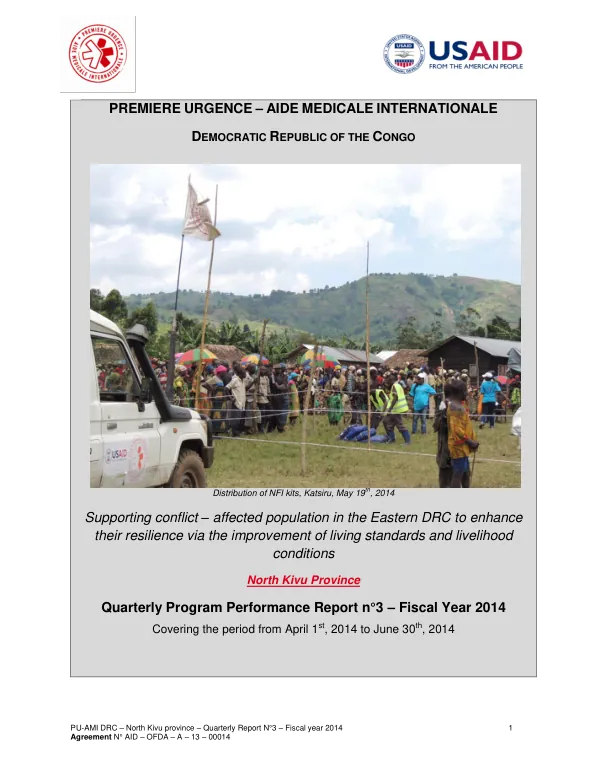
The program aims to enhance the resilience of conflict-affected populations by improving their living standards and livelihood conditions in North Kivu Province. The program focuses on supporting conflict-affected populations in Masisi and Rutshuru territories, specifically in Mweso and Birambizo Health zones. The program's main objective is to restore livelihoods and basic living conditions of conflict-affected populations in North Kivu. To achieve this goal, PU-AMI implements various activities, including the distribution of Non-Food Items (NFIs) and agricultural inputs. The program targets 127,500 beneficiaries, with 48,792 being internally displaced persons (IDPs). The program's geographic area of intervention includes 16 priority localities, which were identified in coordination with other partners. The Agriculture and Food Security sector is a key component of the program, aiming to contribute to the restoration of food security to displaced and returnee households through agricultural activities. The sector focuses on improving agricultural production and food security, with a target of 36,000 beneficiaries. The program distributes agricultural kits, including seeds, tools, and gardening materials, to beneficiary households. A post-distribution monitoring of agricultural kits was implemented in April, showing that 95.5% of beneficiaries received tool types that correspond to their needs, and 58% of distributed seeds were sown. The Logistic Support and Relief Commodities sector is another key component of the program, aiming to cover basic needs of newly displaced/returned households in conflict-affected areas. The sector focuses on Non-Food Items (NFIs), with a target of 54,000 beneficiaries. The program distributes standard NFI kits to 9,000 households, with each household receiving a kit valued at 45 USD. The program also monitors the use of NFIs, with 80% of beneficiaries continuing to use the majority of distributed NFIs three months after receiving the kits. The program's activities are ongoing, with progress reported in various sectors. The Agriculture and Food Security sector has made significant progress, with the distribution of agricultural kits and training of agronomists. The Logistic Support and Relief Commodities sector has also made progress, with the distribution of NFI kits and monitoring of their use. The program's overall goal is to restore livelihoods and basic living conditions of conflict-affected populations in North Kivu Province.
Related documents