USAID DEC
Public Awareness of Air Pollution and Health Threats: Challenges and Opportunities for Communication Strategies to Improve Environmental Health Literacy
Sign inUSAID DEC
Public Awareness of Air Pollution and Health Threats: Challenges and Opportunities for Communication Strategies to Improve Environmental Health Literacy
Air pollution is the leading environmental toxin, attributed to diseases responsible for an estimated 16% of premature deaths globally.
2019 · 15 pages
Sign in to readA free account is required to download.
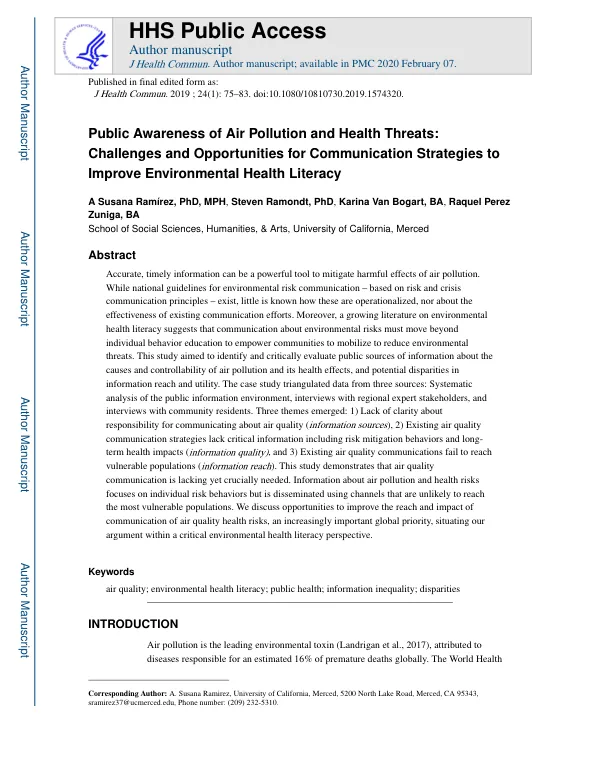
Abstract
The World Health Organization recognizes air pollution as an unequivocal carcinogen, and other adverse health effects include asthma attacks, asthma attacks, respiratory symptoms, respiratory symptoms, increased risk for acute myocardial infarction, loss of work and school days, and premature death. Air pollution is a complex issue, requiring multilevel intervention. The construct of environmental health literacy (EHL) has evolved from a focus on individual educational processes to a process and philosophy that empowers individuals to use communication to control environmental exposures. Effective communication is a tool for achieving EHL, providing education and information that motivates individuals to mitigate the health risks of air pollution. At the individual level, communication can achieve functional EHL by providing factual information about health risks and motivating behaviors to mitigate those risks. At the interactive level, communication can build skills that increase self-efficacy, and at the structural level, communication can effect change by conveying the causes of air pollution and advocating for policies that reduce air pollution. Despite the potential of communication to mitigate the health risks of air pollution, little is known about the extent and effectiveness of air pollution communication. The mass media are recognized as sources of information about air quality, but a recent content analysis of wildfire-related air quality press releases and public complaints published in regional newspapers found that both were poorly correlated with actual air quality. Entertainment programming exaggerates for dramatic effect, and standards for effective communication of environmental risks exist, but the extent to which these are operationalized by official organizations is unclear. The U.S. Environmental Protection Agency (EPA) has guidelines for the effective communication of environmental risks, including using websites showing data visualization tools, engaging local news media, local officials, and schools, and tailoring information to the needs of extra-sensitive populations. However, a recent study of news coverage of environmental risks found that there was insufficient efficacy information, limiting the actual practical value of the media to inform publics about such risks. Implementation of the EPA's guidelines is left to individual state and local agencies, which may deploy their own or adaptations of the EPA's data visualization and interpretation tools. Audiences recognize local governments' air quality indices as valid risk sources, but a recent systematic review found little evidence for the effectiveness of such indices at inducing behavior changes during bouts of poor air quality. The efficacy of air quality alerts has been questioned, with one recent study showing minimal behavioral and health effects. Some of the EPA's recommendations have been challenged by more recent constructions of effective communication strategies for diverse populations. This study aimed to document existing communication strategies and techniques about the causes and controllability of air pollution and its health effects, and to identify disparities in information reach and utility. The study used a case study approach, focusing on one highly-polluted region, the San Joaquin Valley in California. The region is home to 4 million people and is characterized by high levels of air pollution, particularly during the summer months. The study found that existing communication strategies lack critical information about risk mitigation behaviors and long-term health impacts. Existing air quality communications fail to reach vulnerable populations, including low-income and minority communities. The study also found that air quality information sources, including local governments' air quality indices, are not effective at inducing behavior changes during bouts of poor air quality. The study suggests that air quality communication is lacking, yet crucially needed to mitigate the health risks of air pollution. The study's findings highlight the need for more effective communication strategies that provide local, real-time information tailored to the needs of diverse audiences. The study's results also emphasize the importance of examining the larger cultural context of media and its impact on public understanding of environmental risks. The study's findings have implications for public health policy and practice, highlighting the need for more effective communication strategies that prioritize the needs of vulnerable populations. The study's results also suggest that more research is needed to understand the effectiveness of communication strategies to increase audiences' environmental health literacy, and to examine the larger cultural context of media and its impact on public understanding of environmental risks.