USAID DEC
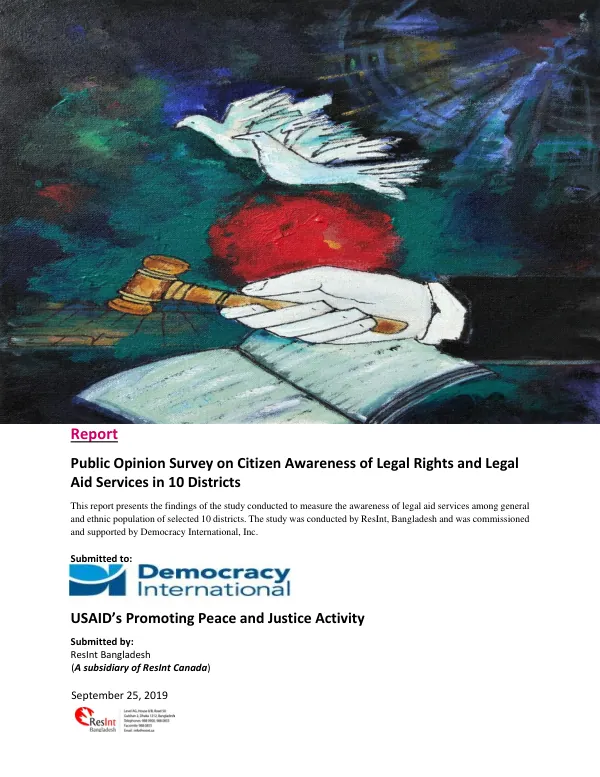
Public Opinion Survey on Citizen Awareness of Legal Rights and Legal Aid Services in 10 Districts
Sign inDEMOCRACY INTERNATIONAL, INC.
Public Opinion Survey on Citizen Awareness of Legal Rights and Legal Aid Services in 10 Districts
Public Opinion Survey on Citizen Awareness of Legal Rights and Legal Aid Services in 10 Districts was conducted by ResInt, Bangladesh, and commissioned by Democracy International, Inc.
2019 · 176 pages
Sign in to readA free account is required to download.
Abstract
The study aimed to measure the awareness of legal aid services among the general and ethnic population of selected 10 districts. The survey was conducted in September 2019. The study employed a survey design with a target of 1,200 respondents. The sampling strategy involved a multi-stage sampling method, with a sample size of 1,200 and a sample distribution of 120 respondents per district. The survey tools included a questionnaire with 15 questions, which were administered to the respondents through a field team that underwent training. The field work was conducted over a period of 10 days, and the data management and analysis were carried out using a quality control process. The findings of the study revealed that 45% of the respondents were aware of their rights, while 55% were not aware. The respondents who were aware of their rights mentioned the right to education, healthcare, and employment as the most important citizen rights. However, the respondents who were not aware of their rights mentioned the right to food, shelter, and clothing as the most important citizen rights. The study also found that 70% of the respondents had faced disputes, and 60% of them had sought legal remedy to resolve the dispute. The most common type of dispute faced by the respondents was related to property, followed by family and employment disputes. The respondents who had faced disputes mentioned that the main barriers to the formal justice system were the cost of legal services, lack of awareness, and lack of access to legal aid services. The study also found that 40% of the respondents were aware of legal aid services, while 60% were not aware. The respondents who were aware of legal aid services mentioned that they had learned about it through radio, television, and social media. The respondents who were not aware of legal aid services mentioned that they had not heard about it before. The study also found that 50% of the respondents had sought legal help from legal aid offices, while 50% had not sought legal help. The respondents who had sought legal help mentioned that they had liked the services provided by the legal aid offices, while the respondents who had not sought legal help mentioned that they had disliked the services provided by the legal aid offices. The demographic profile of the respondents showed that 60% of them were male, 40% were female, and 50% were between the ages of 25 and 44. The study concluded that there was a need to increase awareness of legal aid services among the general and ethnic population of the selected 10 districts. The study recommended that the government and non-governmental organizations should work together to increase awareness of legal aid services and provide access to legal aid services for all citizens. The study also recommended that the government should establish a legal aid office in each district to provide access to legal aid services for all citizens. The study further recommended that the government should provide training to the field team on legal aid services and provide them with the necessary resources to conduct the survey. The study also found that there was a need to increase awareness of the eligibility criteria for legal aid services among the general and ethnic population of the selected 10 districts. The study recommended that the government and non-governmental organizations should work together to increase awareness of the eligibility criteria for legal aid services and provide access to legal aid services for all citizens who are eligible. The study concluded that the findings of the study would be useful for the government and non-governmental organizations to develop policies and programs to increase awareness of legal aid services and provide access to legal aid services for all citizens. The study recommended that the government and non-governmental organizations should work together to implement the recommendations of the study and increase awareness of legal aid services among the general and ethnic population of the selected 10 districts.
Related documents