USAID DEC
Public-Private Partnerships for a Centralized Waste Disposal Treatment Plant in Eastern Uganda
Sign inJOHN SNOW INTERNATIONAL
Public-Private Partnerships for a Centralized Waste Disposal Treatment Plant in Eastern Uganda
The establishment of a centralized health care waste disposal plant in Bulowooza village, Iganga district, Eastern Uganda, is a critical initiative to address the growing problem of hazardous waste disposal in the region.
2012 · 3 pages
Sign in to readA free account is required to download.
Abstract
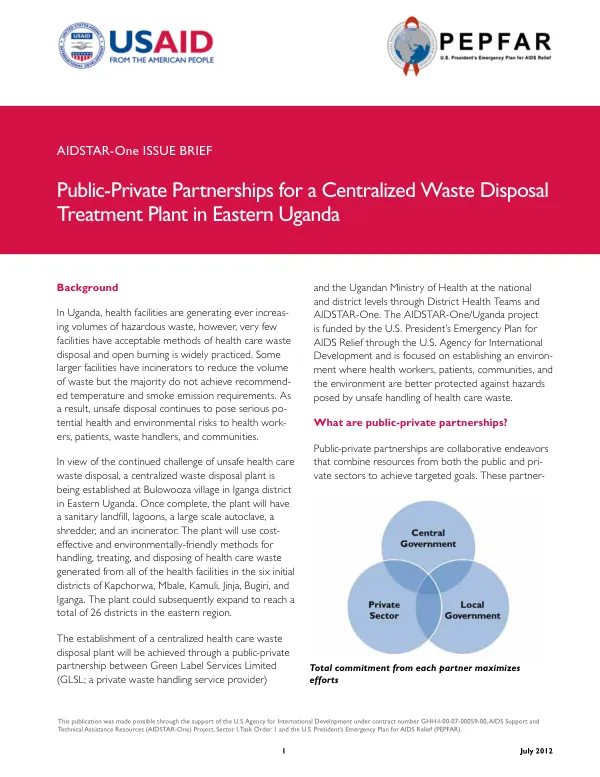
The plant will utilize cost-effective and environmentally-friendly methods for handling, treating, and disposing of health care waste generated from health facilities in the six initial districts of Kapchorwa, Mbale, Kamuli, Jinja, Bugiri, and Iganga. The plant's design includes a sanitary landfill, lagoons, a large-scale autoclave, a shredder, and an incinerator. The project is being implemented through a public-private partnership between Green Label Services Limited (GLSL), a private waste handling service provider, and the Ugandan Ministry of Health at the national and district levels through District Health Teams and AIDSTAR-One. The AIDSTAR-One/Uganda project is funded by the U.S. President's Emergency Plan for AIDS Relief through the U.S. Agency for International Development. The partnership aims to establish an environment where health workers, patients, communities, and the environment are better protected against hazards posed by unsafe handling of health care waste. The public-private partnership model provides a number of benefits for health workers, patients, communities, and the country at large. The public sector will provide overall leadership in the management of health care waste disposal, while the private sector will contribute to timely collection, transportation, and disposal at the centralized disposal plant in Iganga. Additional benefits include accelerated private investment in health care waste disposal, availability of an acceptable and affordable solution to health care waste disposal, increased access for health facilities to quality disposal methods, and protection for health workers, communities, and the environment. Implementation of the project involves GLSL setting up and operating the centralized waste treatment and disposal facility, while AIDSTAR-One will procure a high-temperature incinerator capable of destroying 1,000 kilograms of waste per hour. GLSL will also procure trucks and other waste management commodities for collecting waste and transporting it to the centralized facility for safe disposal. A geographical information system will be utilized to map routes for picking up waste from health facilities to identify the most efficient routes. Waste segregation at the source is a best practice that will be enforced by health facility managers, who will also provide technical oversight in treating and weighing waste before it is handed over to GLSL. The waste will be double-bagged and transported in closed rigid containers to avoid exposures and possible subsequent transmission of infections. The U.S. Agency for International Development will initially pay for transportation and destruction of the waste collected from government and private not-for-profit facilities, while waste generated by private health service providers will be paid for by the owners of the facilities at cost recovery rates.