USAID DEC
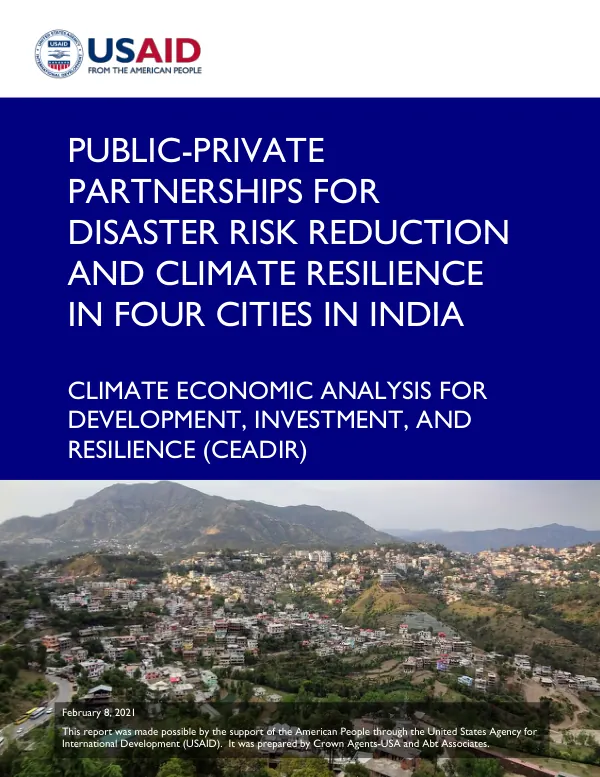
Public-Private Partnerships for Disaster Risk Reduction and Climate Resilience in Four Cities in India
Sign inABT ASSOCIATES
Public-Private Partnerships for Disaster Risk Reduction and Climate Resilience in Four Cities in India
Public-Private Partnerships for Disaster Risk Reduction and Climate Resilience in Four Cities in India began with the identification of opportunities for disaster risk reduction.
2021 · 53 pages
Sign in to readA free account is required to download.
Abstract
The report highlights the importance of addressing climate-related hazards in India, which are projected to increase in frequency and severity due to climate change. The country's urban population is expected to grow significantly, exacerbating the risk of disasters. The report focuses on four cities in India: Cuttack, Vijayawada, Visakhapatnam, and another city not specified. In Cuttack, a decentralized municipal solid waste management system was implemented to reduce flood risks. The system involved the creation of a waste management plan, establishment of a waste collection and transportation system, and construction of a waste treatment facility. In Vijayawada, four public-private partnerships (PPPs) were established to address disaster risk reduction and climate resilience. The PPPs focused on mapping critical community facilities, information, education, and communications for disaster risk reduction, increasing community resilience to heat stress, and reducing heat stress for outdoor workers. The PPPs involved the collaboration of government agencies, private sector companies, and community organizations. The PPPs in Vijayawada were implemented through a phased approach, with each phase building on the outcomes of the previous one. The first phase involved the mapping of critical community facilities, which identified areas that were vulnerable to disasters. The second phase focused on information, education, and communications for disaster risk reduction, which aimed to raise awareness among the community about disaster risks and the importance of preparedness. The third phase involved the implementation of measures to increase community resilience to heat stress, which included the installation of cooling systems in public buildings and the provision of heat stress training to community members. The fourth phase focused on reducing heat stress for outdoor workers, which involved the provision of personal protective equipment and the implementation of heat stress mitigation measures in workplaces. In Visakhapatnam, five PPPs were established to address disaster risk reduction and climate resilience. The PPPs focused on developing a health information management system, integrating emergency health services into the city operations center, mapping critical community facilities, rehabilitating critical community facilities as disaster shelters, and information, education, and communications for community disaster response. The PPPs in Visakhapatnam were implemented through a similar phased approach as in Vijayawada. The first phase involved the development of a health information management system, which aimed to improve the collection and analysis of health data during disasters. The second phase focused on integrating emergency health services into the city operations center, which aimed to improve the response to health emergencies during disasters. The third phase involved the mapping of critical community facilities, which identified areas that were vulnerable to disasters. The fourth phase focused on rehabilitating critical community facilities as disaster shelters, which aimed to provide safe shelter for community members during disasters. The fifth phase involved the implementation of information, education, and communications for community disaster response, which aimed to raise awareness among the community about disaster risks and the importance of preparedness. The report highlights the importance of public-private partnerships in addressing disaster risk reduction and climate resilience in India. The PPPs in Cuttack, Vijayawada, and Visakhapatnam demonstrate the potential of collaborative approaches to address disaster risks and improve community resilience. The report provides recommendations for policymakers and practitioners on how to establish effective PPPs for disaster risk reduction and climate resilience in India.