USAID DEC
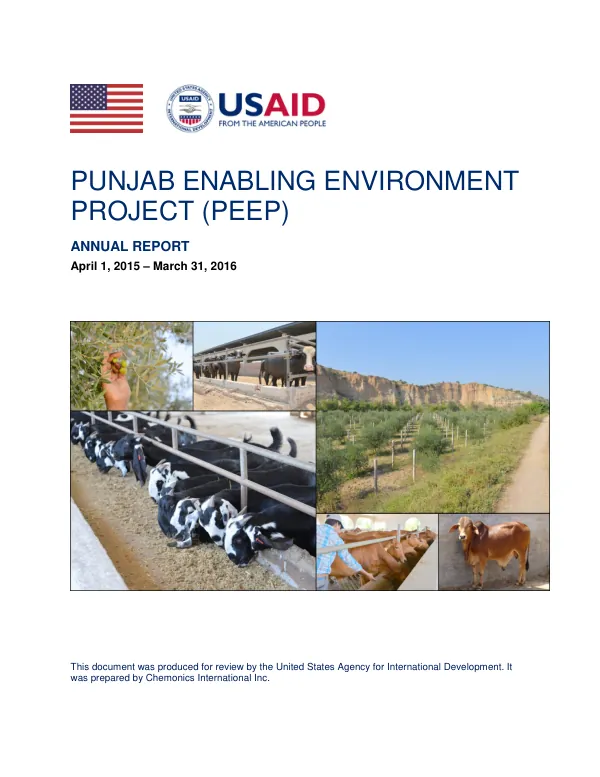
Punjab Enabling Environment Project (PEEP) Annual Report April 1, 2015 - March 31, 2016
Sign inBATANGAS PROVINCE CHAMBER OF COMMERCE AND INDUSTRY, INC.
Punjab Enabling Environment Project (PEEP) Annual Report April 1, 2015 - March 31, 2016
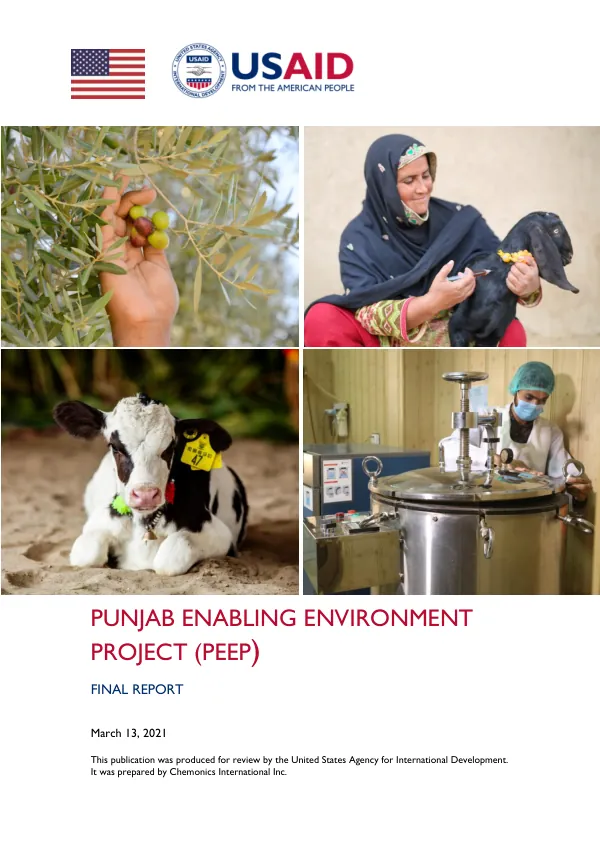
The Punjab Enabling Environment Project (PEEP) aimed to create a business enabling environment in the livestock, dairy, and horticulture subsectors of Punjab through policy and legal reforms and enhanced institutional capacities.
2016 · 59 pages
Sign in to readA free account is required to download.
Abstract
PEEP worked closely with the Government of Punjab (GoPb) to sensitize stakeholders towards the need for creating a business enabling environment. The project's efforts focused on policy and legal reforms, institutional capacity building, and mobilizing private sector investment. In Year 2, PEEP adopted a multi-pronged strategy for accelerated policy and legal reforms. The project's advocacy efforts involved one-on-one meetings, panel discussions, and roundtable meetings with private sector stakeholders and key policy makers and implementers in the public sector. These efforts led to structured discussions and deliberations through the Core Advocacy Groups (CAGs). Roundtables and issue-specific panel meetings continued to channel private sector inputs for framing issues, while the CAGs provided direction for PEEP's advocacy efforts with GoPb. The GoPb, Livestock and Dairy Development Department (L&DDD), initiated consultation with relevant stakeholders, sector experts, academia, and development partners to formulate a livestock policy paper. This effort aimed to provide a coherent policy document for the sector. PEEP's advocacy efforts were supplemented with technical assistance to GoPb and its allied agencies. PEEP's partnerships played a crucial role in achieving the project's objectives. The project collaborated with various institutions, including the Department of Agriculture, the Punjab Halal Development Agency, and the Center for Applied Policy Research in Livestock. These partnerships facilitated the implementation of the project's components, including private sector-led advocacy for policy reforms, institutional capacity building, and mobilizing major private sector investment. The project's budget execution and financial management were also critical aspects of its implementation. PEEP's financial report and estimated costs for Year 2-5 were presented in the annual report. The project's administration and project management were also discussed in the report, highlighting the challenges faced and opportunities for the future. In terms of key achievements, PEEP's advocacy efforts led to the formulation of a livestock policy paper by the GoPb, L&DDD. The project's partnerships with various institutions facilitated the implementation of its components, including private sector-led advocacy for policy reforms and institutional capacity building. The project's budget execution and financial management were also satisfactory, with a financial report and estimated costs for Year 2-5 presented in the annual report. Overall, PEEP's efforts in Year 2 contributed to the creation of a business enabling environment in the livestock, dairy, and horticulture subsectors of Punjab. The project's advocacy efforts, partnerships, and budget execution were critical aspects of its implementation, and its achievements laid the foundation for future growth and development in the sector.