DAIRY AND RURAL DEVELOPMENT FOUNDATION
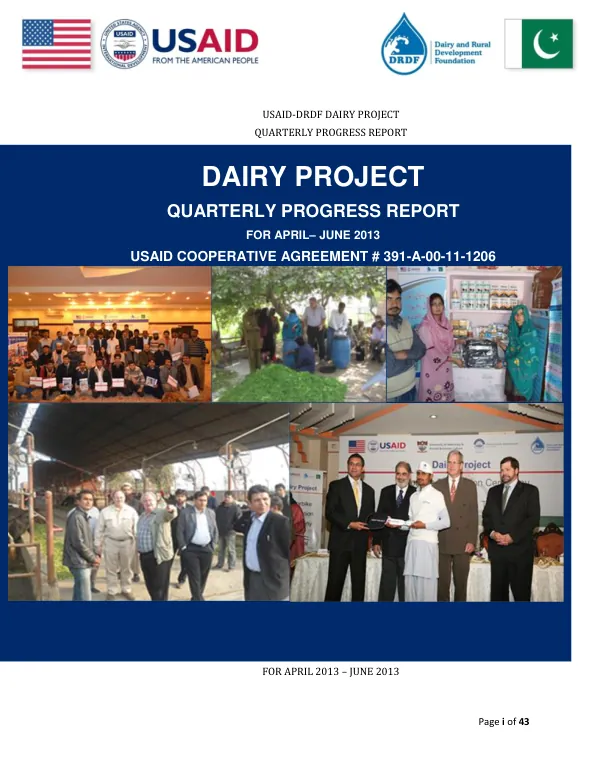
Quarterly Progress Report July-September 2016
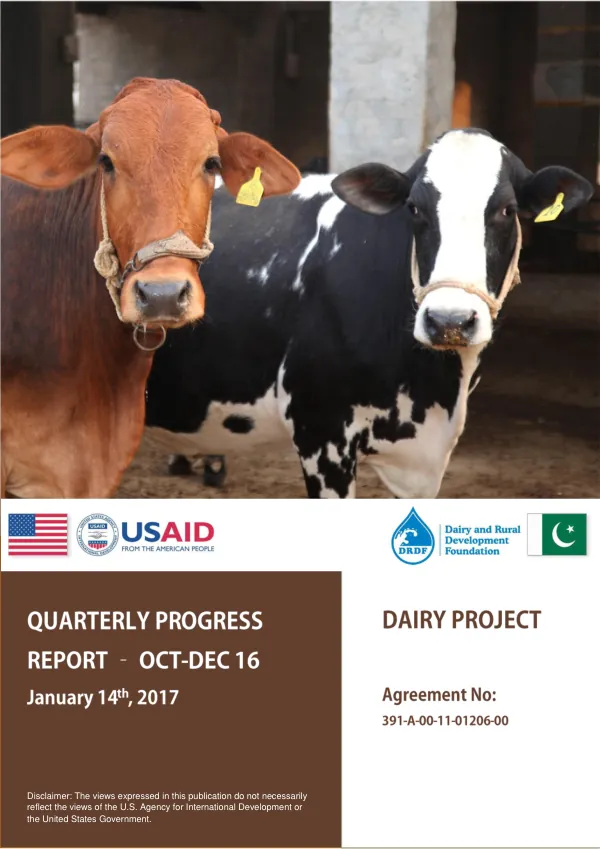
The Dairy Project, a joint collaboration of the United States Agency for International Development (USAID) and Dairy and Rural Development Foundation (DRDF), aims to enhance rural incomes by increasing livestock productivity.
2016 · 40 pages
Sign in to readA free account is required to download.
Abstract
Initially, the project was given three years for the intervention, during which it focused on farmer trainings and adoption of best dairy farming practices. Simultaneously, the project trained young rural men and women from these farming communities and established them as extension service providers for dairy farmers. After completing its three years, the project received a two-year extension in October 2014. In the extension period, the project continued the implementation methodology of farmers' capacity building on best dairy farming practices, providing farmers with an integrated system where they have easy access to extension services. The project also trained and established Artificial Insemination Technicians (AITs) and Women Livestock Extension Workers (WLEWs) as key services providers to small farmers at their doorstep. The project initiated a farm upgradation component in the extension phase to support small/medium-level farmers in upgrading their farms on a cost-sharing basis. The project's farm upgradation team works closely with these farms to overcome farm-level inefficiencies and improve farm economics. In this regard, the project has launched the 3:1:7 strategy, which primarily focuses on optimal herd composition. The overall progress and performance in the reporting period are as follows: the project has provided training to 49,430 dairy farmers, including 518 farm managers and commercial dairy farmers, in best dairy farm practices to help them increase milk productivity and consequently increase their income. In the reporting quarter, the project trained a few of the remaining 165 farmers to achieve the total target of the number of farmers to train. The last survey done by the project revealed an increase in milk yield per animal of the project-trained beneficiaries by 17%. A total of 118 farms have been upgraded till 31st December, 2016, which serve as training and learning centers. After upgradation, these farms are handed over to a team of veterinarians who work closely with the farm owners and provide advisory services to increase farm efficiency through proper herd management. The farm upgradation team is gradually bringing the upgraded farms under the fold of the 3:1:7 strategy, where majority of them have started to implement it. These training farms will be open for the parent organization for the next two years, after the close out of the project. DRDF can replicate the same concept if it wishes to do so on these farms and make a difference in the lives of the other small-scale farmers willing to take their farms to the next level. Breeding is one of the important pillars in best dairy farming practices, and the project has made significant progress in this area, with a total of 118 farms upgraded and 49,430 dairy farmers trained in best dairy farm practices. The project's training programs have focused on various aspects of dairy farming, including artificial insemination, farm management, and animal health. The project has also established a network of extension service providers, including AITs and WLEWs, who work closely with dairy farmers to provide them with technical assistance and advisory services. The project's farm upgradation component has been instrumental in improving the productivity and efficiency of dairy farms, with a significant increase in milk yield per animal and a corresponding increase in farm income. The project's overall impact has been significant, with a total of 49,430 dairy farmers trained and 118 farms upgraded. The project's training programs have helped to increase milk productivity and farm income, while the farm upgradation component has improved the efficiency and productivity of dairy farms. The project's extension service providers have played a crucial role in providing technical assistance and advisory services to dairy farmers, helping them to overcome farm-level inefficiencies and improve farm economics.