USAID DEC
Bangladesh Policy and Regulatory Assessment to Inform the New Agriculture Policy Activity Design
Sign inGOVERNMENT OF BANGLADESH
Bangladesh Policy and Regulatory Assessment to Inform the New Agriculture Policy Activity Design
The agricultural development initiative in Bangladesh began with the assessment of the country's policy and regulatory framework to inform the design of a new agriculture policy activity.
2020 · 55 pages
Sign in to readA free account is required to download.
Abstract
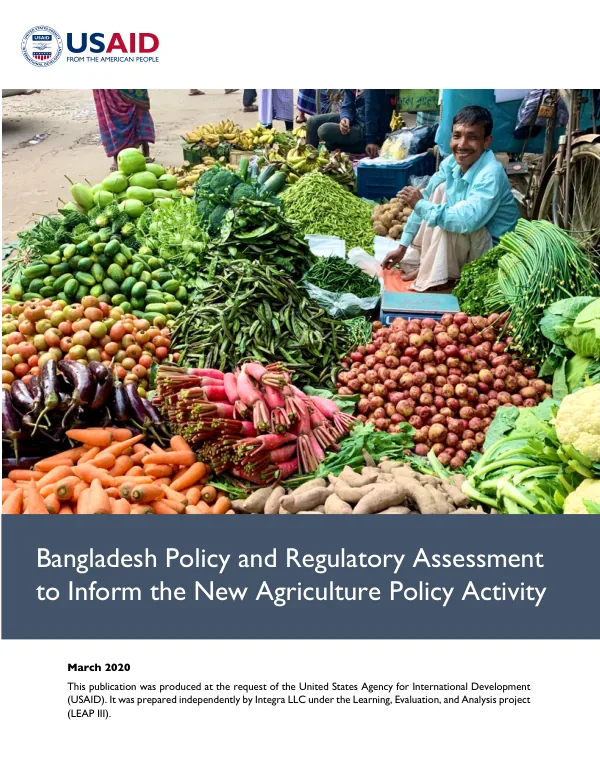
The assessment was conducted by Integra LLC under the Learning, Evaluation, and Analysis project (LEAP III) at the request of the United States Agency for International Development (USAID). The assessment aimed to improve policy implementation in four key pillar areas: seeds, food safety, social safety nets, and nutrition. The assessment involved desk research and qualitative interviews with experts in government, the private sector, NGOs, think-tanks, the press, academia, and civil society. The research and interviews provided insights into the current state of regulation, reform, and main issues within the four areas. The assessment also outlined possible themes for activity tasks, providing a flexible framework to define specific tasks further over the activity term. The assessment highlighted the challenges faced in Bangladesh in addressing the four key pillars. It discussed the private sector-focused, regulatory delivery orientation proposed for the activity and contrasted it with a top-down approach. The assessment gave main findings on the four key pillar areas, including the business enabling environment, seeds, food safety, social safety nets, and nutrition. The business enabling environment in Bangladesh is characterized by low rankings in the World Bank's Doing Business rankings, despite a well-developed legal and policy framework. The low rankings stand in stark contrast to the country's comparative advantage in terms of its legal and policy framework. The assessment noted that despite decades of policy work, the framework has still not translated into good implementation scores. The assessment identified several key issues in the four pillar areas. In the seed sector, research institutes are often unable to meet market demand, leading to shortages and sub-optimal use by farmers of saved seed. The government continues to furnish rice and other seeds at heavily subsidized prices, making it difficult for the private sector to compete. Market surveillance is uneven, with very few agents and inadequate lab capacity, leading to worry among farmers about being sold fake or expired seeds. In the food safety sector, there is widespread mistrust of the safety of food, especially among educated urban residents, and widespread misinformation. Regulatory power is divided among 20 agencies, 10 with inspection powers, and the new Bangladesh Food Safety Authority (BFSA) is challenged to bring consistent, well-implemented, modern regulatory enforcement to this patchwork. Private sector representation in governing committees is very limited, and rules can be written and applied without any regulatory impact assessment. In the social safety net sector, a number of the government's 116 Social Safety Net (SSN) programs overlap, targeting the same beneficiaries and missing others, especially the urban poor. SSN programs provide much assistance where needed but offer little to aid recipients to develop skills or get resources to graduate to greater self-sufficiency. Territoriality and lack of structured data sharing among too many programs can lead to waste and poor programming. In the nutrition sector, nutrition programs are stronger on paper than in practice, and still appear to be too weak and limited in coverage. Coordination of nutrition programs is fragmented and lacking real leadership. Limited data about nutritional intake and tastes at the household and farmer level can hinder planning and behavior change. The needed skills and incentives to deliver nutrition improvements can be lacking, especially among over-burdened government officials. The assessment concluded that a regulatory delivery approach can trigger reform through work with lower levels of the Government of Bangladesh (GoB). This approach can improve bureaucratic habits and office procedures, increase the use of information technology (IT) and process tracking data, simplify where and how often forms have to be filed or licenses renewed, and so on. This approach can be used with equal effect to improve the delivery of social safety net (SSN) services.