ADRA
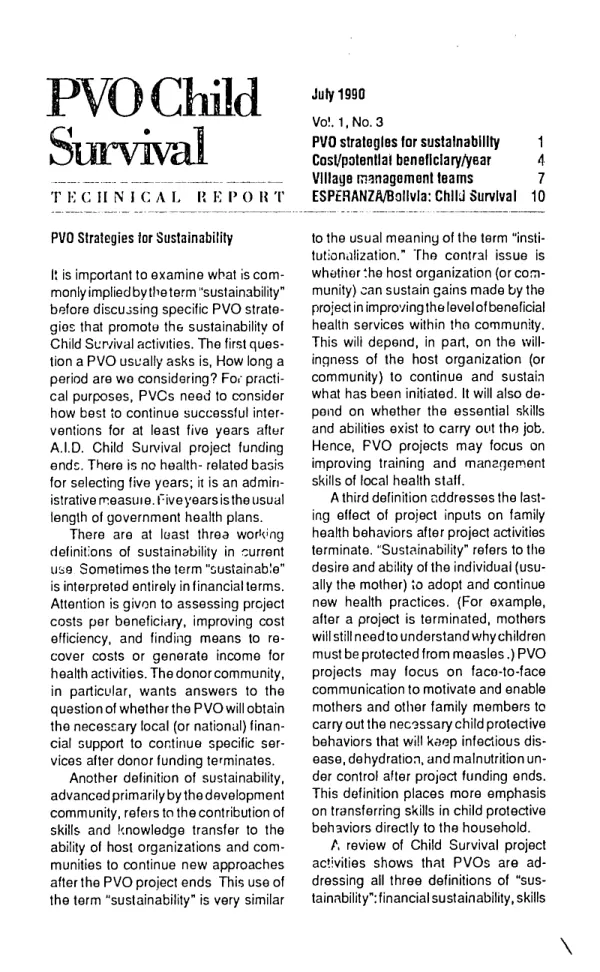
PVO Strategies for Sustainability in Child Survival Activities
PVO Child Survival strategies for sustainability emphasize the importance of examining the commonly implied meaning of the term "sustainability" before discussing specific strategies that promote the sustainability of Child Survival activities.
2010 · 36 pages
Sign in to readA free account is required to download.
Abstract
The first question a PVO usually asks is how long a period are they considering, with a practical consideration of at least five years after A.I.D. Child Survival project funding ends. This administrative measure is based on the usual length of government health plans. There are at least three working definitions of sustainability in current use. Sometimes the term "sustainable" is interpreted entirely in financial terms, with attention given to assessing project costs per beneficiary, improving cost efficiency, and finding means to recover costs or generate income for health activities. The donor community, in particular, wants answers to the question of whether the PVO will obtain the necessary local (or national) financial support to continue specific services after donor funding terminates. Another definition of sustainability, advanced primarily by the development community, refers to the contribution of skills and knowledge transfer to the ability of host organizations and communities to continue new approaches after the PVO project ends. This use of the term "sustainability" is very similar to the usual meaning of the term "institutionalization." The central issue is whether the host organization (or community) can sustain gains made by the project in improving the level of beneficial health services within the community. A third definition addresses the lasting effect of project inputs on family health behaviors after project activities terminate. "Sustainability" refers to the desire and ability of the individual (usually the mother) to adopt and continue new health practices. PVO projects may focus on face-to-face communication to motivate and enable mothers and other family members to carry out the necessary child protective behaviors that will keep infectious disease, dehydration, and malnutrition under control after project funding ends. PVOs are addressing all three definitions of sustainability: financial sustainability, skills transfer (institutionalization), and sustainable behavioral change. PVOs have learned that sustainability must be explicitly included in project design. Talks with the community on sustainability issues should start at the beginning of a project. Child Survival programs must be locally acceptable and affordable. Collaboration with local government is essential. The strategies for implementing interventions should build on local resources. Financial sustainability is a critical aspect of PVO Child Survival projects. PVOs are aware of the need for finding a predictable means of locally funding recurrent project activities. However, in the short three- to four-year time span of most projects, few PVOs have found time to study alternative financing mechanisms, unless these mechanisms were specifically part of the original Child Survival proposal. Only limited data are available on successful experiences using financing mechanisms for Child Survival activities. Community participation is the most common strategy PVOs advocate to achieve sustainability. PVOs strongly believe that if community members participate in project decisions, the community will be better able to prioritize its health problems and, therefore, generate solutions without depending on PVOs or other outside organizations. The participation process enables the community to understand the costs and benefits of the project's activities, as well as to develop a sense of project "ownership" and confidence. MOH collaboration and institutionalization are also critical strategies for improving sustainability. The aim is to improve service delivery and efficiency. The crucial activities to be included in this collaboration are training of government health services personnel, upgrading supervision and management potential, and developing effective health information systems. As a measure of sustainability, PVOs may elect to monitor the extent to which the MOH absorbs the costs and responsibility for all relevant project services. Partnership with local non-governmental organizations (NGOs) is another strategy for improving sustainability. However, to date, only a few PVO Child Survival projects are working through local, indigenous organizations. The major drawback to these existing partnerships is that, with few exceptions, the local NGOs have little or no expertise with the more technical Child Survival interventions.
Related documents