USAID DEC
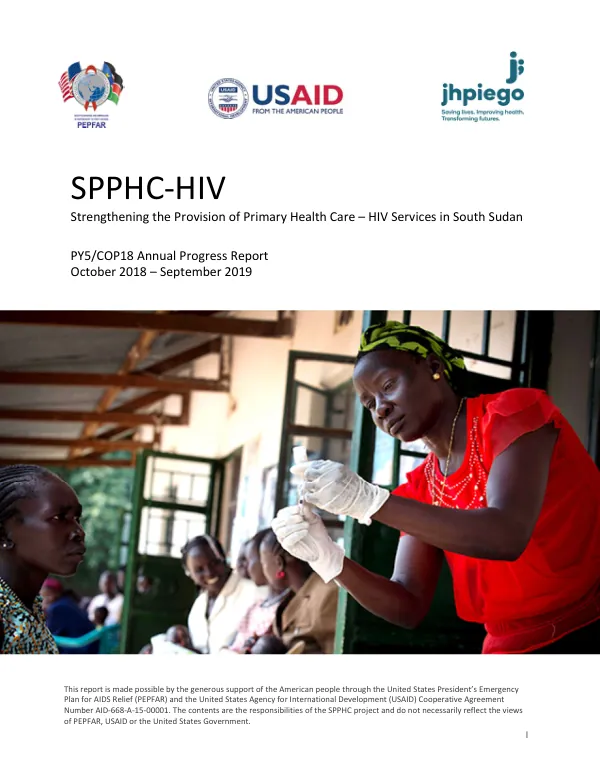
PY5/COP18 Annual Progress Report: Strengthening the Provision of Primary Health Care – HIV Services in South Sudan
Sign inINTERNATIONAL MEDICAL CORPS
PY5/COP18 Annual Progress Report: Strengthening the Provision of Primary Health Care – HIV Services in South Sudan
The SPPHC-HIV project in South Sudan continued to provide quality, comprehensive service delivery in COP18, leveraging the South Sudan primary health care system to ensure that people living with HIV (PLHIV) have access to comprehensive, quality HIV services across the continuum of care.
2019 · 32 pages
Sign in to readA free account is required to download.
Abstract
The project met or came close to meeting the majority of its PEPFAR targets through strong efforts in service delivery and supportive supervision, and through engagement with national, state, and community platforms. The project achieved 97% of its positive-identification target, 145% of its testing target, 87% of its treatment initiation target, and 184% of its Viral Suppression (TX_PLVS (N)) target. This means significant life-saving support to the people of South Sudan, with 43,603 individuals tested and receiving a HIV test result, 1,783 new cases of HIV detected, and 1,893 individuals linked to care and treatment. Additionally, 4,133 people are continuing to take life-saving Antiretroviral Therapy (ART), including 651 pregnant or breastfeeding women, and 527 TB patients. Of those over 4,000 people on treatment, 1,513 people are virally suppressed. The project is working in conjunction with the Ministry of Health (MOH), implementing partners, PEPFAR, and other partners to support and increase access to comprehensive integrated HIV testing and counseling (HTC), Prevention of Mother-to-Child Transmission (PMTCT), and Antiretroviral Therapy (ART) services in Western and Central Equatoria States. The project is working to address coverage gaps and core challenges by building the capacity of State Ministries of Health (SMOH) and County Health Departments (CHDs) to better plan for and deliver comprehensive, quality HIV care and treatment services. The SPPHC project is being implemented in 8 static sites in Jubek State and Tambura State, with the following services available at each site: HIV testing services (HTS), PMTCT, Early Infant Diagnosis (EID), ART, Viral Load (VL), and Tuberculosis (TB) services. These static sites are MOH-run Primary Health Care Centers (PHCCs), with the exception of the Protection of Civilian (POC) site, which is operated by the United Nations Mission in South Sudan (UNMISS) and health services are overseen by International Medical Corps (IMC). At the community level, the project engaged two Civil Society Organizations (CSOs) as sub-awardees to leverage their community platform for client tracing, with a focus on tracing clients lost to follow up (LTFU) as well as index case partners. The two CSOs (NEPWU, Tambura YWCA) began implementation in Q2. In POC, the project has directly engaged Community Health Workers (CHWs) to implement LTFU and Index Contact tracing in the community, using Nuer-speaking CHWs. The project has made significant progress in COP18, with a focus on strengthening the capacity of State Ministries of Health (SMOH) and County Health Departments (CHDs) to better plan for and deliver comprehensive, quality HIV care and treatment services. The project has also engaged with national, state, and community platforms to ensure that people living with HIV (PLHIV) have access to comprehensive, quality HIV services across the continuum of care.
Related documents