BREAKTHROUGH ACTION
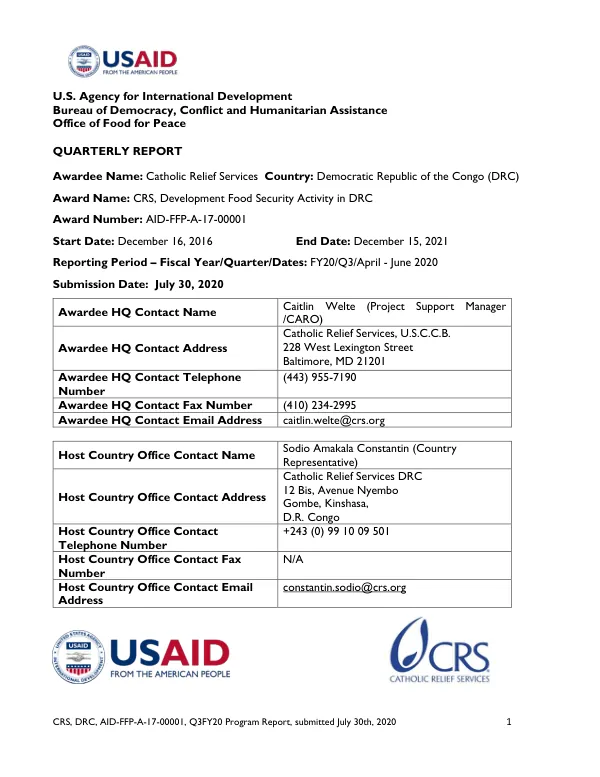
Quarterly Report: Development Food Security Activity in DRC
The Development Food Security Activity in the Democratic Republic of the Congo (DRC) aims to improve nutrition, food security, and economic well-being for vulnerable households in Eastern Kasai.
2020 · 23 pages
Sign in to readA free account is required to download.
Abstract
The program is implemented by Catholic Relief Services (CRS) in collaboration with local partners, including the Government of the DRC, the National Cooperative Business Association Cooperative League of the USA, and others. The program's goal is to empower communities to sustain improvements in food security and nutrition by 2021. The program focuses on five strategic purposes, including reducing chronic malnutrition in children under five, improving household inclusive social and economic well-being, and increasing household income. The program targets 110,907 beneficiaries in the agricultural sector, 105,172 in maternal and child health, 217,218 in nutrition, 81,149 in capacity building, and 93,515 in water supply and sanitation. CRS is responsible for overall management of the award and compliance with USAID/FFP requirements. The program's management plan is tailored to strengthen the capacity of relevant government structures, community structures, local NGOs, and the private sector. Locally based partners are brought in for their expertise and local knowledge. The program's geographic focus is on three health zones: Cilundu, Miabi, and Kasansa, in the Kasai Oriental province. The program's implementation period is from December 2016 to December 2021. The program's foundational purpose is to empower communities to sustain improvements in food security and nutrition. The program's specific purposes include reducing early pregnancies and forced marriages, promoting optimal household nutrition and wellness behaviors, and increasing access to high-quality health services. The program also aims to improve household inclusive social and economic well-being by increasing household income, promoting equitable sharing of household responsibilities, and increasing access to diverse and nutritious foods. The program's implementation involves training facilitators, organizing community programs, and promoting social and behavior change interventions. The program's progress is monitored through regular monitoring and evaluation activities, including quarterly reports, site visits, and assessments. In the third quarter of fiscal year 2020, the program reached 3,113 beneficiary couples through the The Faithful House (TFH) approach, which aims to prevent early pregnancy and forms of SGBV. The program also organized online meetings with other implementers to identify complementarities in social and behavior change interventions. The program's achievements include increasing the number of pregnant women benefiting from small animal source foods, promoting the use of high-quality health services, and strengthening the capacity of community structures. The program's challenges include the challenges faced by breeding rabbits, which have not had the same positive results as guinea pig rearing. The program's future plans include increasing the number of households benefiting from small animal source foods, promoting the use of high-quality health services, and strengthening the capacity of community structures. The program's overall goal is to empower communities to sustain improvements in food security and nutrition by 2021.
Related documents