USAID DEC
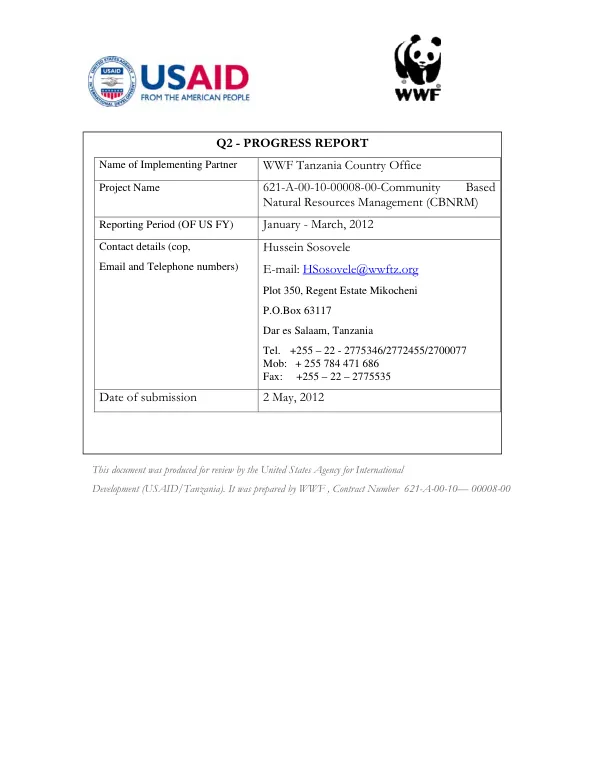
Q2 - PROGRESS REPORT: Enhancing Conservation and Community Gains through the Implementation of Wildlife Management Areas and Environmental Policies in Tanzania
Sign inWILDLIFE CONSERVATION SOCIETY
Q2 - PROGRESS REPORT: Enhancing Conservation and Community Gains through the Implementation of Wildlife Management Areas and Environmental Policies in Tanzania
The Community Based Natural Resources Management (CBNRM) Policy program in Tanzania began in January 2010 with funding from the United States Agency for International Development (USAID).
2012 · 23 pages
Sign in to readA free account is required to download.
Abstract
The program's primary goal is to enhance community participation in wildlife conservation through the establishment and management of Wildlife Management Areas (WMA) on village land. By doing so, communities are expected to benefit from sustainable use of natural resources in a WMA and improve their livelihoods. The program also supports the operationalization of the Environmental Management Act (EMA), 2004. During the reporting period of January to March 2012, progress was severely limited due to several major incidents occurring at the WWF-Tanzania Country Office that affected implementation. The WWF-Tanzania Country Office faced unexpected challenges when audit reports revealed the misuse of funds by staff working on GAA-funded projects. As a result, there were serious capacity constraints and activity delays due to the departure of the Country Director, Conservation Manager, and Finance Manager, in addition to 11 other staff. Steps to fill these positions are underway, and new staff will be joining the WWF CBNRM/CFW team in early May 2012 to replace some of the positions that were affected by the changes. The program's target areas include national coverage on policy issues, with a specific focus on the Selous, Ruaha-Rungwa, Tarangire-Manyara Ecosystem, and Rukwa-Katavi Ecosystems. The program has a budget of $10,595,000.00, with an obligated amount of $3,795,000. The program's standard indicators include the number of hectares of biological significance and/or natural resources under improved natural resource management, the number of hectares of biological significance and/or natural resources showing improved biophysical conditions, and the number of person-hours of training in natural resources management and/or biodiversity conservation. During the reporting period, the program made progress in some areas, but implementation was severely limited due to the challenges faced by the WWF-Tanzania Country Office. The program's activity implementation progress was affected by the departure of key staff and the need for reforms. The program's principal target beneficiaries include local communities in 14 WMAs, local and central government, and the AA consortium. Major counterpart organizations include the Ministry of Natural Resources and Tourism-Wildlife Division and the Vice President's Office-Division of Environment. The program's standard indicators show that progress was made in some areas, but implementation was severely limited due to the challenges faced by the WWF-Tanzania Country Office. The number of hectares of biological significance and/or natural resources under improved natural resource management increased to 115,050, but the number of hectares of biological significance and/or natural resources showing improved biophysical conditions remained at 0. The number of person-hours of training in natural resources management and/or biodiversity conservation increased to 9,480, but the number of people with increased economic benefits derived from sustainable natural resource management and conservation remained at 0.
Related documents