USAID DEC
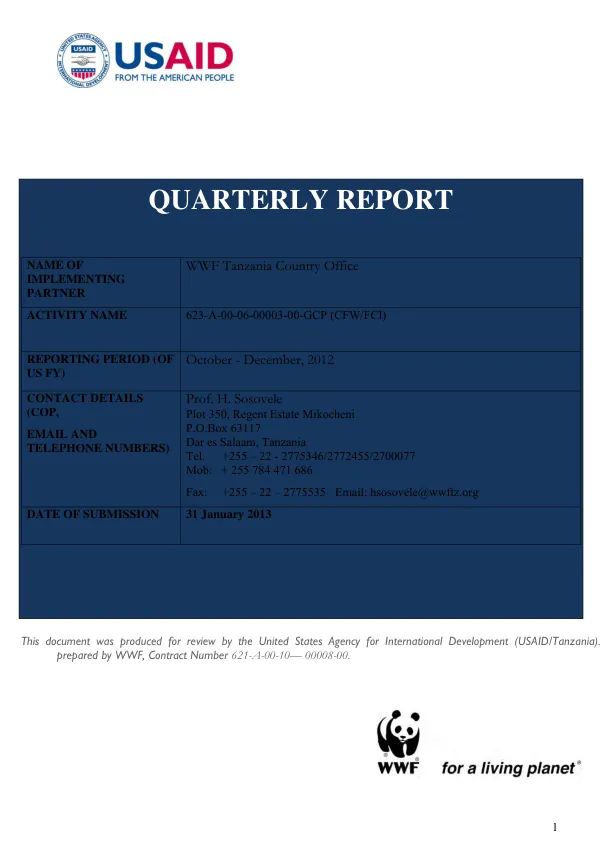
Quarterly Report: WMA Conservation Corps: Infrastructure Support Program in Wildlife Management Areas (WMAs) through the Cash-for-Work Program
Sign inAFRICAN WILDLIFE FOUNDATION
Quarterly Report: WMA Conservation Corps: Infrastructure Support Program in Wildlife Management Areas (WMAs) through the Cash-for-Work Program
The WMA Conservation Corps: Infrastructure Support Program in Wildlife Management Areas (WMAs) through the Cash-for-Work Program is a project implemented by WWF Tanzania Country Office in collaboration with various partners.
2013 · 12 pages
Sign in to readA free account is required to download.
Abstract
The project aims to provide employment opportunities to local communities in five selected WMAs of Ipole-Sikonge District, Ikona-Serengeti District, Burunge-Babati District, Enduimet-Longido District, and Pawaga-Idodi (MBOMIPA) -Iringa District Tanzania. The project is funded by the United States Agency for International Development (USAID/Tanzania) with a budget of US $10,648,500. The project's main objective is to improve conservation and livelihoods of local communities through the provision of employment opportunities, infrastructure development, and natural resource management. The project targets 11,343 people, with 2,274 females and 9,079 males, who have earned a total of Tshs. 630,631,242 ($406,858) as of 31 December 2012. The project has achieved significant progress, with 10 out of 13 projects under Phase I completed 100%, and 9 out of 13 projects under Phase II completed 100%. The project has implemented various infrastructure development activities, including the construction of visitors centers, village game scouts posts, entry gates, observation posts, and natural resource facilities. The project has also improved road infrastructure, with 78 kilometers of road improved through cash-for-work activities. However, some contracts were not completed in December 2012 as earlier projected, and replacement processes were undertaken to complete the remaining works. The project has also achieved significant results in terms of employment opportunities, with 963 people employed in the quarter October-December 2012, out of which 226 were females and 747 were males. The project has also improved the livelihoods of local communities, with a 27% increase in household income among program participants compared to the control group. The project's geographic focus is on five selected WMAs in Tanzania, with a target area of 5,000 square kilometers. The project's timeframes are from September 2009 to December 2012, with a planned life of 3 years. The project's budget is US $10,648,500, with an unobligated balance of Federal funds of $110,319.23. The project's implementation progress is monitored through various indicators, including the number of USG social assistance beneficiaries participating in productive safety nets, the number of offices, visitor centers, entry gates, and natural resource facilities constructed through the cash-for-work program. The project's results performance is also monitored through various indicators, including the number of people employed, the number of infrastructure projects completed, and the number of kilometers of road improved. Overall, the WMA Conservation Corps: Infrastructure Support Program in Wildlife Management Areas (WMAs) through the Cash-for-Work Program has achieved significant progress in improving conservation and livelihoods of local communities in Tanzania. The project's results demonstrate the effectiveness of the cash-for-work program in providing employment opportunities and improving the livelihoods of local communities.
Related documents