USAID DEC
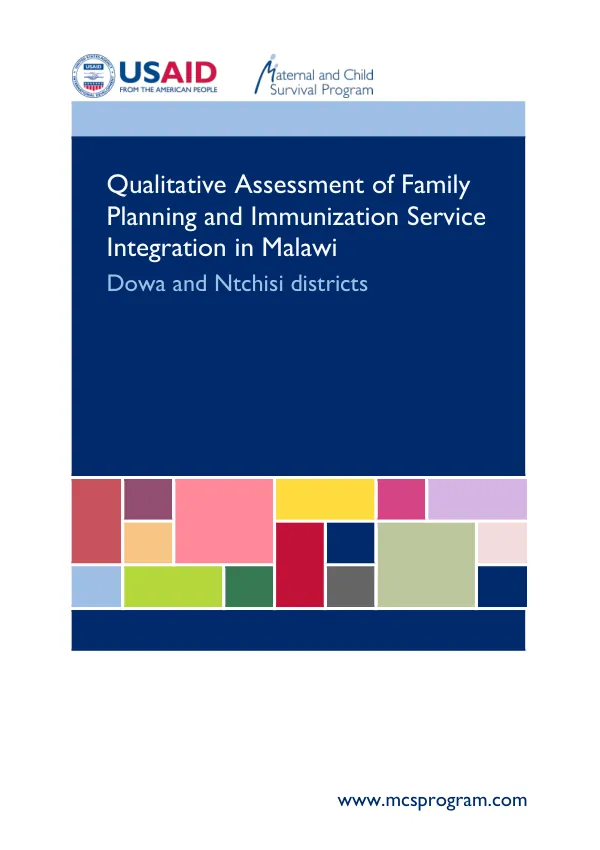
Qualitative Assessment of Family Planning and Immunization Service Integration in Malawi
Sign inUNITED NATIONS FUND POPULATION
Qualitative Assessment of Family Planning and Immunization Service Integration in Malawi
Family planning and immunization services have been provided largely in parallel in Malawi, with separate schedules and providers.
2018 · 35 pages
Sign in to readA free account is required to download.
Abstract
To optimize health contacts and reduce missed opportunities for care, the Maternal and Child Survival Program (MCSP) supported Malawi's government in testing the systematic integration of family planning and routine infant immunization services in all facilities and associated outreach sites in the Dowa and Ntchisi districts. The intervention took place between July 2016 and November 2017. The study used a mixed-methods process evaluation approach, with a qualitative component that assessed how integration of family planning and immunization services affects service provision, utilization, and perceptions of quality at MCSP sites in the two districts. In-depth interviews were conducted with health workers and program managers, and focus group discussions were held with mothers of children under 1 year of age who accepted family planning and immunization referrals, as well as those who refused family planning referrals. The findings of the study show that there are substantial perceived benefits associated with family planning and immunization service integration. Clients reported that they could now access both services in one day at the same place, unlike in the past when they had to visit the health facility twice to receive the two services. Health care workers noted that integration has reduced their workload, as they are now able to provide both services at the same time. However, the study also identified challenges and barriers to the effective implementation of the integrated approach. Lack of adequate resources, such as staff, commodities, and transportation, were cited as difficulties in the effective implementation of the integrated approach. The program should consider addressing these challenges and barriers to ensure the effective continuation and scale-up of integrated services. The integration of family planning and immunization services has been shown to have a positive impact on health indicators among women and young children. The study highlights the importance of addressing the challenges and barriers to effective implementation to ensure the continued success of the integrated approach. The findings of the study provide valuable insights for policymakers and program managers seeking to improve the delivery of family planning and immunization services in Malawi. The study's findings suggest that the integration of family planning and immunization services has the potential to improve health outcomes and reduce the workload of health care workers. However, the lack of adequate resources and infrastructure poses significant challenges to the effective implementation of the integrated approach. To overcome these challenges, the program should consider investing in staff training, commodity supply, and transportation infrastructure to support the continued delivery of integrated services. The integration of family planning and immunization services is a critical component of the Essential Health Package in Malawi. The study's findings highlight the importance of addressing the challenges and barriers to effective implementation to ensure the continued success of the integrated approach. By addressing these challenges, the program can ensure that the benefits of integration are realized and that the health outcomes of women and young children continue to improve.