USAID DEC
Quality Assurance and Quality Control Manual for Khyber Pakhtunkhwa Reconstruction Program
Sign inUSAID
Quality Assurance and Quality Control Manual for Khyber Pakhtunkhwa Reconstruction Program
The Khyber Pakhtunkhwa Reconstruction Program (KPRP) is a USAID-funded initiative aimed at rebuilding public infrastructure in Khyber Pakhtunkhwa, Pakistan.
2021 · 56 pages
Sign in to readA free account is required to download.
Abstract
The program focuses on rebuilding education, health, water, sanitation, and irrigation facilities damaged during the 2009 military operations and the 2010 flooding. The program's objectives include rebuilding conflict-affected public schools, health, and water infrastructure, improving the learning environment in public schools, and rehabilitating essential irrigation and communication infrastructure. The program's main activities include reconstructing and rehabilitating militancy-affected public schools, rehabilitating and improving outdated water systems, rehabilitating and restoring flood-damaged infrastructure, providing essential equipment to damaged health facilities, and providing consultative services to improve the capacity of the Khyber Pakhtunkhwa government to manage reconstruction programs. Quality assurance (QA) and quality control (QC) functions are integral components of the KPRP. The QA/QC mechanism comprises different layers of site monitoring to ensure that the quality of construction is in accordance with specifications and other contractual quality parameters. The QC mechanism includes site engineers from contractor and consultant companies, while the QA mechanism includes designated engineers from executing agencies and the KPRP/PaRRSA. Quality is defined as a desirable characteristic in construction, based on the expectations set by all stakeholders. It means that a construction project is completed within the defined guidelines set out in the Scope of Work (SOW). The SOW serves as a set of rules for the project based on the client's expectations, and sheds light on how to execute the project in a way that meets these standards. The QA function is a set of planned and systematic actions laid out before and after a construction project. It involves ensuring that the project is executed in accordance with the SOW and other contractual quality parameters. The QA function is responsible for monitoring and controlling the quality of construction, and for taking corrective action when necessary. The QC function is responsible for ensuring that the construction work is carried out in accordance with the specifications and other contractual quality parameters. It involves inspecting and testing the construction work to ensure that it meets the required standards. The KPRP/PaRRSA has established a robust QA/QC mechanism to ensure that the quality of construction is maintained throughout the project. The mechanism includes a clear communication plan, defined duties and responsibilities, and a system for reporting and documenting quality-related issues. The QA/QC manual outlines the procedures and guidelines for ensuring quality in construction. It includes sections on definitions, communication plan, duties and responsibilities, design stage, construction stage, laboratory testing, complete rework items, reporting, and annexes. The manual provides a comprehensive framework for ensuring quality in construction and for maintaining a robust QA/QC mechanism. The KPRP/PaRRSA has established a clear organogram of QA/QC functions, which includes the Deputy Director (Engineering), Consultant company, Site Engineer, Contractor, Project Manager, Site Engineers, Executing Agency, and Engineer. The QA/QC mechanism is designed to ensure that quality is maintained throughout the project, from the design stage to the completion of construction work. The QA/QC manual provides a comprehensive framework for ensuring quality in construction and for maintaining a robust QA/QC mechanism. It outlines the procedures and guidelines for ensuring quality in construction, and provides a clear communication plan, defined duties and responsibilities, and a system for reporting and documenting quality-related issues.
Related documents
Documents in this collection
 2021
2021USAID DEC
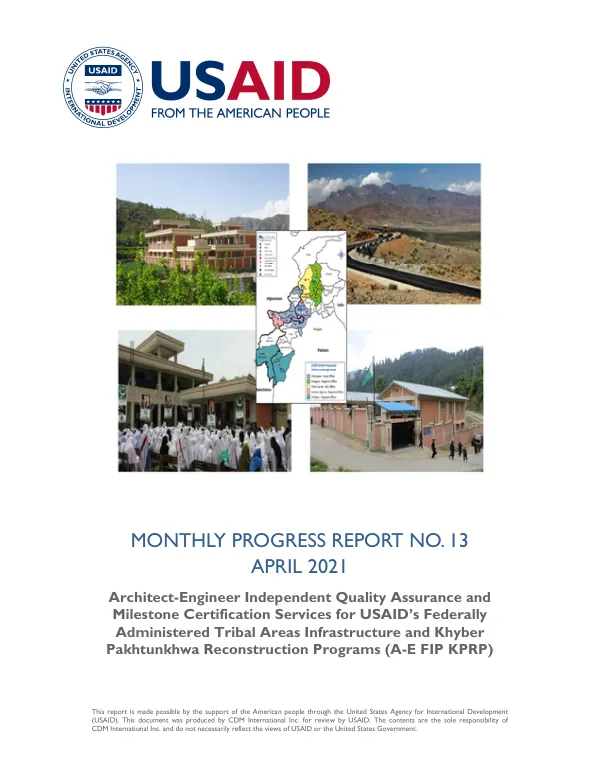
Monthly Progress Report No. 13: Architect-Engineer Independent Quality Assurance and Milestone Certification Services for USAID’s Federally Administered Tribal Areas Infrastructure and Khyber Pakhtunkhwa Reconstruction Programs (A-E FIP KPRP)
Open record 2021
2021USAID DEC