USAID DEC
Quality Improvement Collaborative: Appointment Reminders Increase Migrant Retention in Care
Sign inFHI
Quality Improvement Collaborative: Appointment Reminders Increase Migrant Retention in Care
The Quality Improvement Collaborative, a project funded by the U.S.
2018 · 2 pages
Sign in to readA free account is required to download.
Abstract
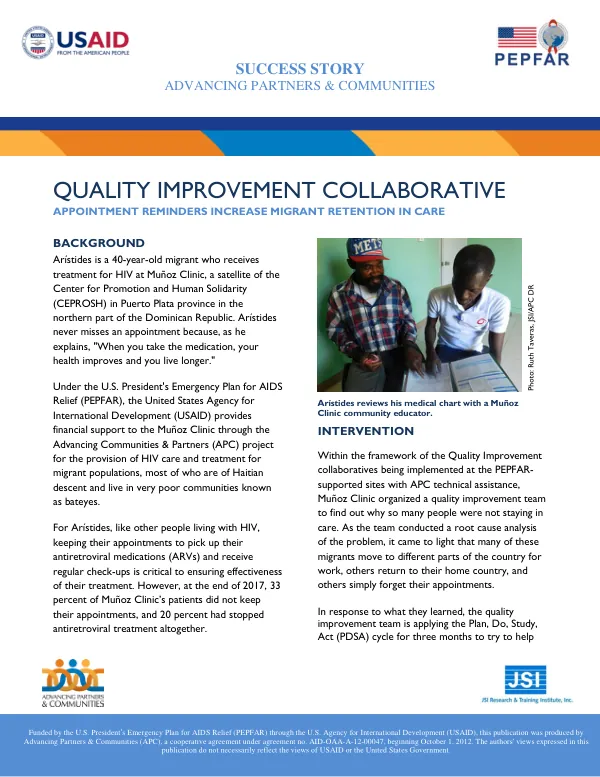
President's Emergency Plan for AIDS Relief (PEPFAR) through the U.S. Agency for International Development (USAID), aimed to improve retention in care among migrant populations in the Dominican Republic. The project was implemented by Advancing Partners & Communities (APC), a cooperative agreement under agreement no. AID-OAA-A-12-00047, beginning October 1, 2012. Arístides, a 40-year-old migrant living with HIV, receives treatment at Muñoz Clinic, a satellite of the Center for Promotion and Human Solidarity (CEPROSH) in Puerto Plata province. Arístides attributes his adherence to treatment to the improvement in his health and increased lifespan. However, at the end of 2017, 33 percent of Muñoz Clinic's patients did not keep their appointments, and 20 percent had stopped antiretroviral treatment altogether. A quality improvement team was formed at Muñoz Clinic to investigate the reasons behind the low retention rates. The team conducted a root cause analysis and identified that many migrants move to different parts of the country for work, return to their home country, or simply forget their appointments. In response, the team applied the Plan, Do, Study, Act (PDSA) cycle to develop a plan to improve retention in care. The PDSA cycle involved Creole-speaking patient navigators calling patients to remind them of their appointment two days in advance. The navigators also called those who missed their appointment as soon as possible to reschedule. The quality improvement team monitored the performance of the PDSA cycle by tracking the total number of clinic appointments, the number of patients who kept them, the number who came late, and those who did not keep their appointment at all. The results of the PDSA cycle showed a significant improvement in clinic attendance. From February through mid-March 2018, the initial period of the PDSA cycle, clinic attendance increased from 67 percent to 83 percent. Arístides expressed his satisfaction with the efforts of the Muñoz Clinic staff to remind him of his appointments, which also gave him time to arrange transportation to the clinic. The success of the PDSA cycle demonstrates the effectiveness of active follow-up with migrant patients via phone calls in increasing attendance at clinic appointments.