USAID DEC
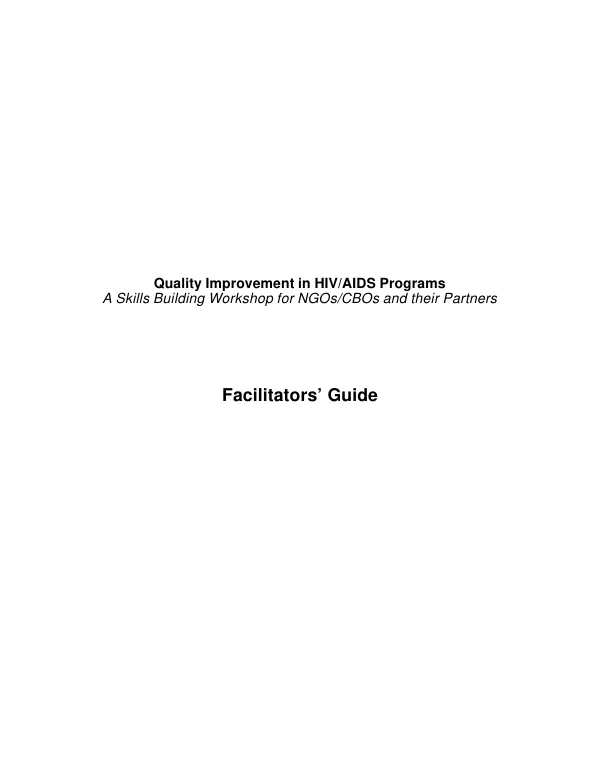
Quality Improvement in HIV/AIDS Programs: A Skills Building Workshop for NGOs/CBOs and their Partners
Sign inUSAID
Quality Improvement in HIV/AIDS Programs: A Skills Building Workshop for NGOs/CBOs and their Partners
The Quality Improvement in HIV/AIDS Programs Skills Building Workshop for NGOs/CBOs and their Partners is a facilitator's guide designed to equip participants with the skills and knowledge necessary to implement the Performance Improvement Review (PIR) process.
17 pages
Sign in to readA free account is required to download.
Abstract
The workshop is scheduled to last five and a half hours and is designed for 50 participants. The workshop outline and case study questions are projected from overheads or a PowerPoint presentation, and participants receive a workshop book containing the case study, questions, and examples of PIR instruments and forms. The facilitators lead each small group discussion, reading the case study section with their group and guiding the discussion. The workshop begins with a welcome and introduction to the ZIHP project and its experience with the PIR process. The facilitators then present the goal and objectives of the workshop, which include equipping participants with the skills and knowledge necessary to implement the PIR process and improve program performance. The case study is divided into five parts, each focusing on a different aspect of the PIR process. Part 1 introduces the PIR planning process, including the formation of the PIR team and the steps necessary for organizing a review. Part 2 outlines the process of data collection and problem identification, including a list of qualitative and quantitative problems. Throughout the workshop, participants engage in small group discussions, reviewing the case study and answering questions. The facilitators guide the discussions, encouraging participants to share their thoughts and experiences. The workshop also includes time for participants to review the Performance Improvement Review Schedule example and discuss their findings. The PIR process is designed to measure program performance on a routine basis, improve program performance by identifying problems and creating solutions, strengthen partnerships and program activities, and build staff competence to identify problems and develop solutions to key issues. The process involves assembling the PIR team, assembling and copying materials, arranging logistics, making a data collection plan, and planning a meeting. The workshop facilitators are responsible for leading the discussions, answering questions, and providing guidance and support to the participants. They are also responsible for ensuring that the workshop runs smoothly and that all materials are available. The workshop materials include overhead projectors, overhead projector screens, flip charts, markers, and pens. The facilitators' guide provides detailed instructions and guidance on how to lead the workshop and facilitate the discussions. The workshop is designed to be flexible and adaptable to the needs and limitations of the participants. It is intended to be a skills-building workshop, equipping participants with the knowledge and skills necessary to implement the PIR process and improve program performance.