MERCY CORPS INTERNATIONAL
Quarter 3 Report: January 1, 2017 - March 31, 2017
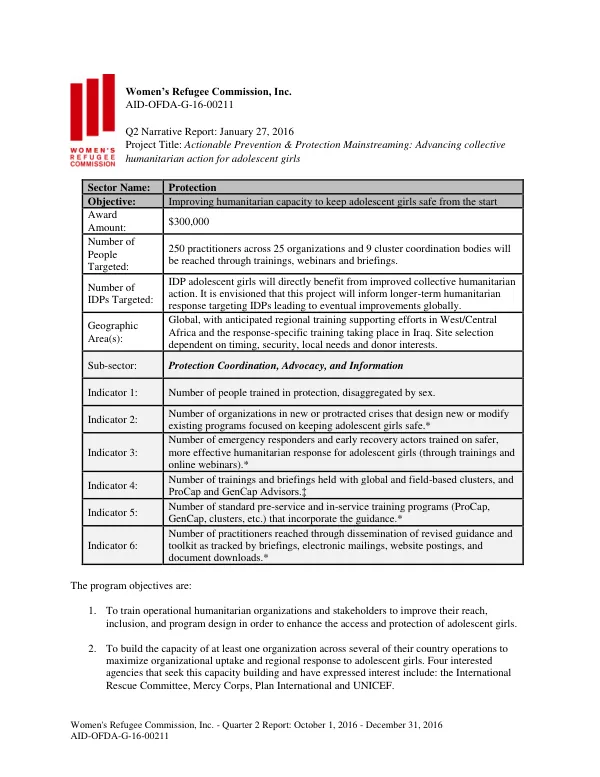
The Actionable Prevention & Protection Mainstreaming project aims to improve humanitarian capacity to keep adolescent girls safe from the start.
2017 · 5 pages
Sign in to readA free account is required to download.
Abstract
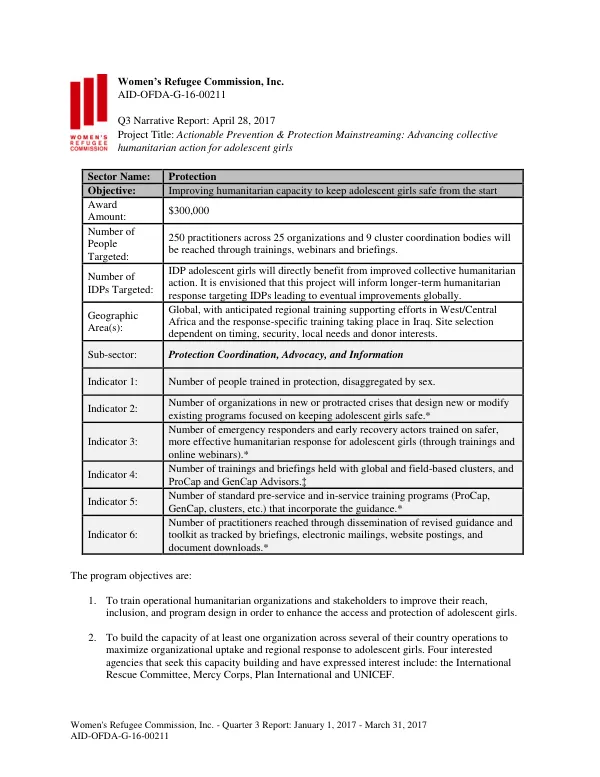
The project is led by the Women's Refugee Commission, Inc. and is funded by the United States Agency for International Development (USAID) through the Office of Foreign Disaster Assistance (OFDA). The project has a total budget of $300,000 and targets 250 practitioners across 25 organizations and 9 cluster coordination bodies. The project's geographic focus is global, with anticipated regional training supporting efforts in West/Central Africa and the response-specific training taking place in Iraq. The project's objective is to improve humanitarian capacity to keep adolescent girls safe from the start, with a focus on protection coordination, advocacy, and information. The project's indicators include the number of people trained in protection, disaggregated by sex, the number of organizations in new or protracted crises that design new or modify existing programs focused on keeping adolescent girls safe, and the number of emergency responders and early recovery actors trained on safer, more effective humanitarian response for adolescent girls. During the third quarter of 2017, the project made significant progress. The Women's Refugee Commission co-hosted an online webinar with the Population Council and Restless Development on January 17, 2017, which reached 369 persons, including 42 humanitarian practitioners and 16 USAID staff persons. The webinar shared the latest learning, findings, and tools from I'm Here implementation across nine crisis-affected countries. The project also continued to provide remote support to several actors who have led I'm Here implementation following in-person/in-field capacity-building by the Women's Refugee Commission. At Mercy Corps, learning expanded to the adaptation of I'm Here steps and tools for use in Lebanon and Jordan, with the capacity of 42 additional Mercy Corps staff built on how to more intentionally reach marginalized adolescent girls, facilitate their access to services, and design targeted asset-building programs for them. The project also discussed potential sites for the regional and country-specific trainings, with several technical advisors at the World Food Programme's MENA office keen to participate in a regional training around the Syria Crisis. Partners have expressed interest in convening a regional training in Jordan and a country-specific workshop in Iraq, South Sudan, and Yemen. The project has made significant progress in achieving its indicators, with 17 people trained in protection, 13 of whom are females, and 4 males. One organization, the Danish Refugee Council Lebanon, has designed a new program focused on keeping adolescent girls safe, and four organizations, including UNICEF Lebanon and Mercy Corps Yemen, have modified existing programs to prioritize adolescent girls' safety. The project's next steps include drafting key sections of the I'm Here Playbook, drafting a strategic plan to guide engagement with global clusters, and finalizing the locations for the regional and country-specific trainings. The project will also seek to finalize the locations for the regional and country-specific trainings in consultation with OFDA.
Related documents