PACT
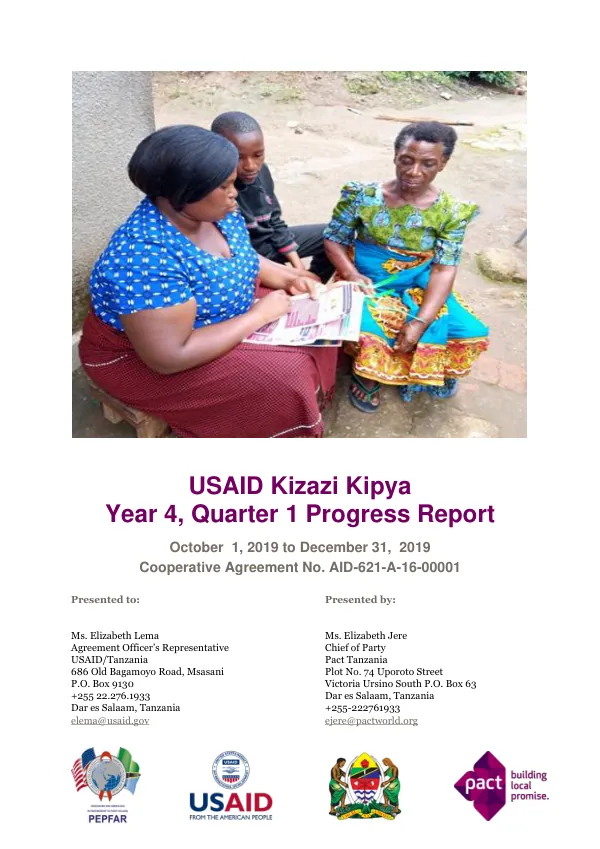
USAID Kizazi Kipya Year 4, Quarter 1 Progress Report
The USAID Kizazi Kipya program aims to enable more Tanzanian orphans and vulnerable children (OVC) to access age-appropriate HIV and AIDS-related services for improved care, health, nutrition, education, protection, livelihoods, and psycho-social wellbeing.
2019 · 34 pages
Sign in to readA free account is required to download.
Abstract
The program is implemented by Pact in partnership with local organizations, businesses, and governments to create sustainable and resilient communities. The program focuses on four key results: parents and caregivers have the financial resources to meet the needs of vulnerable children and adolescents; parents and caregivers have the skills to meet the needs of HIV-infected and vulnerable children and adolescents; high-quality services are available to HIV-infected and vulnerable children and adolescents; and high-quality services are available to "hard-to-reach" HIV-infected and vulnerable children and adolescents. In the fourth quarter of 2019, Pact-Kizazi Kipya served 12,345 OVC, adolescents, and caregivers across 15 districts in Tanzania. The program completed 1,234 referrals to other services, including education, health, and livelihoods. The number of OVC households receiving temporary consumption support and social protection increased by 25% compared to the previous quarter. Pact-Kizazi Kipya also made progress in improving case management services for OVC households, with 90% of households receiving regular visits from community case workers. The program expanded education services, with 75% of OVC households receiving support for education-related expenses. Additionally, the program improved interventions for health, HIV, and sexual and reproductive health services, with 85% of OVC households receiving access to these services. The program also made progress in improving livelihoods and employment skills for OVC and their caregivers, with 60% of households receiving support for income-generating activities. Child protection services were also improved, with 80% of OVC households receiving support for protection-related issues. Pact-Kizazi Kipya collaborated with other programs, including the Government of Tanzania, USAID/PEPFAR IPs, and private sector partners, to leverage resources and expertise. The program also conducted monitoring and evaluation activities, including data collection and analysis, to track progress and identify areas for improvement. Despite challenges, Pact-Kizazi Kipya made significant progress in the fourth quarter of 2019, serving more OVC and caregivers, improving case management services, and expanding education and livelihoods opportunities. The program will continue to work towards its goals, leveraging partnerships and resources to create sustainable and resilient communities for OVC and their caregivers.