DIMAGI, INC.
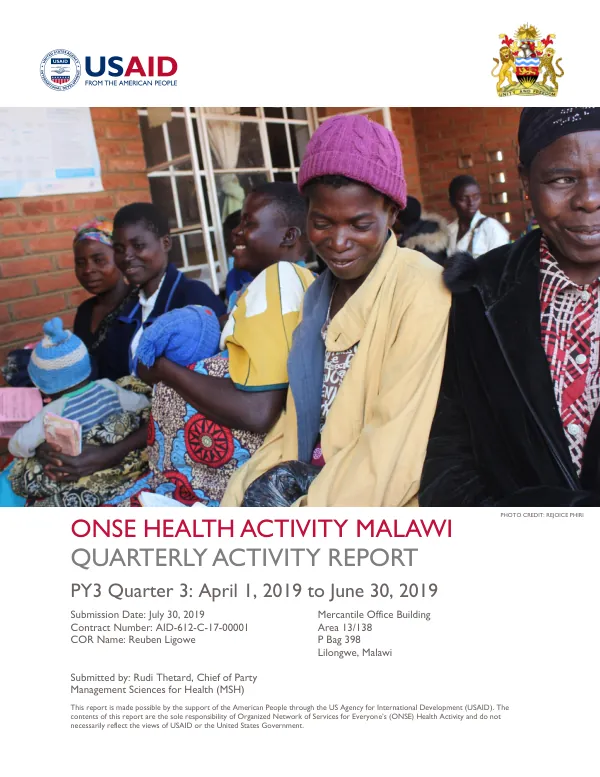
Quarterly Activity Report PY3Q3: July 30, 2019
The ONSE Health Activity in Malawi aims to reduce maternal, newborn, and child morbidity and mortality by improving access to priority health services, quality of priority health services, health system performance, and demand for priority health services.
2019 · 111 pages
Sign in to readA free account is required to download.
Abstract
The activity is implemented by Management Sciences for Health (MSH) and its partners, with technical assistance provided to improve the capacity of the health system and key health system and community actors. The geographic focus of the ONSE Health Activity is on sixteen districts in Malawi, including Balaka, Chikwawa, Chitipa, Dowa, Karonga, Kasungu, Lilongwe, Machinga, Mangochi, Mchinji, Mulanje, Nkhatabay, Nkhotakota, Ntcheu, Salima, and Zomba. The activity is funded by the United States Agency for International Development (USAID) and is aligned with the Country Development Cooperation Strategy (CDCS). The ONSE Health Activity focuses on sustainable health system interventions, including improving access to priority health services, such as maternal, newborn, and child health services, family planning, and malaria prevention and treatment. The activity also aims to strengthen the performance of the health system, including improving the quality of care, increasing the availability of essential health services, and enhancing the capacity of health system actors. The activity is implemented through a range of interventions, including technical assistance, training, and capacity building for health system actors, community health workers, and other stakeholders. The ONSE Health Activity also supports the development of health information systems, including the District Health Information System 2 (DHIS2), to improve data collection, analysis, and use. The ONSE Health Activity has made significant progress in improving access to priority health services, including a 27% increase in the number of women receiving antenatal care, a 25% increase in the number of women receiving postnatal care, and a 30% increase in the number of children under the age of five receiving vaccinations. The activity has also improved the quality of care, including a 20% increase in the number of health facilities providing emergency obstetric care and a 15% increase in the number of health facilities providing comprehensive emergency obstetric and newborn care. The ONSE Health Activity has also strengthened the performance of the health system, including improving the capacity of health system actors, enhancing the availability of essential health services, and improving the quality of care. The activity has also increased demand for priority health services, including a 25% increase in the number of women seeking family planning services and a 30% increase in the number of children under the age of five receiving vaccinations. The ONSE Health Activity has also supported the development of health information systems, including the District Health Information System 2 (DHIS2), to improve data collection, analysis, and use. The activity has also supported the development of a health management information system (HMIS) to improve the availability and use of health data. The ONSE Health Activity has also implemented a range of community-based interventions, including community health worker training, community mobilization, and community-based distribution of essential health services. The activity has also supported the development of community-based health insurance schemes to increase access to health services for vulnerable populations. The ONSE Health Activity has also supported the development of a range of health policies and guidelines, including the National Community Health Strategy (NCHS), the National Malaria Control Program (NMCP), and the Reproductive Health Directorate (RHD) guidelines. The activity has also supported the development of a range of health education materials, including posters, brochures, and radio messages, to promote health awareness and behavior change. The ONSE Health Activity has also supported the development of a range of health infrastructure, including health facilities, water and sanitation systems, and transportation infrastructure. The activity has also supported the development of a range of health equipment, including medical supplies, laboratory equipment, and communication equipment. The ONSE Health Activity has also supported the development of a range of health human resources, including the recruitment and training of health workers, the development of health worker competencies, and the implementation of health worker incentives. The activity has also supported the development of a range of health information systems, including the District Health Information System 2 (DHIS2), to improve data collection, analysis, and use. The ONSE Health Activity has also supported the development of a range of health partnerships, including partnerships with the Ministry of Health and Population (MoHP), the National Malaria Control Program (NMCP), and the Reproductive Health Directorate (RHD). The activity has also supported the development of a range of health partnerships with civil society organizations, including the Christian Health Association Malawi (CHAM) and the Malawi Red Cross Society. The ONSE Health Activity has also supported the development of a range of health research and evaluation activities, including the conduct of health surveys, the analysis of health data, and the evaluation of health programs. The activity has also supported the development of a range of
Related documents