KNCV TUBERCULOSIS FOUNDATION
Quarterly Monitoring Report: Challenge TB - Democratic Republic of Congo
The Challenge TB program in the Democratic Republic of Congo (DRC) is a collaborative effort between the International Union Against Tuberculosis and Lung Disease (The Union), Management Sciences for Health (MSH), and KNCV Tuberculosis Foundation (KNCV).
2016 · 43 pages
Sign in to readA free account is required to download.
Abstract
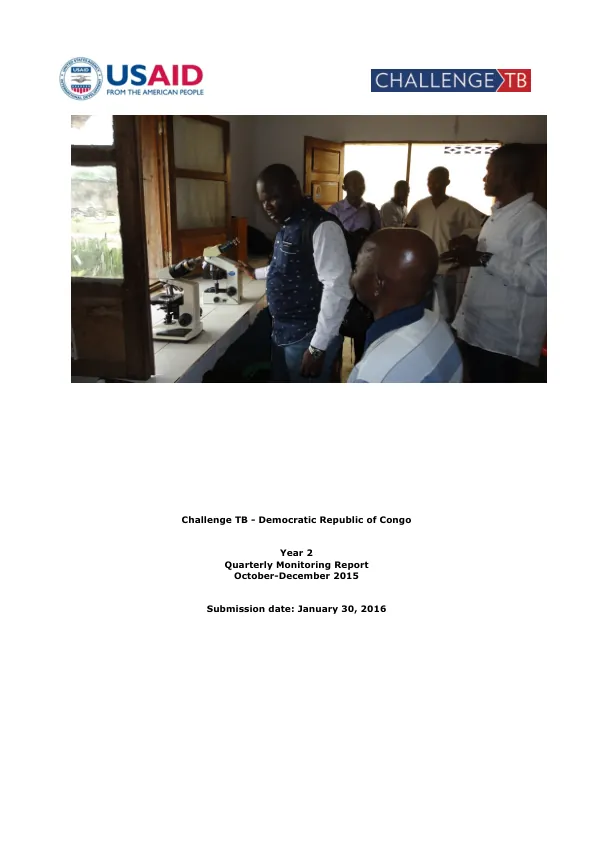
The program's lead partner is The Union, and its workplan timeframe is from October 2015 to September 2016. The reporting period for this quarterly monitoring report is October to December 2015. During this quarter, several key achievements were reported. Three Challenge TB-funded GeneXpert machines were supplied to provincial coordination areas (CPLTs) in Equateur Est, Kasai Occidental Ouest, and Sankuru. These machines were installed with the assistance of a biologist and an IT specialist from the National TB Program (NTP). The new technology will improve access for rapid diagnosis of presumed multi-drug resistant tuberculosis (MDR-TB) patients and allow for earlier treatment initiation among these patients. During this reporting period, 33 patients were diagnosed with TB using Xpert, of whom 3 were rifampicin-resistant (RR-TB) and were directly linked to MDR-TB treatment. Sputum samples were transported with Challenge TB support from several diagnostic centers (CDSTs) to CPLTs to be tested by Xpert. In the 7 Challenge TB-supported CPLTs, 691 sputum samples of presumed tuberculosis (TB) patients, including 348 presumed MDR-TB, were transported, of which 665 (96%) were tested on Xpert. 175 (25%) were confirmed TB, including 11% (20/175) confirmed RR-TB. Active TB case finding activities in the community were continued by the four local partner non-governmental organizations (NGOs). A total of 4,065 sputum samples from presumed TB patients were tested, and 740 (18%) were diagnosed with smear-positive TB and initiated on treatment. Technical support was provided for 13 private health facility structures from 03/12/2015 to 24/12/2015 for the implementation of TB care and prevention activities in four CPLTs. This support was provided jointly by NTP and Challenge TB staff members. The smooth running of these structures will extend the scope of NTP, provide better access to TB diagnosis and care for patients, and strengthen public-private partnership. Chronic cough was the most frequently used symptom to identify presumed TB cases in the private facilities, with other symptoms such as extra-pulmonary TB cases also being used. Post-training supervision visits for childhood TB services were conducted from 1 to 13 December 2015 by a NTP and Challenge TB team in three CDSTs of Kasai Oriental Sud. These visits aimed to strengthen implementation of clinical practices during on-site training. The lessons learnt will be used in the nationwide scaling up of childhood TB services. Technical/administrative challenges and actions to overcome them were also reported. The delayed approval of the work plan for year 2 (APA2) was a major challenge. At the request of USAID, the initial work plan was split into two separate plans and budgets: one dedicated to TB care and prevention activities with Global Health funding and the other dedicated to TB/HIV activities funded by PEPFAR. Meanwhile, monthly requests from October 2015 to date have been submitted and were approved to enable continuation of activities on a monthly basis. The work plan for TB care and prevention activities was partially approved on 05/01/2016. Approval of the work plan and budget for TB-HIV activities is still pending. The positions of Challenge TB Deputy Director and Senior Monitoring and Evaluation Officer are not filled yet. Despite concerted efforts made by The Union's Global Human Resources Department and assistance by Challenge TB PMU, and a significant number of applications and candidates interviewed, none of them met the requirements of the sought-after profile and USAID's criteria. USAID has approved engagement of a recruitment firm to assist the Challenge TB country director to identify suitable persons to fill these two positions in quarter 2. In terms of activity progress, no activities were reported under sub-objective 1. Under sub-objective 2, Comprehensive, high-quality diagnostics, several key activities were planned, including finalizing the National Laboratory Strategic Plan (NLSP) and its implementation, setting up accreditation processes for reference laboratories and peripheral reference laboratories based on Laboratory Quality Management System (LQMS), and revising the national laboratory guidelines and Xpert algorithm in line with the latest global guidelines. However, some of these activities were not met due to the delayed approval of the work plan for year 2 (APA2).
Related documents