KNCV TUBERCULOSIS FOUNDATION
Quarterly Monitoring Report: Challenge TB - Nigeria Year 2 October-December 2015
The Challenge TB project in Nigeria, led by the KNCV Tuberculosis Foundation, aimed to improve TB control and prevention in the country.
2016 · 32 pages
Sign in to readA free account is required to download.
Abstract
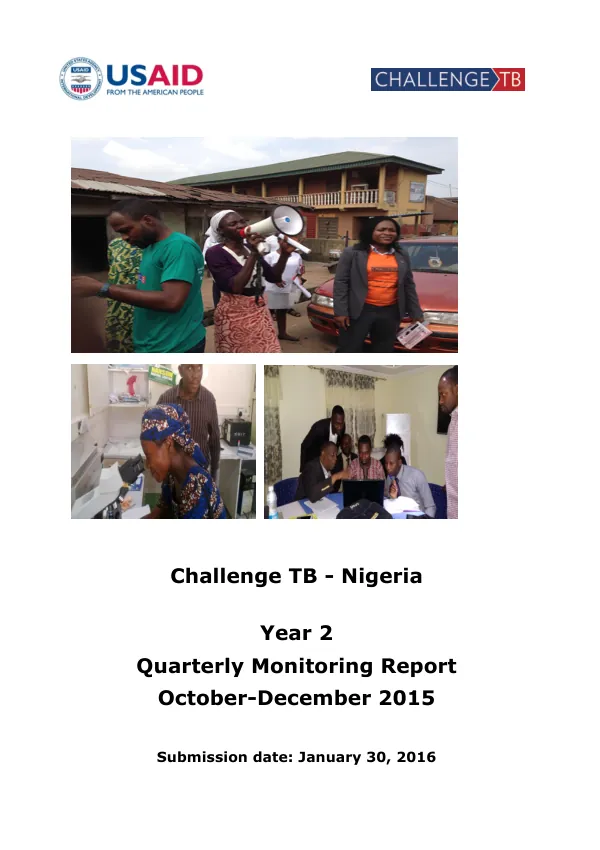
The project's work plan for the period of October 2015 to September 2016 focused on several key areas, including demand creation, improving program quality through supervision, expanding access to diagnosis and TB care services, and expanding community-based care for DR-TB. During the first full quarter of implementation, the project team was able to commence most work plan activities. Demand creation efforts were intensified to raise public awareness of TB and prompt action. Mentoring of State TB teams on effective supervision was also conducted, with visits made to six supported states to assess implementation of CTB activities and review program data. The visits demonstrated the potential of effective supervision to improve program performance rapidly. The project also focused on expanding access to diagnosis and TB care services. Leveraging on the pool of laboratory experts in-country, visits were conducted to identify states for site assessments and installation of GeneXpert machines. In total, 29 sites were assessed and 22 GeneXpert machines were installed across CTB-supported states. To complement this process, visits were conducted to existing laboratory sites to assess their functionality, and 75 non-functional microscopic sites were identified and 33 (44%) were re-activated. In addition, the project expanded community-based care for DR-TB, enrolling a total of 64 DR-TB patients on treatment at the community level during the quarter. Cumulatively, support was being provided for a total of 184 patients receiving treatment in the community, including those discharged from treatment facilities during the quarter. Technical and administrative challenges were also identified during the quarter. In the North region, inadequate human resources for laboratory and DOTS sites inhibited CTB's ability to expand activities as described in the work plan. CTB will continue to actively engage State governments to ensure adequate staffing. In Lagos, the ongoing need of local government officials for strict control over all activities hindered the smooth implementation of the program. CTB will continue to build trust and negotiate with Lagos officials to improve the speed of implementation. Procurement approval delays also slowed the pace of conduct of certain activities. CTB has established three regional offices that provide oversight of CTB-supported states within each region. Without approval for procurement of a vehicle, currently all three regions are constrained due to non-provision (Kano region) and inadequate provision of project vehicle (Akwa Ibom and Lagos regions) making coordination and implementation difficult. In the meantime, CTB has made funds available for car hire but this is an expensive solution in the long term. There is a need to hasten the procurement approval for the delivery of project vehicle. In addition, the project continues to await approval for the procurement of microscopes, which has delayed diagnostic expansion activities. The project also continued to engage community CBOs to conduct outreach activities in the identified hard-to-reach areas in 4 states of Akwa Ibom, Benue, Cross Rivers, and Osun states. In addition, outreach was conducted in Lagos, Ondo, and Rivers states. A total of 20 outreach activities to intensify case finding were held, reaching 753 persons, examining 153 samples using AFB microcopy and GeneXpert, and detecting 22 TB cases and commencing them on treatment. The project also continued to create awareness on TB, signs, and symptoms, and on availability of treatment services in 11 states through radio jingles aired in different languages. A total of 930 radio jingles were aired, including complementary slots provided by the radio stations. In addition, CTB was able to leverage on the existing community gatherings such as market days and festivals to create awareness in the communities by engaging former TB patients as spokespersons.