JSI
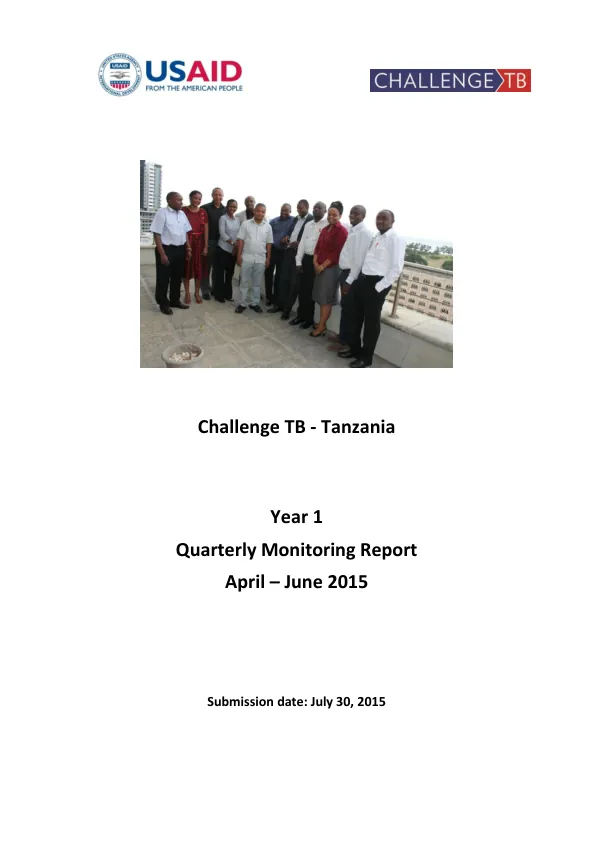
Quarterly Monitoring Report: Challenge TB - Tanzania, Year 1, April – June 2015
The Challenge TB project in Tanzania began in October 2014 with a work plan timeframe of October 2014 to September 2015.
2015 · 17 pages
Sign in to readA free account is required to download.
Abstract
The project's lead partner is KNCV, with other partners including PATH and ATS. The reporting period for this quarterly overview is April to June 2015. Project start-up was delayed, with the work plan being approved in March 2015. Following this, KNCV started recruitment processes and solicitation of office space. The project activities commenced in late May/June 2015 when critical staff positions were on board. A total of 4 staff have been hired to implement the CTB project in 6 regions, namely Dar es Salaam, Pwani, Arusha, Kilimanjaro, Mwanza, and Zanzibar. Implementation of the project's activities was delayed due to the delayed start of implementation. Despite this, several achievements were made during the quarter. The National TB and Leprosy Programme (NTLP) from the Ministry of Health and Social Welfare (MoHSW) was involved in Challenge TB APA1 work plan activities. A courtesy call and introduction meeting was held on 9th June 2015 involving the existing KNCV staff at the time and NTLP staff. During the introductory meeting, the KNCV team shared KNCV's background, the Challenge TB project strategies, and planned activities for year 1. Six GeneXpert machines were distributed and successfully installed in six health facilities under Challenge TB area. A total of 12 laboratory personnel from 6 Hospitals were trained on how to use the GeneXpert machine for detection of MTB/RIF. The training was conducted for five days covering 10 modules for laboratory diagnosis training. This is expected to provide access to rapid testing to about 1,596,000 people in the geographical areas where the facilities are located. A two days' operational TB research meeting was conducted to establish the national TB operational research committee and to set up a national operational research agenda for TB in Tanzania. Participants came from various organizations and government institutions, including representatives from NTLP, regional TB and leprosy coordinators from 3 regions, National Institute for Medical Research (NIMR), and other research institutes. Technical/administrative challenges and actions to overcome them included delayed staff recruitment, which resulted in a delayed start of implementation. Staff recruitment started in March 2015 by hiring the Country Representative followed by other positions. Given the short period of time, there was little time for staff orientation and smooth implementation. With the time constraint, the technical team reviewed the APA1 work plan and prioritized activities that can be implemented in the remaining timeframe and identified activities to be carried over to APA2. Office space was identified but partitioning could not be completed during the quarter in time for the team to move in from the PATH offices, where they were being hosted. Delayed procurement of office equipment and other accessories were also a big challenge and setback for smooth project implementation. A short-term technical person was contracted to provide maintenance services for some of the computers to enable the technical team to make use of them. To overcome this, the project also used other office equipment from PATH office. In the country, a total of 11 out of 66 GeneXpert machines available are not operational for various reasons: 10 awaiting installation by the NTLP and 1 to be installed by KNCV at the site that will be assessed in the next quarter. Most of the activities that were planned for the period of April to June 2015 have been postponed to July-September, 2015. Therefore, much will be reported in the July-September quarterly report. The project's progress in year 1 is as follows: Sub-objective 1. Enabling environment, planned key activities for the current year include supporting implementation of the 2013 ACSM strategy - COMBI focused on key populations. The activity of developing the ACSM training package was partially met, with the draft package collected from NTLP for review and finalization. The actual implementation started in June 15, and the activity will be completed by 30th September, 2015. Sub-objective 2. Comprehensive, high-quality diagnostics, planned key activities for the current year include facilitating (funding and TA) the Laboratory Technical Working Group (TWG) meeting. This activity could not be implemented during the quarter due to delayed commencement of implementation of all activities. The update and finalization of the TB laboratory strategic plan, including the Xpert Roll-out plan, was met, with a one-week workshop conducted and the lab strategic plan finalized and endorsed. The mapping of laboratory (public and private) network was not met, with the activity planned in the next quarter. The technical working group meeting will be implemented in the next quarter, and the mapping tool and protocol will be developed during the TA that will be conducted in August, 2015. The accreditation status assessment from KNCV was completed, but the activity could not be implemented during the quarter.
Related documents