KNCV TUBERCULOSIS FOUNDATION
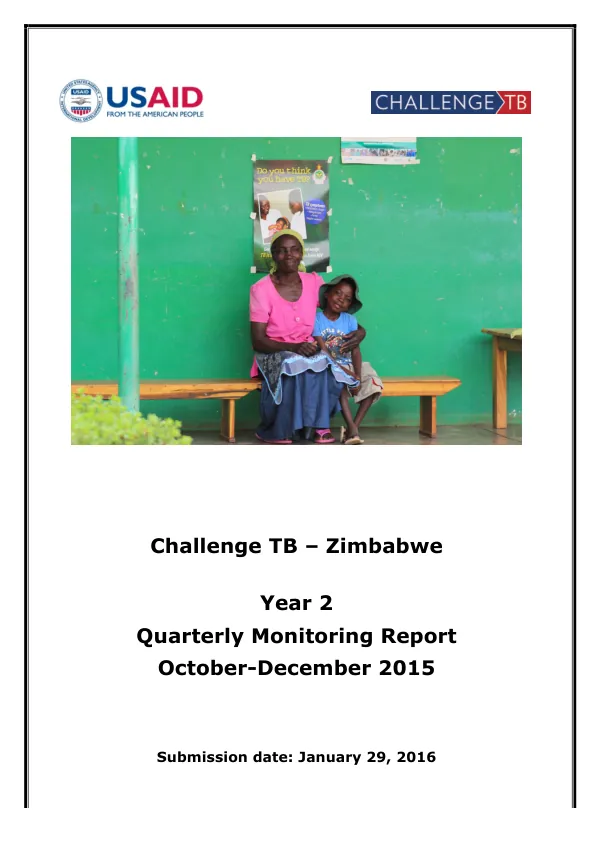
Quarterly Monitoring Report: Challenge TB – Zimbabwe Year 2 October-December 2015
The Challenge TB program in Zimbabwe, led by the International Union Against TB and Lung Disease (The Union), is a collaborative effort with other partners, including KNCV Tuberculosis Foundation, Interactive Research and Development, and the World Health Organization (WHO).
2016 · 36 pages
Sign in to readA free account is required to download.
Abstract
The program's work plan spans from October 2015 to September 2016, with the reporting period covering October to December 2015. A significant achievement during this quarter was the development of a childhood TB desk guide for the Ministry of Health and Child Care (MOHCC). The guide was adapted from The Union's Desk Guide for Management of TB in Children for Health Care Workers, and 2,000 copies were printed to cover all facilities in the country. Additionally, childhood TB training materials were developed using the desk guide, which will be distributed during provincial Childhood TB trainings planned for the second quarter under Global Fund support. The National Tuberculosis control Program (NTP), WHO, and The Union technical officers were supported by Challenge TB to lead the first postgraduate course on innovative TB data management at the 46th World Conference on Lung Health in Cape Town, South Africa. The course introduced the Challenge TB-supported user-friendly guide on the use of routine TB data for program management and decision making. Participants suggested strengthening staff relations and supportive supervision, analyzing data at peripheral levels to inform decision-making, reporting data for childhood TB, and putting in place mechanisms to follow up recommendations of previous support supervision visits. The results of the national prevalence survey completed in 2015 informed the calibration of the estimated TB case detection rate, which was reviewed upward to 70% in 2014. This achievement is partly attributed to the support from Challenge TB and other US-supported grants such as TB CARE I. In recognition of the technical competence of the Challenge TB Zimbabwe country office, The Union has been awarded a Global Fund grant for TB under the New Funding Model as Sub Recipient for community systems strengthening. Additionally, the World Diabetes Foundation has awarded the country office a 2-year grant to pilot the feasibility of integrating TB and Diabetes Mellitus Care in selected primary health facilities. The Challenge TB program has also supported the successful involvement of affected communities in TB care, as showcased at the 46th World Conference on Lung Health. Constance Manwa, a person living positively with HIV, shared her experiences and testimonial of being "cured" from Multidrug-resistant TB (MDR TB). Constance received her MDR-TB and anti-retroviral treatment and support from Mzilikazi Clinic, one of the Integrated TB HIV Care (ITHC) sites supported under Challenge TB. Technical and administrative challenges were encountered during the quarter, including a delay in the implementation of Childhood TB activities supported by Challenge TB in partnership with Maternal and Child Health Intervention Program (MCHIP). The printed revised recording and reporting tools were not adequate to cover all facilities in the country, and certain mandatory indicators were not routinely collected by NTP. Continuous efforts are being made to ensure that these data are collected and reported from Challenge TB-supported areas and/or nationally. The differences in reporting timelines for NTP and Challenge TB resulted in the collection of incomplete data on selected indicators. The installation and use of the District Health Information System (DHIS2) will be supported in Challenge TB Quarter 2, which is expected to significantly improve the timeliness of reporting. The Challenge TB program has made progress in enabling the environment for TB control, including conducting a knowledge, attitude, practice, and behavior (KAPB) assessment to determine the percentage of community with correct knowledge and positive attitude towards people affected by TB. The technical assistance (TA) terms of reference have been developed, and the first draft of the research protocol is in place. A communications strategy has been developed to guide communication interventions for community empowerment in response to TB, and a press conference was held to strengthen coverage of TB, MDR-TB, and TB-HIV activities. The office procured a mobile information booth to be used for information dissemination during events and exhibitions.
Related documents