KNCV TUBERCULOSIS FOUNDATION
TB CARE Annual Work Plan and Budget
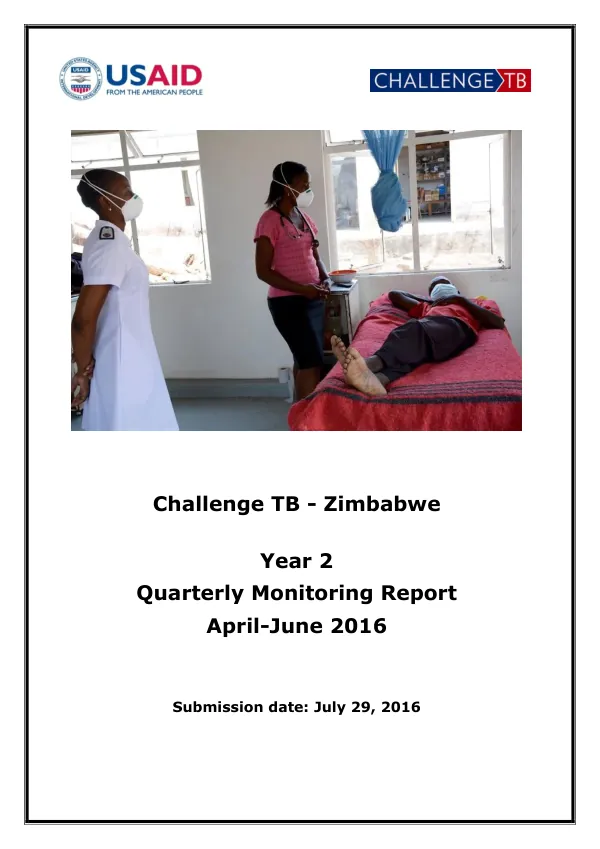
However, this report focuses on the Challenge TB program in Zimbabwe, which is a separate initiative.
2016 · 48 pages
Sign in to readA free account is required to download.
Abstract
The Challenge TB program in Zimbabwe is a collaborative effort between the International Union Against TB and Lung Disease (The Union) and other partners, including KNCV Tuberculosis Foundation (KNCV), Interactive Research and Development (IRD), and World Health Organization (WHO). The program's work plan timeframe is from October 2015 to September 2016, with the reporting period being April to June 2016. During this quarter, the program achieved several significant milestones. The roll-out of the District Health Information Software Version 2 (DHIS2) is progressing successfully, with 80.2% of health facilities having entered their TB data from their quarterly reports into the software. This has enabled the National TB Program (NTP) and other stakeholders to view and analyze data online down to the primary health facility level. The program also supported the development and printing of the first edition of the NTP newsletter, titled "TB News." Two thousand five hundred copies have been printed, and the distribution is ongoing, including online distribution to partners and CTB country directors around the world. The newsletter will be published bi-annually and will be used as a platform for program information dissemination, health education and promotion, advocacy to mobilize domestic resources, as well as enhancing visibility of CTB as a USAID funding mechanism for TB in Zimbabwe. Another significant achievement is the expansion of the Childhood TB intervention package to the community level in Makoni District. A total of 298 community-based health workers (CBHWs) were trained on TB prevention, transmission, treatment, and recording and reporting. The training is anticipated to result in increased community referrals of children with presumptive TB to health facilities. The immediate outcome of this intervention is encouraging, with an observed increase in the proportion of children diagnosed with TB and the absolute numbers of children diagnosed. The program also co-funded an external NTP review that was successfully completed on June 10, 2016. The review team provided technical assistance with additional support from 8 CTB staff. The lead consultant, Dr. Jeremiah Chakaya, was provided through CTB funding. The review highlighted several key areas, including tuberculosis case finding and holding, TB/HIV collaborative activities, programmatic management of drug-resistant TB, and monitoring and evaluation/operations and implementation research. The review team noted several challenges, including uneven coverage of TB/HIV collaborative activities across districts and concerns about the quality of implementation of Isoniazid Preventive Therapy in several districts. However, the program has made significant progress in several areas, including the diagnosis and treatment of drug-resistant TB, with a treatment success rate of 75%. The program is also facing several technical and administrative challenges, including a worsening liquidity crunch in Zimbabwe, which has slowed down implementation of activities. Global Fund late disbursements have also delayed implementation of co-funded activities. The revision of the NTP TB guidelines has been postponed due to the delayed publication of the WHO treatment guidelines, 5th edition. The program's year 2 activity progress is also being monitored, with several key activities planned for the current year. The program has made significant progress in several areas, including the conduct of a knowledge, attitude, practice, and behavior (KAPB) assessment to determine the percentage of community with correct knowledge and positive attitude towards people affected by TB. The KAPB survey report is being finalized, and the survey findings will be used for the development of the TB communications strategy. The program has also made progress in developing a communications strategy to guide communication interventions for community empowerment in response to TB. A consultative stakeholders meeting was conducted, followed by a writing workshop, and the review and adoption of the communication strategy is ongoing.