COUNTER PART INTERNATIONAL
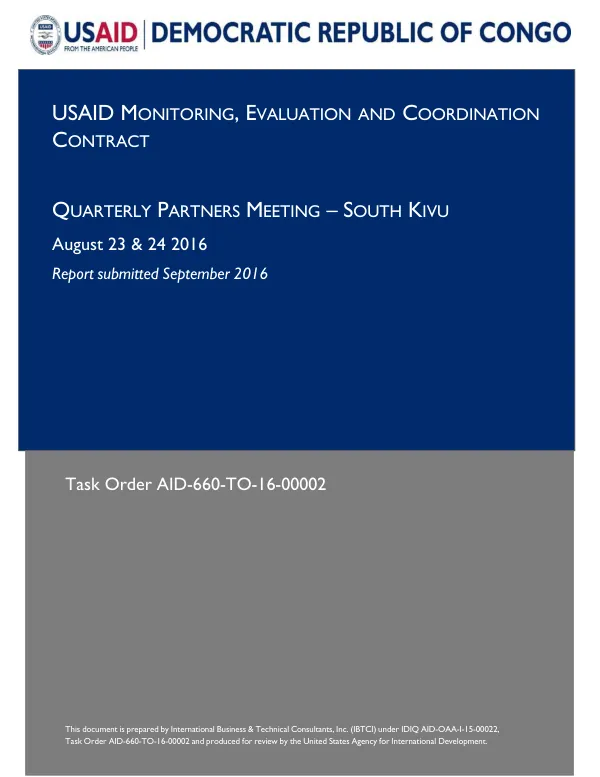
Quarterly Partners Meeting – South Kivu: Activity Report
The quarterly partners meeting for USAID in South Kivu, Democratic Republic of the Congo, took place on August 23 and 24, 2016, in Bukavu.
2016 · 44 pages
Sign in to readA free account is required to download.
Abstract
The meeting aimed to strengthen coordination and collaboration among stakeholders, including USAID staff, implementing partners, and representatives of the Government of the Democratic Republic of the Congo. The meeting began with the introduction of participants and a presentation of the agenda. The first day focused on two key points: training on USAID Environmental Management Compliance and the roll-out of the Performance Management Plan (PMP) of USAID/DRC's Country Development Cooperation Strategy (CDCS). David Kinyua and Diane Mbanzidi of USAID/DRC led the training on USAID environmental compliance, which informed partners of relevant reporting requirements and strengthened their capacity to implement development projects in compliance with environmental protection measures. Key elements of the environmental compliance training included the link between the environment, population growth, climate change, and development, as well as the importance of compliance with environmental procedures by partners implementing projects with funding from USAID. The training also covered pesticides in USAID projects, environmental reporting requirements, and the principles of Integrated Pest Management (IPM). James Mashikano of USAID/DRC's Program Office and Laurent Kopi, DCOP of MECC, presented the CDCS PMP and the role of MECC vis-à-vis PMP performance monitoring, respectively. The CDCS PMP is a tool used by USAID to monitor, evaluate, and learn from interventions. The USAID/DRC CDCS Results Framework includes different levels of objectives and results, and achieving the CDCS goal and Development Objectives (DO)/Technical Objectives (TO) will require rigorous implementation of Monitoring and Evaluation (M&E), learning, and adaptation tools and processes throughout the program cycle. Day 2 was dedicated to joint work planning among USAID projects and an address by provincial government officials. Twelve participants from USAID/DRC, the provincial government, and 47 implementing partners attended the session on the second day. Joint work planning aimed to identify and propose collaborations or joint activities to maximize efficiency and impact. Participants were divided into three thematic groups to identify opportunities for synergies between or among projects. The three working groups identified a total of 17 opportunities for collaboration, which would be sent to MECC for consolidation and onward transmission to USAID. After consolidation, joint plans would be subject to the approval of the COR/AOR of each project before their effective implementation on the ground. Agnes Sadiki Nyabisoki, Minister of Transport, Communication, and Housing and Urban Affairs, addressed the session on behalf of the provincial government, sharing the provincial government's vision for supporting the DRC's development partners, particularly USAID. Several activities were organized around the meeting, including the handover ceremony of medical equipment provided by USAID's PROSANI Plus, presided over by the Provincial Governor and attended by the provincial Minister of Health. Site visits were also organized for activities of the following USAID projects: Congo Democrasia, implemented by Counterpart International; Food for Peace, implemented by Food for Hungry; and ASILI, implemented by the American Refugee Committee. Feedback from participants indicated that over 78.8% of participants reported being very satisfied with the first day of the meeting, and 70% for the second day. Participants appreciated the presentation on joint work planning, and the meeting was closed by the TO3 team leader. MECC provided note-taking, audio recording, and photography to document the meeting.