PLAN INTERNATIONAL USA
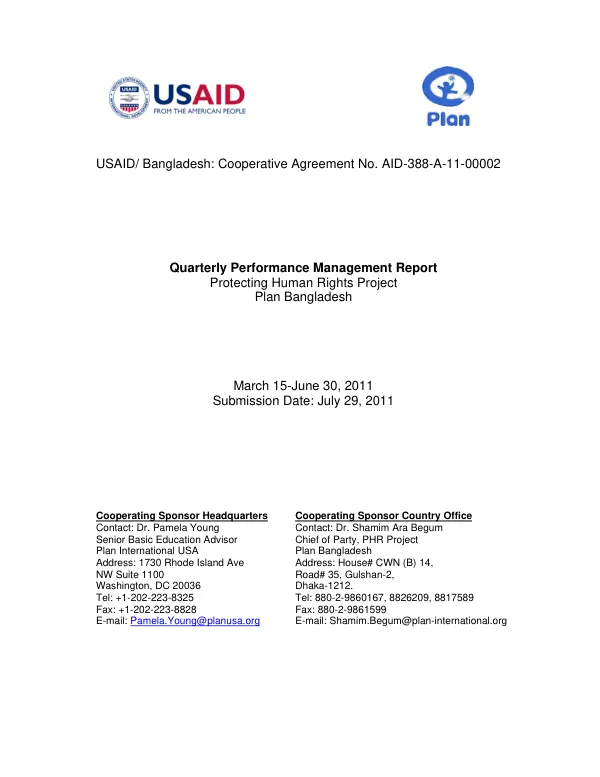
Quarterly Performance Management Report: March-June 2011
Protecting Human Rights (PHR) is a five-year human rights activity project funded by the United States Assistance for International Development/Bangladesh Mission (USAID).
2011 · 28 pages
Sign in to readA free account is required to download.
Abstract
The project began on March 15, 2011, and is contracted to end on March 14, 2016. PHR is being implemented by Plan International/Bangladesh under a Cooperative Agreement with USAID. Plan Bangladesh works with two key partners, Bangladesh National Woman Lawyers' Association (BNWLA) and International Center for Research on Women (ICRW). In addition, Plan will subcontract with 20 local NGOs in the delivery of survivor support services to victims of domestic violence. The goal of PHR is to reduce the high prevalence of domestic violence and other related human rights violations in targeted areas of Bangladesh. To achieve this goal, PHR will engage in an array of activities that will encourage policy reform and advocacy, enhance public awareness, and increase public dialogue between the government and civil society on issues of domestic violence and other associated human rights abuses. Interventions under PHR will include advocating for the Government of Bangladesh to adopt and enforce comprehensive women's rights and domestic violence policies, ensuring that survivors of domestic violence and other related human rights abuses have greater access to justice, and increasing the awareness and capacity of communities throughout Bangladesh to reduce domestic violence. During the first quarter of the project, most of the activities were associated with setting up the PHR project. This included staff recruitment, office set up, procurement of materials, trainings for PHR staff, and the development of the Annual Work Plan, Performance Management Plan, and Crisis Management Plan. The project team was formed, with almost all staff recruited by the end of the quarter. The principal PHR office was set up in the Plan Bangladesh headquarters in Dhaka, and the offices of BNWLA and ICRW were also established. The Annual Work Plan for the first year was developed through close collaboration between Plan Bangladesh, BNWLA, and ICRW, with input from Plan USA staff who traveled to Bangladesh to assist with the work plan development. The draft annual work plan was submitted to USAID/Bangladesh on May 14, 2011, and after incorporating feedback, the final document was submitted on June 30, 2011. USAID/Bangladesh approved the work plan on June 30, 2011. A Performance Management Plan (PMP) was also developed through the participation of staff, partners, and with guidance from USAID/Bangladesh. The PMP was submitted to USAID/Bangladesh and after incorporating their feedback, it was resubmitted on June 30, 2011. The project will work with USAID to finalize the PMP in the early stages of the next quarter to start monitoring activities. A baseline survey will be conducted within 90 days following the approval of the work plan and PMP. Plan Bangladesh and ICRW have undertaken activities during the first quarter to prepare the groundwork for carrying out the baseline survey. A preliminary literature review was conducted to gather information on the prevalence and nature of domestic violence in Bangladesh, as well as legal injunctions and support services and justice mechanisms available. According to the Bangladesh Demographic and Health Survey 2007, more than half of women in Bangladesh who have been married have experienced some form of physical violence or sexual violence. Factors such as illiteracy, working for cash, poverty, rural residence, and early marriage are reported to have an aggravating impact on the experience of violence. Overall, literature points to the fact that domestic violence is widely prevalent in Bangladesh. Although the Domestic Violence Act of 2010 is a positive step, it remains to be operationalized in a manner that establishes a strong institutional mechanism to deal with cases of domestic violence. Efforts must be made to make support services more accessible to survivors of domestic violence, including improving the quality and reach of services and building survivor confidence in the services. A coordinated effort from the government, law enforcement agencies, and civil society is required to combat domestic violence successfully.