THE INTERNATIONAL CENTER FOR RESEARCH ON WOMEN
Quarterly Performance Management Report: Protecting Human Rights (PHR) Program
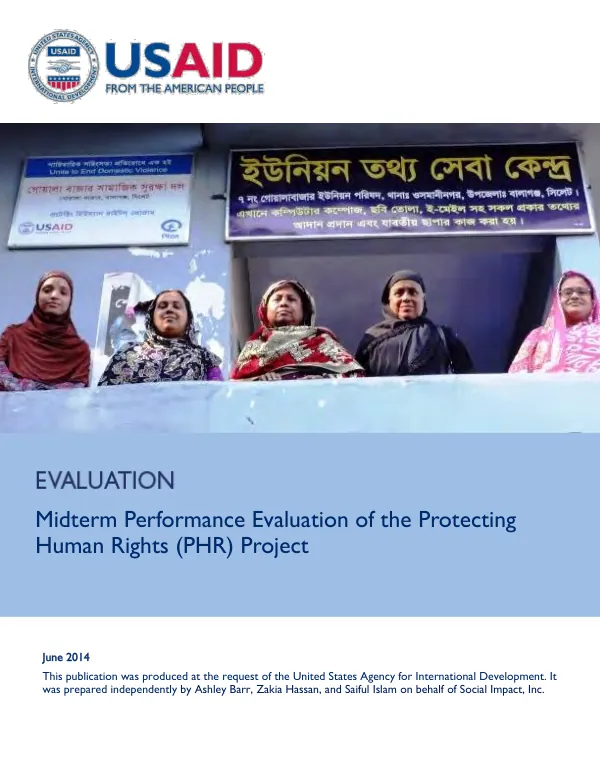
The Protecting Human Rights (PHR) Program is a five-year domestic violence prevention and protection program implemented by Plan International Bangladesh, with the support of the USAID.
2015 · 101 pages
Sign in to readA free account is required to download.
Abstract
The program focuses on 102 unions and eight upazilas of six districts in Bangladesh, including Barguna, Bogra, Chittagong, Dinajpur, Jessore, and Sylhet. The primary goal of the PHR program is to reduce domestic violence and related human rights abuses in the targeted areas. To achieve this goal, the PHR program is designed around four Intermediate Results (IRs): IR 1, which involves enforcing key domestic violence and human rights legislation and policies; IR 2, which aims to increase the use of formal and informal justice systems by survivors of human rights abuses; IR 3, which focuses on providing support services to survivors of human rights abuses; and IR 4, which seeks to improve public awareness on human rights issues. The PHR program is implemented through five major components: advocacy for law reform and enforcement to reduce domestic violence; capacity building of key stakeholders involved with the protection and promotion of human rights; increasing access to justice for survivors of human rights abuses; providing survivor services for the needs of survivors of domestic violence and human rights abuses; and building mass awareness and implementing educational campaigns on domestic violence and other human rights abuses. To achieve success in its mission, the PHR program emphasizes the importance of forming partnerships, alliances, and collaborations with local and national government representatives, non-governmental organizations, and community leaders. These partnerships foster preventive and protective measures, promote legal and human rights, and develop linkages between local and national government representatives, non-governmental organizations, and community leaders. During the first quarter of Program Year Five, the PHR program continued to work towards its goal of reducing domestic violence and related human rights abuses in the targeted areas. The program's activities during this period included capacity building of key stakeholders, increasing access to justice for survivors of human rights abuses, providing survivor services, and building mass awareness and implementing educational campaigns on domestic violence and other human rights abuses. The PHR program also continued to work in partnership with the Bangladesh National Woman Lawyers' Association (BNWLA) and sub-grants to 11 local partner NGOs to carry out specific tasks at the district, upazila, and union levels. These partnerships enabled the program to reach a wider audience and to implement its activities more effectively. The PHR program's efforts during the first quarter of Program Year Five were focused on achieving the program's Intermediate Results (IRs) and major program components. The program's activities during this period included: * Advocacy for law reform and enforcement to reduce domestic violence * Capacity building of key stakeholders involved with the protection and promotion of human rights * Increasing access to justice for survivors of human rights abuses * Providing survivor services for the needs of survivors of domestic violence and human rights abuses * Building mass awareness and implementing educational campaigns on domestic violence and other human rights abuses * IR 1: Key domestic violence and human rights legislation and policies enforced * IR 2: Increased use of formal and informal justice systems by human rights abuse survivors * IR 3: Increased support services to human rights abuse survivors * IR 4: Public awareness on human rights issues improved The PHR program's efforts during the first quarter of Program Year Five were focused on achieving the program's goal of reducing domestic violence and related human rights abuses in the targeted areas. The program's activities during this period were designed to achieve the program's Intermediate Results (IRs) and major program components, and to build partnerships and alliances with local and national government representatives, non-governmental organizations, and community leaders.