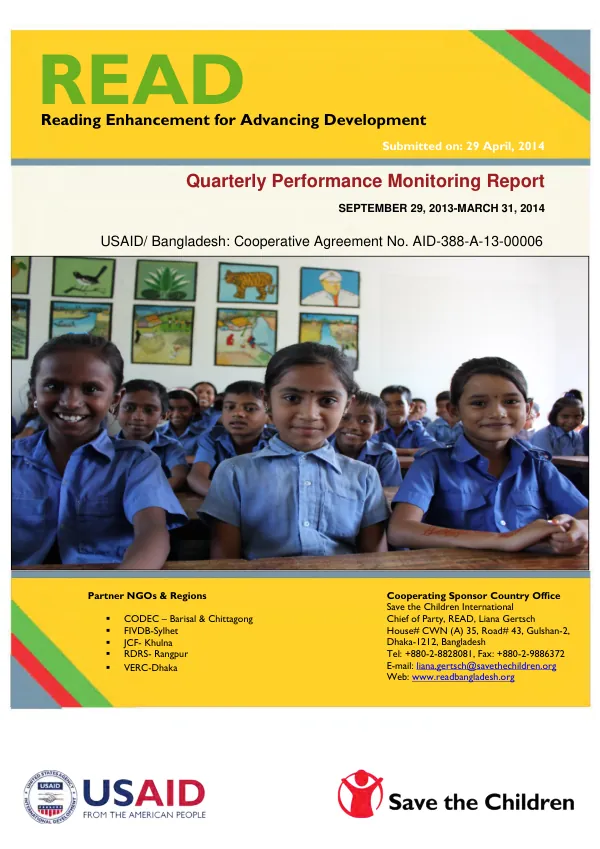
SAVE THE CHILDREN FUND
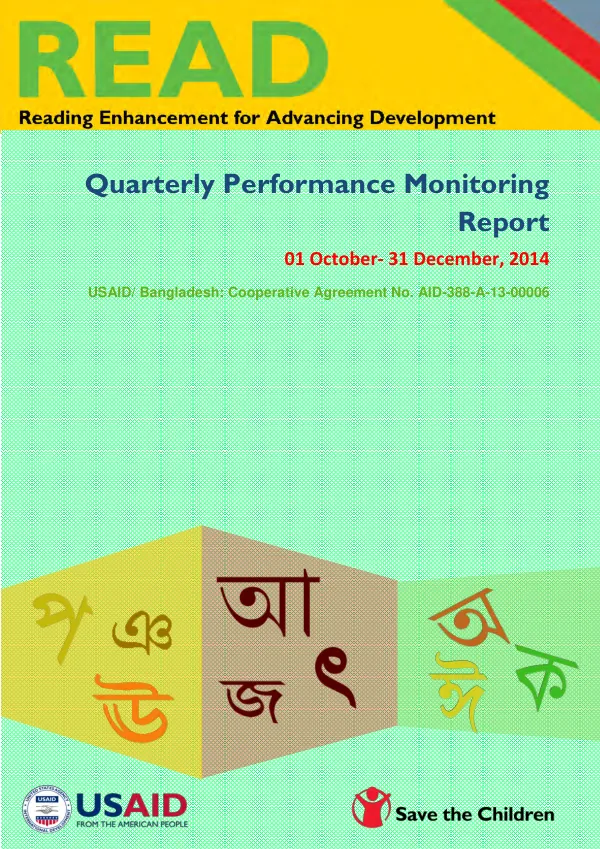
Quarterly Performance Monitoring Report 01 October- 31 December, 2014
Improved evidence-based, interactive early grades literacy instruction is a key focus area for the READ project in Bangladesh.
2014 · 20 pages
Sign in to readA free account is required to download.
Abstract
The project's Reading Instruction Manual was developed in 2014, taking into account the national curriculum and textbooks. The manual provides a framework for teachers to deliver interactive and engaging literacy instruction to grade 1-3 students. The manual includes examples of lesson plans, instructional strategies, and assessment tools to support teachers in improving reading outcomes. The manual was reviewed to ensure that it explicitly refers to curricular and textbook content, in light of the Government's introduction of a new curriculum and textbooks for grades 1-3 in 2015. The review aimed to ensure that the manual remains relevant and effective in supporting teachers to deliver high-quality literacy instruction. The revised manual is expected to be widely disseminated to teachers and schools, and will be used as a key resource in the project's efforts to improve reading outcomes. The READ project has also developed a range of teaching-learning materials that are designed to support the implementation of the revised Reading Instruction Manual. These materials include lesson plans, instructional guides, and assessment tools that are tailored to the needs of grade 1-3 students. The materials are being piloted in a selection of schools and will be refined and disseminated to all project schools in 2015. The project's efforts to improve evidence-based, interactive early grades literacy instruction are being closely monitored and evaluated through the use of diagnostic tools and formative assessments. The project is working closely with the Directorate of Primary Education and the Reading Advisory Committee to ensure that the instruction is aligned with national standards and that teachers are well-supported in their efforts to improve reading outcomes. The READ project has also made significant progress in increasing the use of early grade reading assessment. The project has developed a range of assessment tools, including the Early Grade Reading Assessment (EGRA), which is being used to measure reading outcomes in grade 1-3 students. The EGRA is a comprehensive assessment tool that measures reading fluency, comprehension, and vocabulary skills. The project has also developed an Instructional Adjustment Tool (IAT) that is being used to support teachers in adjusting their instruction to meet the needs of individual students. The IAT is a diagnostic tool that provides teachers with information on student reading strengths and weaknesses, and suggests instructional strategies that can be used to support student learning. The project's efforts to increase the use of early grade reading assessment are being closely monitored and evaluated through the use of data from the EGRA and other assessment tools. The project is working closely with the Directorate of Primary Education and the Reading Advisory Committee to ensure that the assessment is aligned with national standards and that teachers are well-supported in their efforts to improve reading outcomes. The READ project has also made significant progress in expanding the provision and use of relevant and appropriate supplementary materials. The project has developed a range of supplementary materials, including leveled books, that are designed to support the implementation of the revised Reading Instruction Manual. The materials are being piloted in a selection of schools and will be refined and disseminated to all project schools in 2015. The project's efforts to expand the provision and use of supplementary materials are being closely monitored and evaluated through the use of data from the EGRA and other assessment tools. The project is working closely with the Directorate of Primary Education and the Reading Advisory Committee to ensure that the materials are aligned with national standards and that teachers are well-supported in their efforts to improve reading outcomes. The READ project has also made significant progress in strengthening community support for early grade literacy. The project has established a range of community-based initiatives, including reading camps and community reading festivals, that are designed to promote a love of reading among grade 1-3 students. The initiatives are being closely monitored and evaluated through the use of data from the EGRA and other assessment tools. The project's efforts to strengthen community support for early grade literacy are being closely monitored and evaluated through the use of data from the EGRA and other assessment tools. The project is working closely with the Directorate of Primary Education and the Reading Advisory Committee to ensure that the initiatives are aligned with national standards and that teachers are well-supported in their efforts to improve reading outcomes. The READ project has also made significant progress in scaling up its interventions and delivering quality services to a wider range of schools and communities. The project has established a range of partnerships with local organizations and government agencies, including the Directorate of Primary Education and the Reading Advisory Committee, to support the implementation of its interventions. The project's efforts to scale up its interventions are being closely monitored and evaluated through the use of data from the EGRA and other assessment tools. The project is working closely with its partners to ensure that the interventions are aligned with national standards and that teachers are well-supported in their efforts to improve reading outcomes. The READ project has also made significant progress in responding to diversity and meeting the needs of a range of different learners. The project has developed a range of initiatives, including the use of ICT in multimedia-equipped classrooms and the provision of supplementary materials in local languages, that are designed to support the learning needs of students
Related documents