USAID DEC
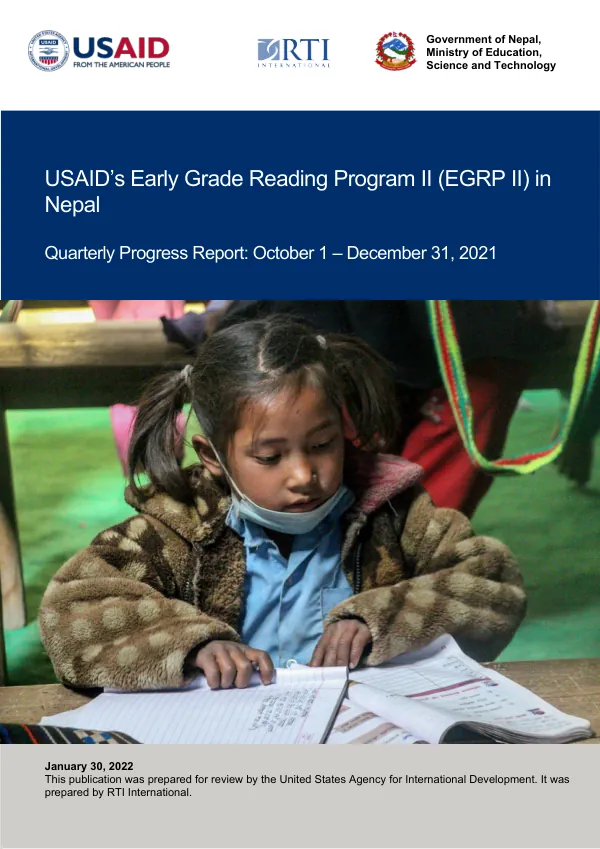
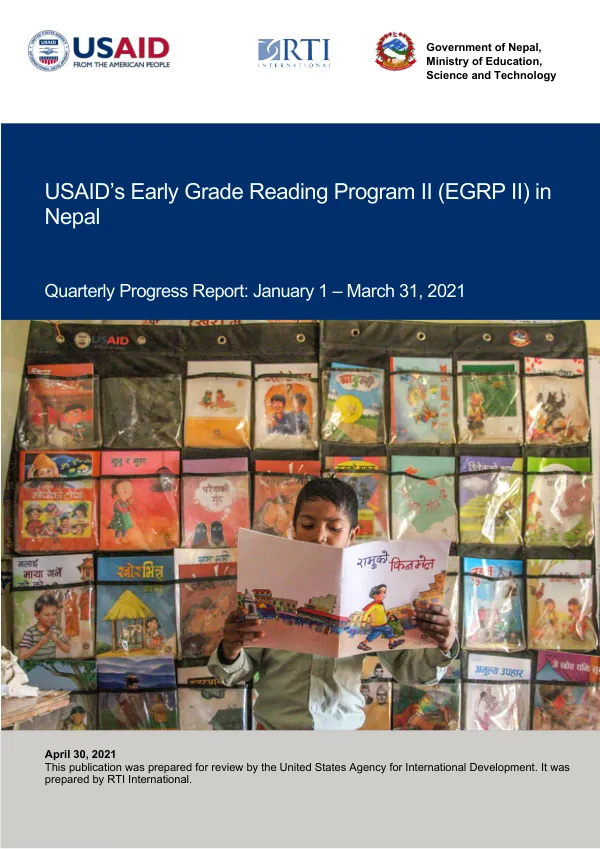
Quarterly Progress Report: January 1 – March 31, 2021 for USAID’s Early Grade Reading Program II (EGRP II) in Nepal
Sign inGOVERNMENT OF SENEGAL
Quarterly Progress Report: January 1 – March 31, 2021 for USAID’s Early Grade Reading Program II (EGRP II) in Nepal
The Early Grade Reading Program II (EGRP II) in Nepal is a USAID-funded initiative aimed at improving reading skills among early grade students.
2021 · 80 pages
Sign in to readA free account is required to download.
Abstract
The program began in 2020 and is implemented by RTI International. The program's primary objective is to support the development and rollout of the Integrated Curriculum (IC) and scale up Early Grade Reading (EGR) services. Implementation of the program is focused on four key objectives. Objective 1 involves supporting the rollout and implementation of the IC, as well as continuing to scale up EGR services. This includes supporting the Ministry of Education, Science and Technology (MOEST) in policy and planning for the National Early Grade Reading Program (NEGRP). Objective 2 focuses on building municipal- and provincial-level capacity for delivering EGR services, including providing capacity building for local government officials and LEU staff, supporting local governments to develop policies and costed plans for NEGRP, and promoting data-driven decision making. Objective 3 aims to improve local governments' ability to provide Training and Performance Support (TPS), coaching, mentorship, and supervision. This includes supporting the Council for Education and Human Resource Development (CEHRD)/Human Resource Development Division (HRDD) to revise TPS guidance and incorporate a menu of options, as well as training and support for LEU staff to use the TPS guide and resource materials. Objective 4 focuses on supporting continuity of learning in response to the COVID-19 pandemic, including EGR learning engagement for students during extended school closures, preparing for EGR instruction upon schools' reopening, and planning for possible school re-closures. The program has made significant progress in the first quarter of 2021. A total of 22,000 students have been reached through the program, with 15,000 students receiving EGR instruction. The program has also supported the development of training resource materials, with 22 participants from various backgrounds and organizations involved in the workshop. Additionally, the program has conducted joint monitoring visits, with 15 participants from different organizations and professions participating in the visits. The program has also made progress in terms of digital lesson development and review, with 10 digital lessons developed and reviewed. The program has also conducted a baseline study, with a sample size of 1,500 students in the first phase and 1,000 students in the second phase. The program has also supported the development of policies and costed plans for NEGRP, with 22 local-level participants and events planned for Round 2 of the local capacity development workshops. The program has also faced several challenges, including the COVID-19 pandemic, which has disrupted school operations and affected the program's implementation. The program has also faced challenges in terms of procurement and logistics, as well as information technology. However, the program has implemented mitigation strategies to address these challenges, including remote work arrangements and the use of digital tools to support program implementation. The program's finance and expenditure status is also being closely monitored. The program has a total budget of $10 million, with $5 million allocated for the first quarter of 2021. The program has also planned activities for the next quarter, including the development of training resource materials and the conduct of joint monitoring visits. Overall, the EGRP II program in Nepal has made significant progress in the first quarter of 2021, with a focus on supporting the development and rollout of the IC and scaling up EGR services. The program has also faced several challenges, but has implemented mitigation strategies to address these challenges. The program's finance and expenditure status is also being closely monitored, with a focus on ensuring that the program is implemented efficiently and effectively.