USAID DEC
Quarterly Performance Report #5: January 1 – March 31, 2015 for Governance for Inclusive Growth Program, Vietnam
Sign inCHEMONICS
Quarterly Performance Report #5: January 1 – March 31, 2015 for Governance for Inclusive Growth Program, Vietnam
The Governance for Inclusive Growth (GIG) program in Vietnam is a USAID-funded initiative aimed at improving governance and promoting inclusive growth.
2015 · 73 pages
Sign in to readA free account is required to download.
Abstract
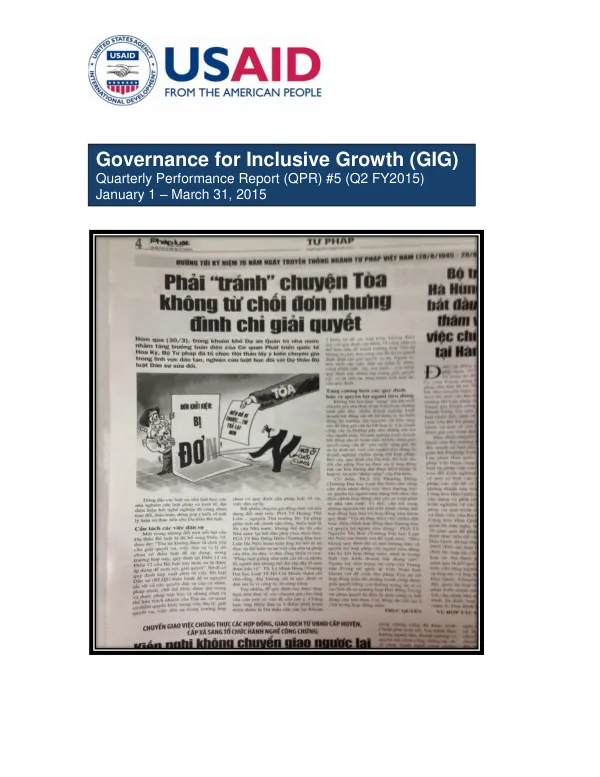
The program is implemented by Chemonics International Inc. and focuses on three key components: improving legal and regulatory frameworks, improving accountability of public institutions, and improving inclusion and equality for marginalized groups. Component 1, Improving Legal and Regulatory Frameworks, has made significant impacts in Q2 FY 2015. The program has supported the development of a revised civil code, which was consulted with legal experts and academia. The event was covered by Phap Luat Vietnam, a prominent Vietnamese newspaper. The program has also provided technical assistance to the Ministry of Justice to improve the country's legal framework. Component 2, Improving Accountability of Public Institutions, has also achieved notable results in Q2 FY 2015. The program has supported the development of a performance monitoring plan for the Ministry of Finance, which aims to improve the ministry's accountability and transparency. The program has also provided training to public officials on financial management and accountability. Component 3, Improving Inclusion and Equality for Marginalized Groups, has focused on promoting gender equality and social inclusion. The program has supported the development of a gender impact assessment tool, which aims to promote gender equality in policy-making. The program has also provided training to women entrepreneurs on business skills and access to finance. Implementation opportunities and challenges in Q2 FY 2015 included the need to improve the program's monitoring and evaluation system, as well as the need to increase the program's engagement with civil society organizations. The program also faced challenges in accessing data and information from government agencies. The program has made significant progress in achieving its key results, including the development of a revised civil code, the improvement of the country's legal framework, and the promotion of gender equality and social inclusion. The program has also established partnerships with key stakeholders, including government agencies, civil society organizations, and the private sector. The program's performance is monitored and evaluated through a performance monitoring plan, which tracks the program's progress against its key results. The program also conducts regular data quality assessments to ensure the accuracy and reliability of its data. The program has a strong management structure, with a program management unit that oversees the program's implementation. The program also has a robust monitoring and evaluation system, which tracks the program's progress and identifies areas for improvement. The program has a number of annexes that provide additional information on its implementation, including annex 1, which provides information on the program's personnel and their level of effort, and annex 2, which provides information on the program's short-term technical assistance and local assignments.
Related documents