CATHOLIC RELIEF SERVICES ORGANIZATION
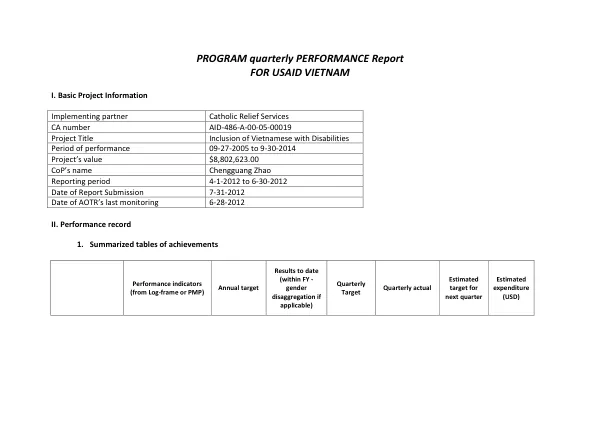
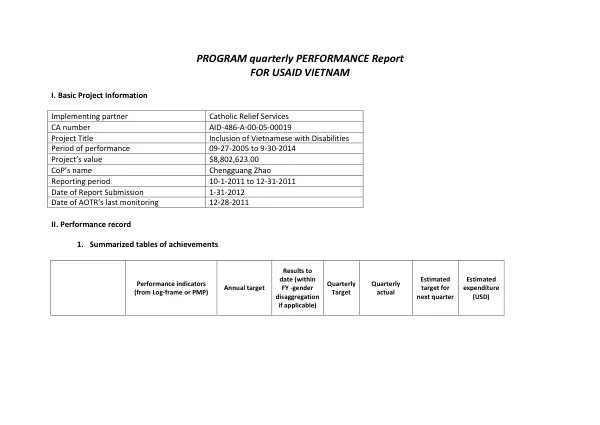
Semi Annual/Annual Programme Report for USAID Vietnam
The Inclusion of Vietnamese with Disabilities program, implemented by Catholic Relief Services, aims to improve the education and employment opportunities for youth with disabilities in Vietnam.
2012 · 17 pages
Sign in to readA free account is required to download.
Abstract
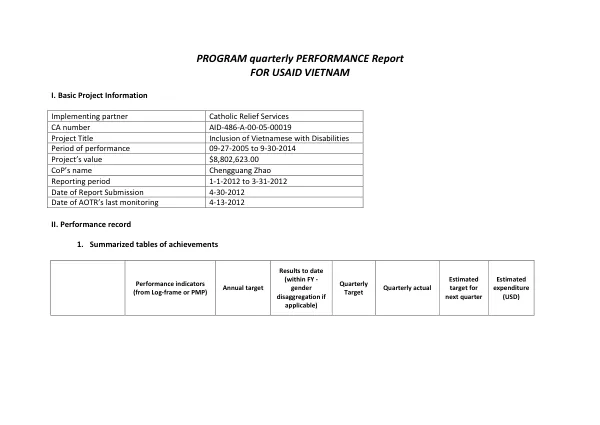
The program, funded by USAID, began in 2005 and concluded in 2014. During the reporting period, January 1 to March 31, 2012, the program focused on implementing various interventions to achieve its objectives. One of the key interventions was the establishment of the Inclusive Training and Technical Assistance Program (ITTP) in Danang. The program aimed to provide training and support services to service providers, including university teachers, managers, and government officials, to enhance their knowledge and skills in providing inclusive education services to students with disabilities. Although the program faced delays in obtaining project approvals, significant progress was made during the reporting period. Dong A University was selected as the partner institution, and an exchange trip was organized for 5 staff members to visit ESTIH. Facilities were selected, renovation blueprints were developed, and budgets were prepared. Linkages to businesses and DPOs were initiated, and the program aimed to launch ITTP in Danang. The program also focused on providing quality training and support services to ITTP students. During the reporting period, 3 classes of 68 students (26 female) started training at VLU, and 3 classes of 80 students (23 female) started training at ESTIH. The program aimed to recruit 140 students in the next quarter, with 2 classes of 47 students (16 female) starting training at VLU in graphic design and AED, and 2 classes of 50 students (12 female) starting training at ESTIH in graphic design and AED. The program also explored an outreach model to provide IT training at the provincial level. In addition to the ITTP, the program also focused on providing soft skills training to students. During the reporting period, 21 students at VLU participated in soft skills training, while the 30 students at ESTIH had just started classes and had not received soft skills training yet. The program aimed to continue soft skills training for all students, with a target of at least 80% of students demonstrating improved knowledge. The program also made progress in developing guidelines for integrating ICT into the education system. The Ministry of Education and Training (MOET) drafted 4 action plans for piloting ICT solutions, and CRS worked with MOET to develop detailed plans for project activities. A consultative meeting was organized with MOET steering committee leaders and secretariat members, and a working group was set up to facilitate project implementation. Overall, the program made significant progress during the reporting period, despite facing some delays and challenges. The program's interventions aimed to improve the education and employment opportunities for youth with disabilities in Vietnam, and the progress made during the reporting period brought the program closer to achieving its objectives. The program's performance indicators showed that at least 80% of ITTP students demonstrated improved soft skills, and at least 190 students completed long-term IT training. The program also aimed to recruit 140 students in the next quarter and to provide soft skills training to all students. The program's online library was also developed, with at least 50 people downloading materials from the library, and at least 100 people visiting the library per month. The program's budget for the reporting period was $6424, and the estimated expenditure for the next quarter was $0. The program's overall performance was satisfactory, and the program aimed to continue making progress in the next quarter to achieve its objectives.
Related documents