UNIVERSITY RESEARCH CORPORATION CO., LLC
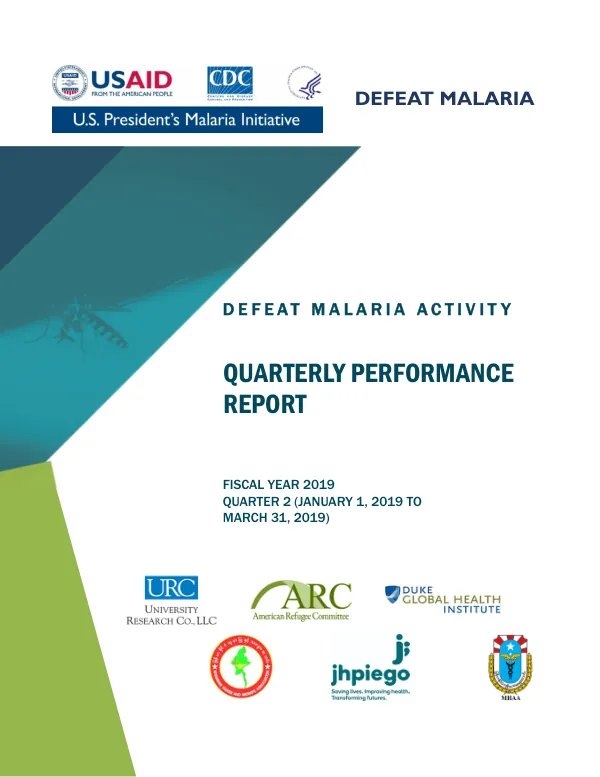
Quarterly Performance Report: Defeat Malaria Activity FY2019 Q2
Defeat Malaria is a USAID-funded project aimed at reducing the malaria burden and controlling artemisinin-resistant malaria in targeted areas of Myanmar.
2019 · 60 pages
Sign in to readA free account is required to download.
Abstract
The project has four core objectives: achieving and maintaining universal coverage of at-risk populations with proven vector control and case management interventions, strengthening the malaria surveillance system, enhancing technical and operational capacity of the National Malaria Control Programme (NMCP) and other health service providers, and promoting the involvement of communities, private healthcare providers, private companies, and state-owned enterprises in malaria control and elimination initiatives. The project's geographic focus is on the entire country of Myanmar, with a particular emphasis on the Rakhine State. As of March 2019, Defeat Malaria activities were implemented in 15 states and regions, with a total of 61,817 people tested for malaria during the second quarter of fiscal year 2019. Of those tested, 721 were positive cases, resulting in a total positivity rate of 1.17%. The project's implementation focused on several key interventions, including the distribution of 114,175 rapid diagnostic tests (RDTs) and 8,144 artemisinin-based combination therapies (ACTs) to Defeat Malaria storage sites. Additionally, 2,022 health workers received refresher trainings on malaria diagnostics and case management, and 80,515 long-lasting insecticide nets (LLINs) were distributed to villages, worksites, and women attending antenatal care clinics. The project also implemented a direct observation treatment (DOT) program, which enrolled 510 individuals and achieved a treatment completion rate of 97.8%. Furthermore, 46,468 people, including 7,422 migrants, were reached through interpersonal communication and health education. The project's surveillance system was strengthened through the implementation of a routine data quality assessment, which revealed a high level of data quality across all states and regions. The project also conducted an entomological survey on persistent malaria transmission methods and findings, which identified several key areas for further investigation. The project's capacity building efforts focused on enhancing the technical and operational capacity of the NMCP and other health service providers. This included the provision of training and technical assistance to health workers, as well as the distribution of equipment and supplies. The project's advocacy efforts focused on promoting the involvement of communities, private healthcare providers, private companies, and state-owned enterprises in malaria control and elimination initiatives. This included the conduct of advocacy meetings and the development of strategies to address mid-term evaluation recommendations. Overall, the Defeat Malaria project made significant progress in reducing the malaria burden and controlling artemisinin-resistant malaria in targeted areas of Myanmar during the second quarter of fiscal year 2019. The project's implementation of key interventions, strengthening of the surveillance system, and capacity building efforts all contributed to this progress.
Related documents