FHI 360
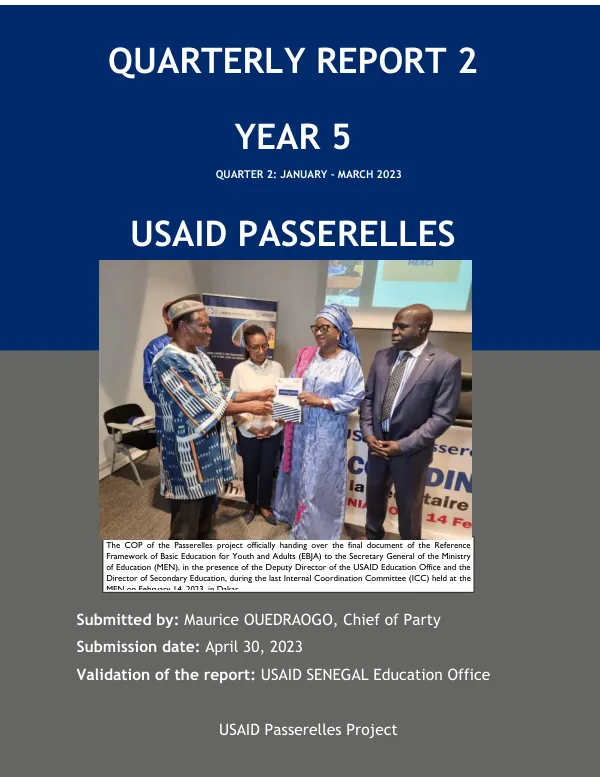
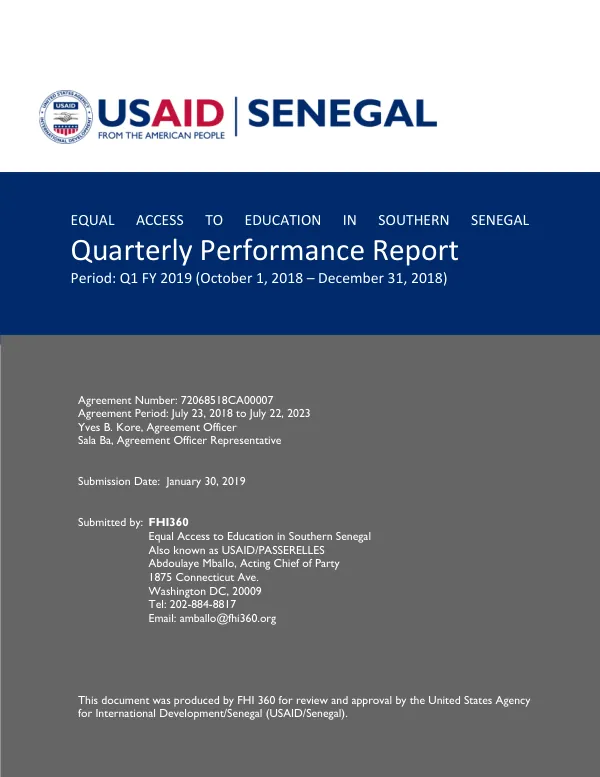
Quarterly Performance Report: Equal Access to Education in Southern Senegal
The Equal Access to Education in Southern Senegal program, also known as USAID/PASSERELLES, is a five-year cooperative agreement with a budget of $24,817,054.
2019 · 36 pages
Sign in to readA free account is required to download.
Abstract
The program aims to support the Ministry of Education and regional and local governments in providing quality basic education to girls and boys aged 9 to 16 in the Casamance and Kedougou regions of Senegal. The program has four outcomes: strengthened education systems, improved instruction of relevant life skills, transition from primary to middle school, and increased engagement of youth to take positive actions to promote enrollment and retention in responsive education services. The program has four outcomes, each with specific objectives and indicators. Outcome 1 aims to strengthen education systems by strengthening the regulatory framework on basic education within the Ministry of Education and throughout the middle school transition from primary to middle school. Outcome 2 aims to improve instruction of relevant life skills in the final two years of primary school. Outcome 3 aims to reduce institutional barriers for children to transition from primary to middle school. Outcome 4 aims to increase the engagement of youth to take positive actions to promote enrollment and retention in responsive education services. The program has several key stakeholders, including the Ministry of Education, regional and local governments, communities, and parents. The program also has several partners, including Save the Children, ENDA Jeunesse Action, and Humanity & Inclusion. The program's geographic coverage includes the Casamance and Kedougou regions of Senegal. The program's quarterly performance report for the first quarter of FY 2019 covers the period from October 1, 2018 to December 31, 2018. The report provides an overview of the program's operational and management performance during this period. The report also highlights the activities and interventions carried out during this period for each of the four outcomes. During the first quarter of FY 2019, the program's regional bureau emphasized the importance of key program management features and functions for program implementation. The program's staff received coaching on several aspects, including prime award management, which involves linking work plans and budgets. The coaching aimed to promote understanding of the cooperative agreement's requirements and increase compliance with funder rules and regulations. The program's regional bureau also noted that the transportation allowance for recipients traveling from a distance was excessive and not reasonable, as it exceeded current market prices. The program's staff were advised to review the main clauses of the prime award contracting mechanism and ensure that the program pipeline is used to track progress in program implementation. The program's quarterly performance report also highlights the activities and interventions carried out during this period for each of the four outcomes. The report provides a summary table of quarterly performance, which highlights the activities carried out during this period and identifies reasons for delays or not meeting established goals. The program's quarterly performance report also includes a discussion of challenges and constraints that could impact the successful attainment of outcomes. The report highlights the importance of addressing these challenges and constraints to ensure the program's success. Overall, the Equal Access to Education in Southern Senegal program aims to provide quality basic education to girls and boys aged 9 to 16 in the Casamance and Kedougou regions of Senegal. The program has four outcomes, each with specific objectives and indicators, and several key stakeholders and partners. The program's quarterly performance report for the first quarter of FY 2019 provides an overview of the program's operational and management performance during this period and highlights the activities and interventions carried out during this period for each of the four outcomes.
Related documents