MINISTRY OF EDUCATION
Quarterly Report 2, Year 5: January - March 2023
The USAID Passerelles project is a 5-year cooperative agreement with a total budget of $24,817,054.
2023 · 28 pages
Sign in to readA free account is required to download.
Abstract
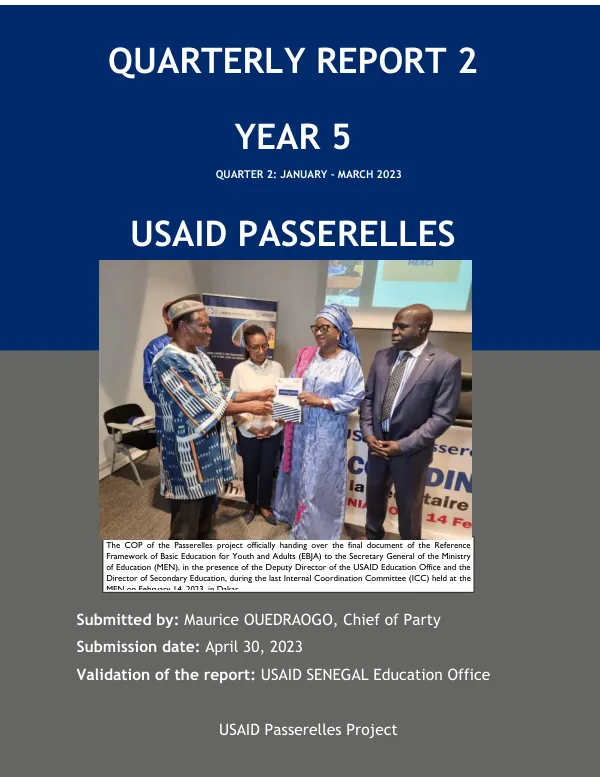
The project aims to improve access to quality education for youth and adults in Senegal. The project is implemented by USAID and is focused on four main components: complementary education services, formal basic education, transition from elementary to middle school, and families and guardians enrolling children in appropriate educational services. The project has made significant progress in the second quarter of year 5, with key activities including the partnership review meeting with the Academy Inspectors in Tambacounda, the Internal Coordination Committee (ICC) meeting chaired by the Secretary General of the Ministry of Education, and the Regional Steering Committee (CPR) meeting in Kolda. These meetings were rich exchanges of information between the project and the intervention partners, with a strong recommendation for more communication about the achievements of the USAID Passerelles Project. Project communication activities focused primarily on producing newsletters and communication materials, with materials produced for activities conducted with the Ministry of Education and in the regions. Rehabilitation for the second phase of the project is underway, with a satisfactory completion rate. The project has also increased the number of qualified teams at all construction sites to achieve the deadline for structural work. Regarding financial management, total expenditures and accruals as of March 31, 2023, are $21,440,321, with a burn rate of 91% of fund obligations. Total Passerelles obligations are $23,563,111.40. An analysis of the project pipeline and request for increased fund obligations has been submitted to USAID. In terms of non-formal education activities, the quarter was marked by the continuation of youth training activities within the framework of the protocol with 3FPT. In terms of formal education activities, the quarter was devoted to the capitalization of the project's innovations and the finalization and integration of the SENPROF and FOAD online platforms into the Ministry of Education's online platform. The project has also focused on coaching teachers and facilitators, the implementation of codes of conduct, and remediation. The codes of conduct are being implemented in the schools of the "flagship" communes in all regions, and the project team is conducting follow-up meetings to ensure proper implementation. School directors and facilitators attended pedagogical animation cells (CAPs), which refocused activities and strengthened the facilitators' capacities to conduct them with fewer difficulties. The results of these CAPs resulted in a clear improvement in student performance in mathematics from 23 to 55% as revealed by results from the post-test. The project's Power BI dashboard shows that coaching visits were not conducted with the same intensity/frequency across regions, due to various reasons including calendar conflicts, teachers' strikes, unrest, and social tension in the field. The project has developed a close-out plan and is implementing the auditors' recommendations regarding financial management. The project will continue to implement the close-out activities, including the progressive closure of regional offices and the release of staff.