FAMILY HEALTH INTERNATIONAL
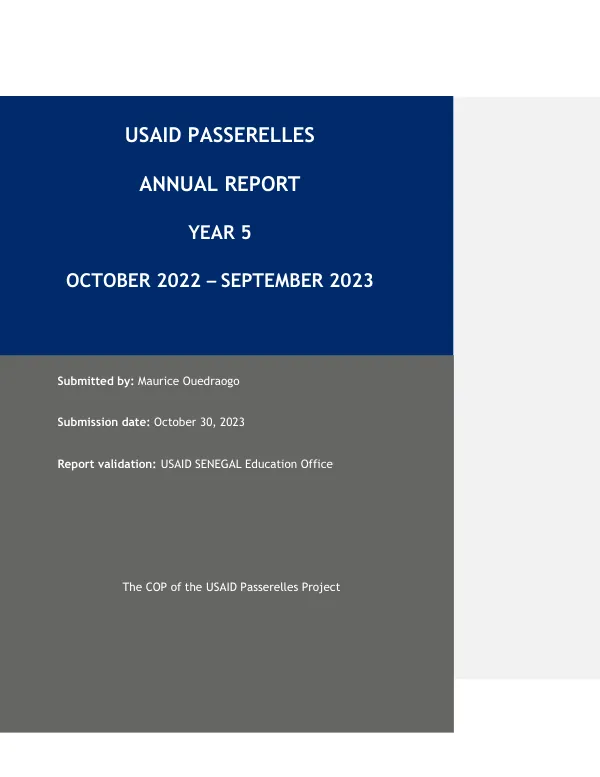
Annual Report: USAID Passerelles Project Year 5 (October 2022 – September 2023)
The USAID Passerelles project is a five-year initiative aimed at improving education outcomes in Senegal.
2023 · 30 pages
Sign in to readA free account is required to download.
Abstract
The project's primary objective is to enhance access to quality education for marginalized populations, particularly in rural areas. The project's scope encompasses four key components: complementary education services, formal basic education, transition from primary to secondary school, and families and guardians enrolling children in appropriate educational services. Component 1 focuses on strengthening the regulatory framework for community-based education (CBE) within the Ministry of Education. This involves increasing the provision of instruction in basic literacy, numeracy, and relevant life skills. The project also aims to make CBE free from school-related gender-based violence and more inclusive of marginalized populations. In Year 5, the project strengthened the regulatory framework on CBE, increased the provision of instruction in basic literacy, numeracy, and relevant life skills, and made CBE more inclusive of marginalized populations. Component 2 targets formal basic education, with a focus on improving instruction of relevant life skills in the final two years of primary education and throughout middle school. The project also aims to reduce school-related gender-based violence in formal basic education and strengthen the capacity of deconcentrated and decentralized regional education authorities. In Year 5, the project improved instruction of relevant life skills, reduced school-related gender-based violence, and strengthened the capacity of regional education authorities. Component 3 focuses on the transition from primary to secondary school, with a goal of reducing institutional barriers for children to transition from primary to middle school. The project also provides remedial education in the formal education system for learners in the upper grades of primary school. In Year 5, the project reduced institutional barriers for children to transition from primary to middle school and provided remedial education for learners in the upper grades of primary school. Component 4 targets families and guardians, with a focus on increasing their knowledge of and value for education. The project also aims to increase parents' and caregivers' financial resources for education and engage daara religious leaders in community education and formal education. In Year 5, the project increased parents' and caregivers' knowledge of and value for education, increased their financial resources for education, and engaged daara religious leaders in community education and formal education. The project's infrastructure rehabilitation component involved the construction and rehabilitation of 72 classrooms and learning rooms, as well as 56 hygiene blocks. The project also implemented codes of conduct in schools in flagship communes in all regions and held meetings to monitor their application. The project's monitoring and evaluation component involved the use of Power BI dashboards to track progress and identify areas for improvement. The project's communication activities focused on highlighting its achievements through the production of newsletters and communication media. In collaboration with the Ministry of Education, the project produced a 13-minute video summarizing its achievements in the four intervention regions, as well as nine thematic videos on community daara management, vocational training, the community approach, safe learning environments, remediation, and more. The project's financial management was marked by a disbursement rate of 95 percent, with $23,563,111 disbursed out of a total project budget of $24,817,054. The project's completion rate was also 95 percent, with $22,396,446 spent out of the total disbursed.
Related documents