USAID DEC
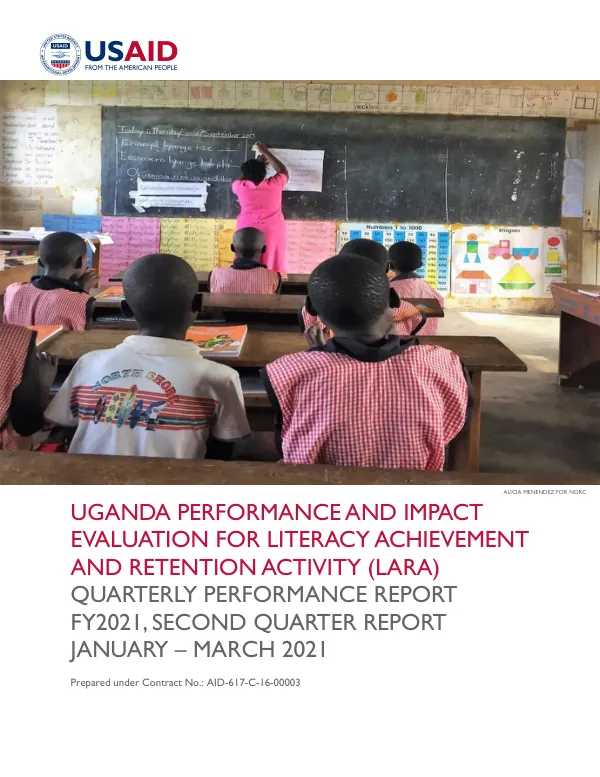
Quarterly Performance Report FY 2021, Second Quarter Report January-March 2021: USAID/Uganda Performance and Impact Evaluation for Literacy Achievement and Retention Activity (LARA)
Sign inCENTER FOR EDUCATIONAL DEVELOPMENT
Quarterly Performance Report FY 2021, Second Quarter Report January-March 2021: USAID/Uganda Performance and Impact Evaluation for Literacy Achievement and Retention Activity (LARA)
The Literacy Achievement and Retention Activity (LARA) in Uganda is a 6-year USAID-funded initiative to improve reading skills for 1.3 million learners in 28 districts.
2021 · 40 pages
Sign in to readA free account is required to download.
Abstract
The project, implemented by RTI International, aims to support the Ministry of Education and Sports (MoES) in improving early grade reading (EGR) and retention. LARA has two main objectives: Result 1 (R1) focuses on strengthening the capacity of MoES and other educational stakeholders to deliver EGR, while Result 2 (R2) focuses on promoting a safer primary school learning environment to prevent and reduce incidents of school-related gender-based violence (SRGBV). The activity hypothesizes that reducing SRGBV will increase learners' retention because they will be able to focus on their lessons and feel secure in their learning environment, thereby improving their ability to learn to read. To realize these objectives, the activity focuses its efforts on systemic capacity building of the education system, school-level support, and community- and household-level support and participation. The Uganda LARA Performance and Impact Evaluation (P&IE) activity has two objectives: (1) to assess the impact of LARA on learners' literacy skills and retention rates; and (2) to assess the performance of LARA in terms of project management, learning, design, implementation, results, and sustainability. The P&IE activity is focused on LARA cluster 2 schools, located in areas where two languages dominate: Luganda and Runyankore-Rukiga. Randomization of treatment assignment was conducted at the coordinating center tutors (CCT) level, assigning the entire cluster of schools under a CCT to treatment T1 (receiving R1 EGR activities only), treatment T2 (receiving R1 EGR + R2 SRGBV activities), or the control group (receiving no activities). During the first quarter of FY2021, NORC and USAID/Uganda continued to be in constant and direct communication to finalize the work plan for Year 5 of the LARA P&IE. Virtual meetings were held on February 3rd and February 5th, to discuss final details which allowed NORC to finalize the proposed work plan based on the Mission's needs. NORC submitted Deliverable 29 which includes the Year 4 Annual Report and Year 5 Work Plan on February 10th. COR Jill Jupiter-Jones, approved it on February 12th. NORC hosted two learning workshops to discuss the P&IE findings, conclusions, and recommendations (FCR). On February 22nd, NORC presented the P&IE FCRs to around 20 representatives of USAID/Uganda, LARA, and ICYD, among others. The presentation summarized the research and evaluation work conducted under the P&IE and presented empirical evidence based on data collected between 2017 and 2019. NORC's presentation was recorded and USAID/Uganda shared the video with everyone that had been invited to the February 22nd session to allow those that could not attend the meeting to see the presentation. Later, on March 11th, the participants reconvened for a Questions and Answers (Q&A) session. NORC uploaded the 2019 data and corresponding code books to the DDL in February 2021. This was followed by uploading all the baseline data and corresponding files associated with the 2017 data collection. Finally, NORC uploaded to the DDL the LARA P&IE retention and attendance data collected each term from Term 1 2017 to Term 1 2020; and the classroom observation data collection in October each year of 2017, 2018, and 2019. The major accomplishment of this past quarter was the submission and approval of Deliverable 29, Year 4 Annual Report and Year 5 Work Plan, as well as the submission and approval of Deliverables 34 and 35, FY2020 Fourth Quarter Report and FY2021, First Quarter Report. NORC also hosted two learning workshops, consisting of two sessions: a presentation of P&IE FCRs and a Q&A session about P&IE FCRs.