USAID DEC
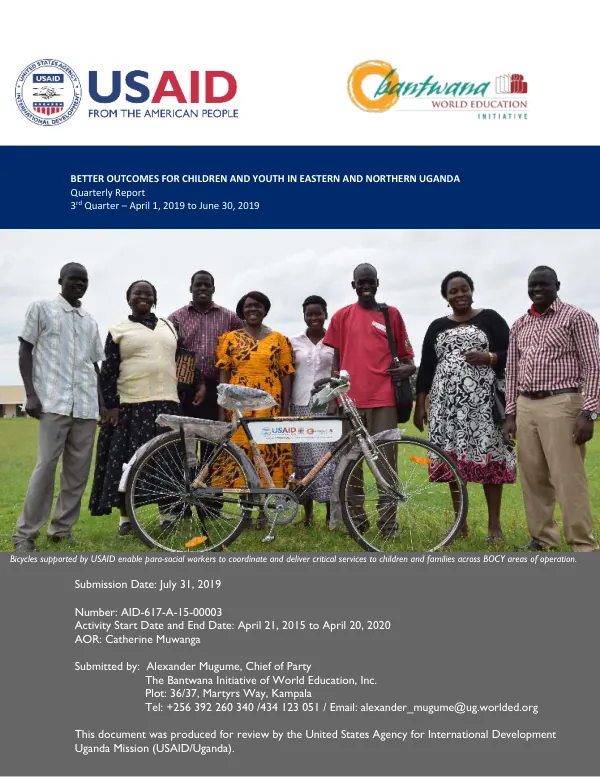
Better Outcomes for Children and Youth in Eastern and Northern Uganda Quarterly Report
Sign inUSAID/UGANDA
Better Outcomes for Children and Youth in Eastern and Northern Uganda Quarterly Report
The Better Outcomes for Children and Youth in Eastern and Northern Uganda project, led by The Bantwana Initiative of World Education, Inc., aims to improve the wellbeing of children and youth orphaned and made vulnerable by HIV and other adversities across 221 districts and 107 sub-counties in Uganda.
2019 · 33 pages
Sign in to readA free account is required to download.
Abstract
Since 2015, the project has worked within the PEPFAR framework to deliver and coordinate a comprehensive package of services across the HIV continuum. In the third quarter of 2019, the project deepened prevention and 95-95-95 goals across the HIV continuum, particularly around linking, and adherence to treatment and viral load suppression. BOCY strengthened its case management approach for improved HIV outcomes for children by strengthening facility-community referral systems, building of staff and community structures in prevention and response to HIV and GBV, and recruiting and placing linkage facilitators in facilities to support CSOs to improve ART service linkages and viral load suppression. The project supported 130,470 OVC and caregivers, reaching 95% of the target, including 19,086 PLHIV (21% OVC) from 12,285 HHs. To ensure comprehensive support, 68% of OVC received three or more services, and 32% received one to two services. The project intensified prevention (risk avoidance/reduction) activities through the DREAMS and OVC initiatives, reaching 50,657 youth (35% AGYW). In line with the first 95, BOCY carried out integrated community and HIV risk screening activities in collaboration with clinical partners, referred 661 at-risk OVC for HIV testing, and linked five children that tested positive for treatment. The project also supported 14,603 beneficiaries (64% F) with economic strengthening activities, 2,630 caregivers (81% F) of children under the age of five with ECD, and 14,233 caregivers and children, including 2,195 male caregivers. BOCY supported 12,415 beneficiaries (54% F) to access health, education, and nutrition support through a VSLA+ fund. The project accelerated DREAMS layering achievements through DREAMS “Boot Camp,” reaching 28,664 and 51% completing the primary package. The project has made significant progress in improving the wellbeing of OVC and caregivers, with 95% of OVC receiving services, and 68% receiving three or more services. The project has also intensified prevention activities, reaching 50,657 youth, and supported 14,603 beneficiaries with economic strengthening activities. However, the project faces challenges in graduation from vulnerability, with only 1.5% of households graduating in the third quarter. The project has refined strategies to meet Q4 targets, including improving tracking and follow-up, and transitioning from THETA to AVSI in Lira, Kole, and Dokolo districts. The project has also strengthened facility partnerships and trained and mentored staff and community structures in case management for HIV+ beneficiaries. As a result, profiled and self-reported CLHIV on ART increased from 3,622 in Q2 to 4,077 (100%) in Q3, with 2,157 (53%) having viral load tests, 1,970 (91%) receiving VL results, 1,751 (88.8%) CLHIV reporting as suppressing, and 219 (11.2%) CLHIV being non-suppressing.