USAID DEC
Quarterly Performance Report Tahafuz: Building Resilience through Community Based Disaster Risk Management in the Sindh Province of Pakistan
Sign inUSAID DEC
Quarterly Performance Report Tahafuz: Building Resilience through Community Based Disaster Risk Management in the Sindh Province of Pakistan
The Tahafuz project, "Building Resilience through Community Based Disaster Risk Management in the Sindh Province of Pakistan," was initiated on January 1, 2015, and is expected to be completed by June 30, 2016.
2016 · 6 pages
Sign in to readA free account is required to download.
Abstract
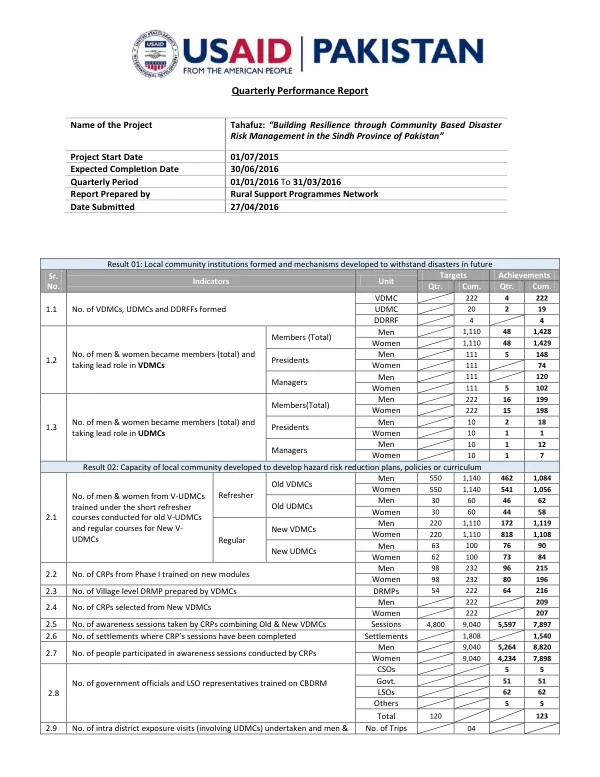
The project aims to establish local community institutions that can withstand disasters in the future. During the reporting quarter, January 1, 2016, to March 31, 2016, the Rural Support Programmes Network (RSPN) achieved the planned target of forming 222 Village Disaster Management Committees (VDMCs). These committees have representation from each settlement in the revenue village, with at least 10 members, including half women. A total of 1,429 women became members of the VDMCs, with 79 taking lead roles as Presidents and 102 serving as Managers. The VDMCs are responsible for providing a platform where communities can meet, share views, identify local hazards, and develop strategies to deal with them. The committees also engage community members in developing coordination with government, line agencies, and other stakeholders to handle unforeseen situations at the tehsil or district level. The Union Disaster Management Committees (UDMCs) have also been formed, with a total of 198 women participating. The UDMCs play a vital role in engaging community members in early preparedness and disaster risk reduction activities. RSPN organized different sets of trainings for both VDMC and UDMC members, focusing on Participatory Disaster Risk Assessment (PDRA), Disaster Risk Assessment & Planning (DRM&P), and Basic Life Support - BLS. The trainings provided knowledge on how to conduct disaster risk assessments using different tools, identify hazards, conduct capacity assessments, and provide basic life support. A total of 2,226 community members, including half women, received training on PDRA and DRM&P. Two days refresher training programs were also organized for already trained VDMC members to refresh their knowledge on PDRA and DRM&P. RSPN also provided training on Organizational Management & Development (OM) and Advocacy & Networking (A&) for selected UDMC members. The training enhanced leadership skills, financial management, planning, advocacy, and networking skills, as well as effective communication with relevant stakeholders. The VDMC members formulated Disaster Risk Management Plans for their respective revenue villages, increasing their resilience by acquiring relevant knowledge and better coping strategies against untoward situations. RSPN achieved the quarter target of 54 DRMPs, with a total of 216 plans developed by VDMC members. RSPN also achieved the target of identifying 302 planned Community Critical Infrastructures (CCIs), which were basically derived from the DRMPs. The social, technical, and financial feasibilities for 289 CCIs have been completed, and RSPN initiated physical work on 191 schemes during the reporting quarter. However, the completion of 131 schemes is behind the set targets. RSPN has highlighted this issue with RSPs' senior management and stressed the need to expedite work on CCIs to ensure their completion within the project period. The project has also focused on Disaster Risk Reduction (DRR) awareness sessions and Community Resource Persons (CRPs). RSPN selected two members, one male and one female, as CRPs from all VDMCs. These individuals were selected based on a pre-post assessment of a five-day training program for VDMCs. The CRPs were tasked with delivering DRR awareness sessions at the grass-root level in target settlements. During the reporting quarter, RSPN provided one-day training on added chapters of the CRP manual to already selected CRPs of Tahafuz I&II. A total of 103 CRPs were trained on new topics, including gardening, health, and health-related issues. The project has also focused on mobilization, mobilization provides a smooth interaction between an organization and the community. RSPN under the Community Based Disaster Risk Management project organizes target communities into community institutions at two different administrative levels, Village Disaster Management Committees (VDMCs) and Union Disaster Management Committees (UDMCs). RSPN has also focused on training of trainers for staff, with a total of 40 staff members trained on Organizational Management & Development (OM) and Advocacy & Networking (A&). The training enhanced leadership skills, financial management, planning, advocacy, and networking skills, as well as effective communication with relevant stakeholders. The project has also focused on Community Critical Infrastructures (CC