RAINFOREST ALLIANCE
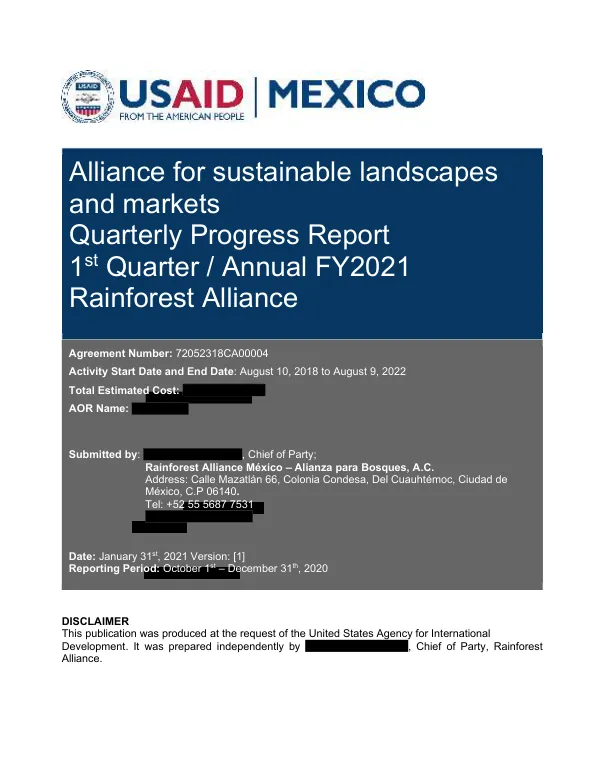
Quarterly Progress Report: Alliance for Sustainable Landscapes and Markets
The Alliance for Sustainable Landscapes and Markets activity began on August 10, 2018, and is set to conclude on August 9, 2022.
2021 · 41 pages
Sign in to readA free account is required to download.
Abstract
The activity aims to reduce deforestation pressures and expand forest conservation and restoration in high deforestation risk production landscapes in Campeche, Quintana Roo, Chiapas, and Oaxaca. The geographic areas of focus include Quintana Roo, Campeche, Chiapas, and Oaxaca, with specific locations such as Bacalar, Chetumal, Felipe Carrillo Puerto, and Othón P. Blanco in Quintana Roo, and Calakmul in Campeche. At the start of the 2021 implementation year, the challenges and uncertainties arising from the COVID-19 pandemic remained in place. These included restrictions on in-person meetings, public events, national or international travel, and training workshops with large groups of participants. In response to this context, the current workplan for 2021 reflects the restriction of field activities during the first two quarters and implementation of activities that can be pursued through virtual collaborations. The activity has strengthened the economic viability of sustainable farming and forestland management by building the capacity of local producer associations, cooperatives, ejidos, and community businesses to manage their agroforestry and forestlands more sustainably and productively. In Campeche and Quintana Roo, an alliance with Alianza Selva Maya has improved the technical capabilities of the wood producers, the development of new furniture prototypes, and the development of their business operations. In Chiapas, the activity has improved partners' production practices, business skills, and access to finance and preferable markets, increasing the economic viability and resiliency of coffee farming, restoring land, and further reducing deforestation. In Oaxaca, the activity is being developed in the three main coffee-producing regions in the state, with partner CEPCO carrying out restoration practices at the cooperative and individual producer level, improving their capacities for producing coffee and new markets for their product. Throughout this quarter, due to continuing COVID-19 restrictions, activities in the field were implemented by local CEPCO technicians and members of the communities. Local production of native species for reforestation and restoration of productive landscapes in Oaxaca continued, with CEPCO technicians and community members maintaining local nurseries to ensure production of native species for the coming year. CEPCO technicians also led trainings with members of the participating communities on seed selection and plant maintenance. Reforestation efforts were successful, with 25 hectares of degraded land reforested in four communities: San Agustín Loxicha, Santiago Atitlán, Santa María Zoogochi, and San José Zaragoza. An additional 35 hectares are in the process of identification for reforestation in the coming year using the region's degradation analysis developed in FY20.