MIYAMOTO INTERNATIONAL, INC.
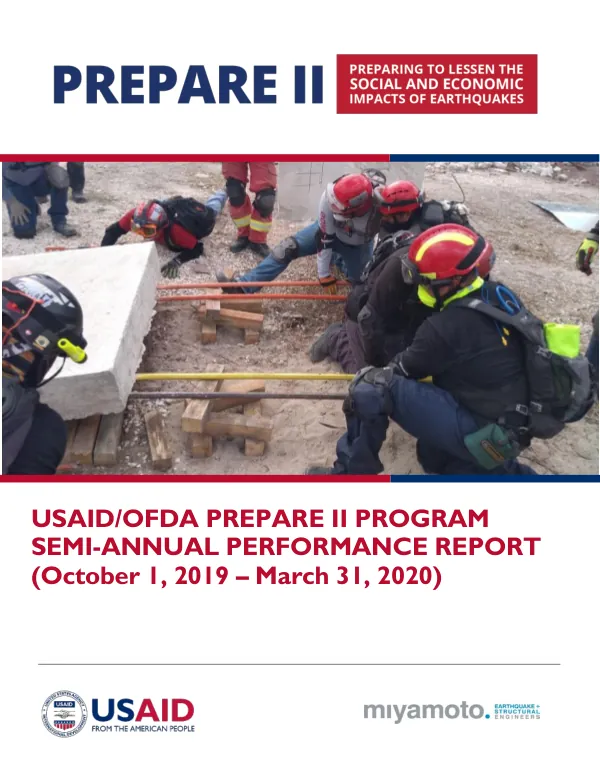
USAID/OFDA PREPARE II Program Semi-Annual Performance Report
The USAID/OFDA PREPARE II Program officially launched on September 25, 2018, with a grant agreement preceded by a pre-award letter issued on April 19, 2018.
2019 · 19 pages
Sign in to readA free account is required to download.
Abstract
The program is implemented by Miyamoto International over a 27-month period in five locations: San Jose, Costa Rica; Pasto, Colombia; Zapopan, Mexico; Mexico City, Mexico; and San Salvador, El Salvador. The program's end date is July 18, 2020. The PREPARE II strategy emphasizes multi-stakeholder engagement to strengthen emergency response capacity and reduce risks from seismic and other natural hazards. The program works with a range of public sector institutions, including ministries of housing, public works, health, and the environment, as well as civil protection units and emergency response commissions. Private sector partners include leaders and technical experts from academia, engineering, and architecture associations, NGOs, and the business community. The program also strives to facilitate cooperation between international and national-level experts in the dissemination and application of global best practices in emergency response and disaster risk reduction (DRR). Miyamoto engineers and DRR specialists share their expertise from participation in more than 100 earthquakes globally to facilitate technical and capacity building assistance for seismic risk modeling, structural vulnerability and damage assessments, debris management planning, and Urban Search and Rescue (USAR) capacity strengthening. The PREPARE II program design and implementation emphasize an integrated approach with the objective of enhancing synergies and economies of scale between four distinct, but complementary, components: seismic risk assessment, rapid damage assessments (RDA) systems and capacity strengthening, advanced draft debris management (DM) strategy, and USAR capacity strengthening. Data and findings from the seismic risk assessment inform policy and planning priorities for emergency response and DRR, which in turn inform a strategy for technical and capacity building assistance to strengthen planning and delivery of RDA, DM, and USAR support activities. During the reporting period from October 1, 2018, to March 31, 2019, the program achieved significant results in terms of stakeholder engagement and capacity building. In Costa Rica, 30 people participated in discussions regarding national risk reduction strategies, exceeding the target by 106%. In Colombia, 29 people participated, exceeding the target by 146%. In Mexico, 31 people participated in Mexico City, exceeding the target by 124%, and 74 people participated in Zapopan, exceeding the target by 123%. In El Salvador, 38 people participated, exceeding the target by 105%. The program also trained a significant number of people in disaster preparedness, mitigation, and management. In Costa Rica, 34 people were trained, exceeding the target by 176%. In Colombia, 37 people were trained, exceeding the target by 190%. In Mexico, 0 people were trained in Mexico City, but 52 people were trained in Zapopan, exceeding the target by 173%. In El Salvador, 23 people were trained, exceeding the target by 76%. Overall, the program trained 116 people, exceeding the target by 132%. The program's implementation challenges during the reporting period included limited resources and capacity constraints in some locations. However, the program is working to address these challenges through continued stakeholder engagement and capacity building.