DAIRY AND RURAL DEVELOPMENT FOUNDATION
Quarterly Progress Report: Dairy Project
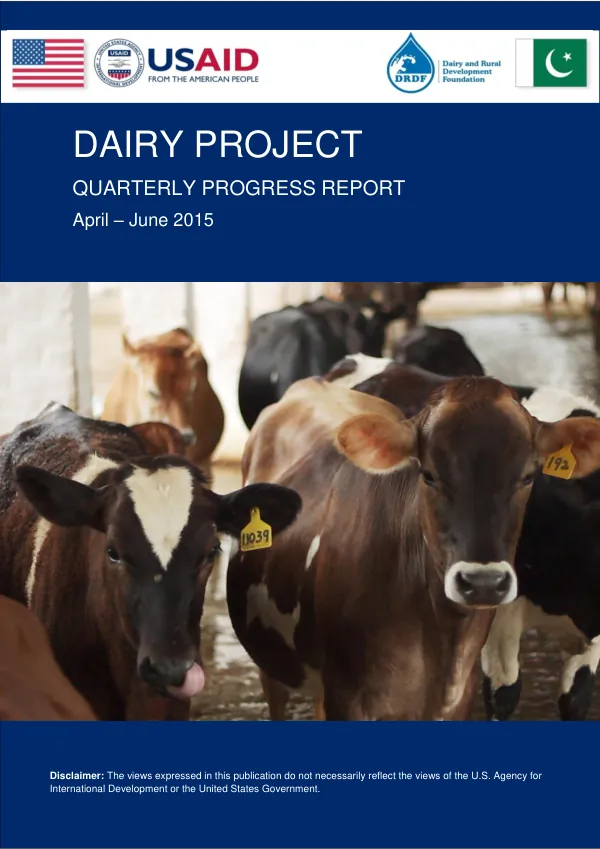
The Dairy Project is a five-year intervention aimed at enhancing rural incomes by increasing livestock productivity.
2015 · 33 pages
Sign in to readA free account is required to download.
Abstract
The project is a joint effort of the United States Agency for International Development (USAID) and Dairy and Rural Development Foundation (DRDF). The primary objective of the project is to provide training to dairy farmers in best dairy farm practices to increase milk productivity and subsequently their income. The project provided training to 22,706 dairy farmers, including 467 farm managers and commercial dairy farmers, in best dairy farm practices. Additionally, the project trained 2,168 rural, unemployed young men as Artificial Insemination Technicians (AITs) and 5,335 rural, unemployed young women as Women Livestock Extension Workers (WLEWs) to assist dairy farmers with quality extension services. The AITs and WLEWs were trained and certified by the University of Veterinary and Animal Sciences (UVAS), Lahore, and were provided with startup kits to establish themselves as entrepreneurs. The project achieved its training targets for WLEW and farmer, while the AITs training target was not achieved due to a change in training duration period with the effect of a new breeding policy in the region. Initial results of a survey conducted by a third party in June-July, 2015, showed satisfactory performance of the AITs and farmers component, while the WLEWs component was on an improvement verge. According to the survey, the adoption rate of three or more than three best dairy farming practices among the trained farmers was 78%. Farm upgradation activities continued in this quarter, and the project selected a total of 53 farms to-date, out of which up-gradation work has been completed on 18 farms. The project conducted 84 silage shows, which were observed by 4,308 farmers, and 251 acres of land was covered. The project also provided training to 97 AITs, 303 WLEWs, 9,933 farmers, and provided 218 working WLEWs with refresher classes. The project's financial summary shows that the total estimated USAID amount is $21,018,293, with an amount obligated of $20,918,293. The leverage amount (non-federal) is $5,108,059, and the total project funds expended to date (end June-2015) is $16,059,083. The project funds expended during the reporting quarter (April-June 2015) is $1,121,219, and the obligated project funds remaining available is $4,959,210. The project funds allocated for the next quarter (Jul-Sep, 2015) is $1,270,074. The project's progress and performance indicate that the training targets for WLEW and farmer were achieved, while the AITs training target was not achieved due to the change in training duration period. The initial results of the survey showed satisfactory performance of the AITs and farmers component, while the WLEWs component was on an improvement verge. The farm upgradation activities continued, and the project selected a total of 53 farms to-date, out of which up-gradation work has been completed on 18 farms. The project also conducted 84 silage shows, which were observed by 4,308 farmers, and 251 acres of land was covered. The project's implementation details include the training of 22,706 dairy farmers, 2,168 AITs, and 5,335 WLEWs. The project also provided startup kits to the AITs and WLEWs to establish themselves as entrepreneurs. The project's geographic focus is on rural areas in Pakistan, and the project's context is the need to enhance rural incomes by increasing livestock productivity. The project's timeframes include the five-year intervention period, with the current reporting quarter being April-June 2015. The project's recommendations include the need to continue the training of AITs and WLEWs, as well as the farm upgradation activities. The project also recommends the need to monitor and evaluate the project's progress and performance regularly.
Related documents